
Insights
Macro Musing: The absurdity and calamity of US tariff policies
Dr Jonathan Kearns - Chief Economist
06 May 2025
How have older members’ retirement income preferences changed following the sustained high inflation environment?
Determining the extent of economic damage, and financial market implications, is difficult because we don't know what tariffs will ultimately land, or how many backflips there are before then. There’s no clear, defining strategy. The justification for tariffs oscillates between reinvigorating US manufacturing, raising revenue to fund tax cuts, the cost of the US providing global security, the provision of the US dollar to support global trade and financial markets, and broadly addressing an 'unfair' trading system. Different justifications would lead to different structures of the tariff regime.
Key individuals in the administration have different goals for tariffs. At one end, there is high tariffs and complete disengagement from China, exemplified by trade advisor Peter Navaro. At the other end some favour lower and more targeted tariffs, such as Treasury Secretary Bennett (or even zero tariffs by Elon Musk). President Trump is a fan of tariffs, having expressed support for trade barriers for decades and through the campaign. But his position changes day-to-day and will no doubt continue to evolve as the impact of tariffs on the US economy and sentiment becomes clear.
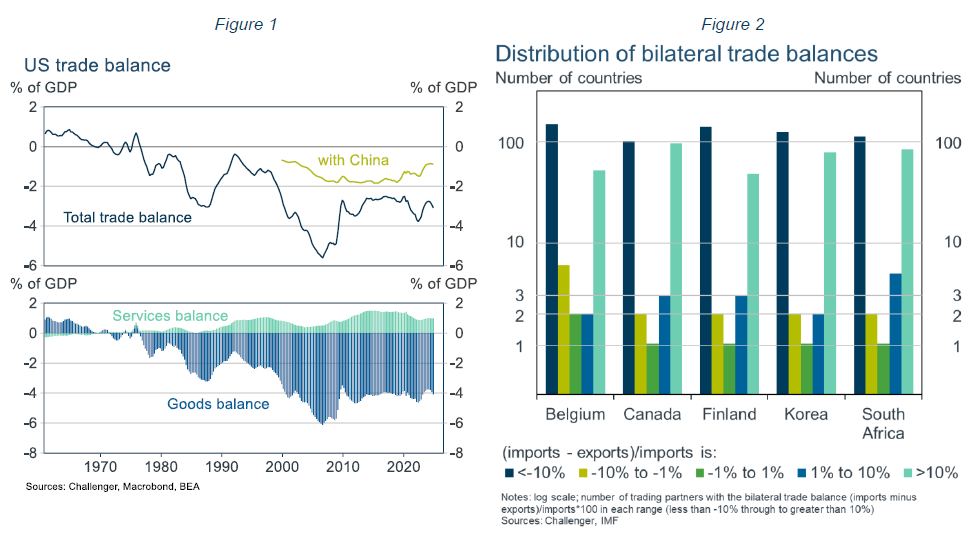
President Trump's tariff obsession is rooted in a dislike of trade deficits. The United States has run a trade deficit since the mid-1970s (Figure 1). He attributes this deficit to unfair practices by other countries and an overvalued US dollar. Unfair trade practices could include tariffs and restrictions on imports (bans, biosecurity etc), subsidies, low wages, lack of environmental controls and 'dumping' goods at unprofitable prices. The overvalued US dollar is supposedly the result of the US 'generously' providing the dollar to be used as the basis of international trade and finance, meaning there is greater demand for US dollars. But President Trump wants both a lower dollar and still having the 'exorbitant privilege' of unlimited demand for US debt at low interest rates, in other words having his cake and eating it too.
A country running a trade deficit needs to fund the additional purchase of imports by selling assets, in other words dissaving. The trade deficit, plus payments on net foreign liabilities (together the current account), equals the difference between national savings and investment. Australia has run a current account deficit for much of its history, in general because of high investment rather than low savings. A current account deficit is less concerning when it results from high foreign investment responding to good investment opportunities, adding to the domestic capital stock and future output. By contrast, low national saving driven by the US Government's substantial fiscal deficit, currently 5% of GDP, is an important factor in the US trade deficit. Blaming the US trade deficit solely on foreigners misses that it also depends on the domestic economic conditions.
Even if balanced trade overall is desirable, there is no reason for this to apply country by country. Indeed, five major countries that have balanced trade in 2023 at a national level have balanced trade with very few of their trading partners (Figure 2).1 Belgium had balance trade with just two countries. And Canada, Finland, South Korea and South Africa each had balanced trade with just one of their trading partners. By contrast, each of these countries had exports significantly exceeding imports (more than 10%) for over 100 countries, and imports significantly exceeding exports for between 52 and 96 countries. Despite having widely varying bilateral trade balances, each of these five countries had balanced aggregate trade. Relative trade between two countries reflects comparative advantage, resource endowments and the demand preferences of consumers. The US goal of balanced bilateral trade with every country is, frankly, bonkers.
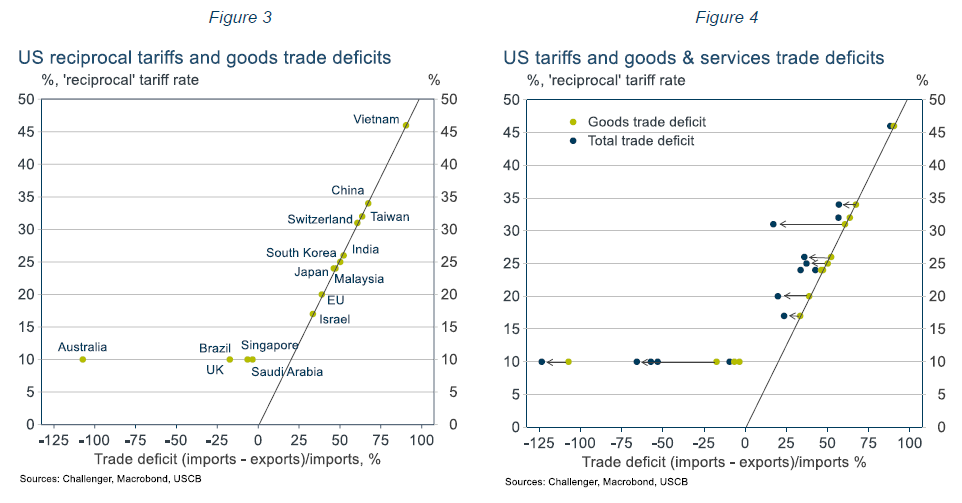
While bilateral trade balances are meaningless, the US has used them to determine each country's 'reciprocal tariff' announced with great fanfare on 'Liberation Day' as "half of imports minus exports divided by imports" (Figure 3). But for countries with which the US has a trade surplus, rather than deficit, – including Australia, the UK and Brazil – the reciprocal tariff has been set at 10% anyway. If Australia applied the same logic of the US, we’d impose a tariff on the US of around 50%. The US administration has attempted to justify the calculation of their tariffs drawing on the economics literature, but several academics they cited have said their work was misinterpreted, with one noting a correct interpretation would result in tariffs one quarter of those determined by the US.
While the US has a goods trade deficit of 1% of GDP, it has a surplus in services trade of around 0.25% of GDP (Figure 1) and indeed a surplus in trade services with most countries. The focus only on goods trade in calculating the tariffs is presumably because tariffs usually apply only to goods, not services . If the purpose of tariffs is to redress apparent trade restrictions that drive the US trade deficit, then the total trade deficit should be used, which would result in smaller tariffs (Figure 4).

The US tariff regime has a mix of tariffs on specific goods (steel, aluminium, vehicles) and on specific countries (Canada, Mexico, China and the reciprocal tariffs) reflecting the varied goals of the tariffs. But many of these goals are in conflict. If, as claimed, tariffs raise revenue without increasing US prices by forcing foreign suppliers to absorb the tariff, then US manufacturers won't be more competitive as US prices won't be higher. And if tariffs are successful in boosting US production, then there would be fewer
imports, and so less tariff revenue.
Several bad design elements of the tariffs have important implications:
The 145% punitive tariff applied to China makes most imports from China prohibitively expensive. This is a problem as the US economy is not ready to disengage from China which has supplied 13% of US imports. To establish domestic production or alternative import sources takes time, if it is even feasible. Factories don't pop up overnight.
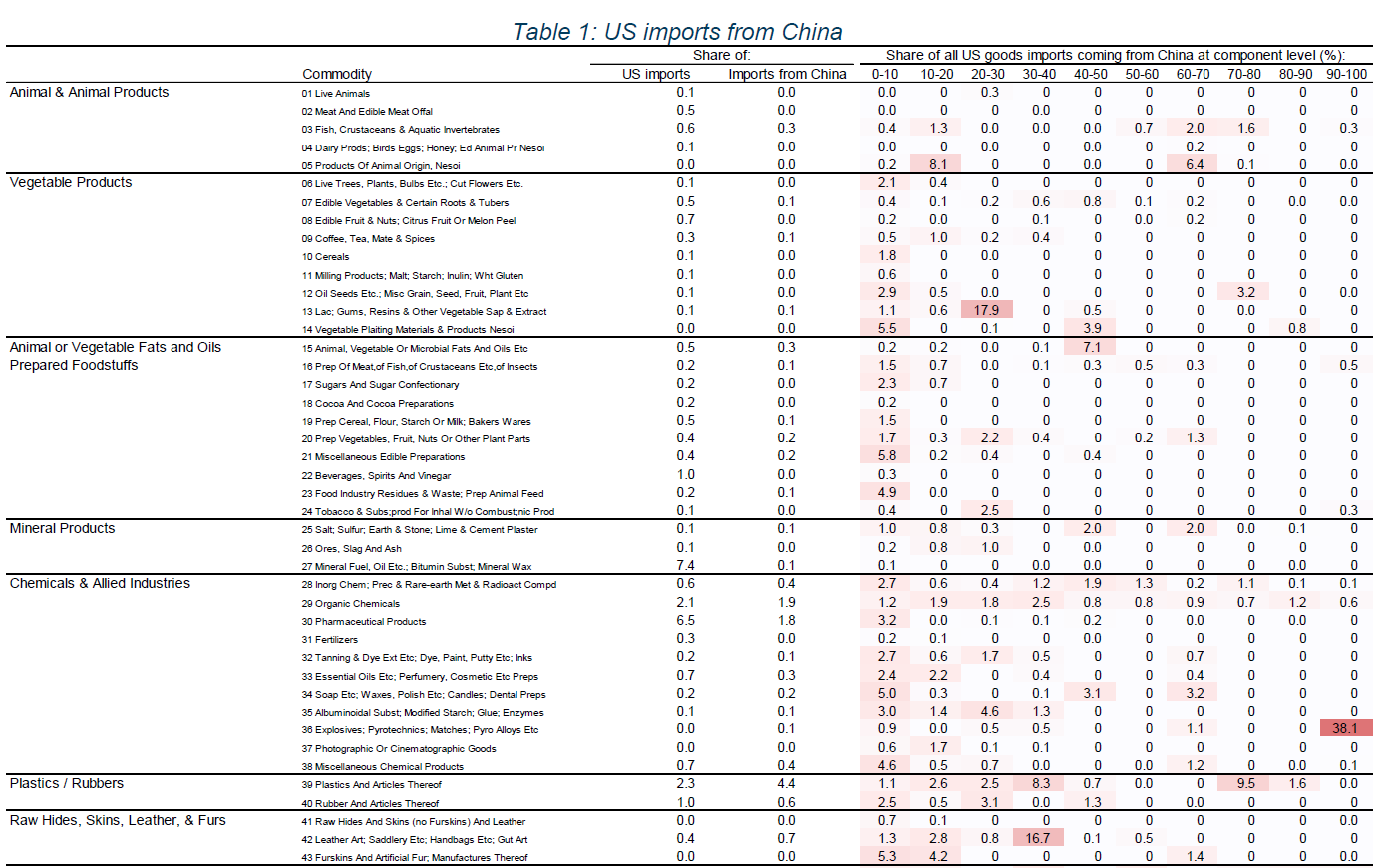
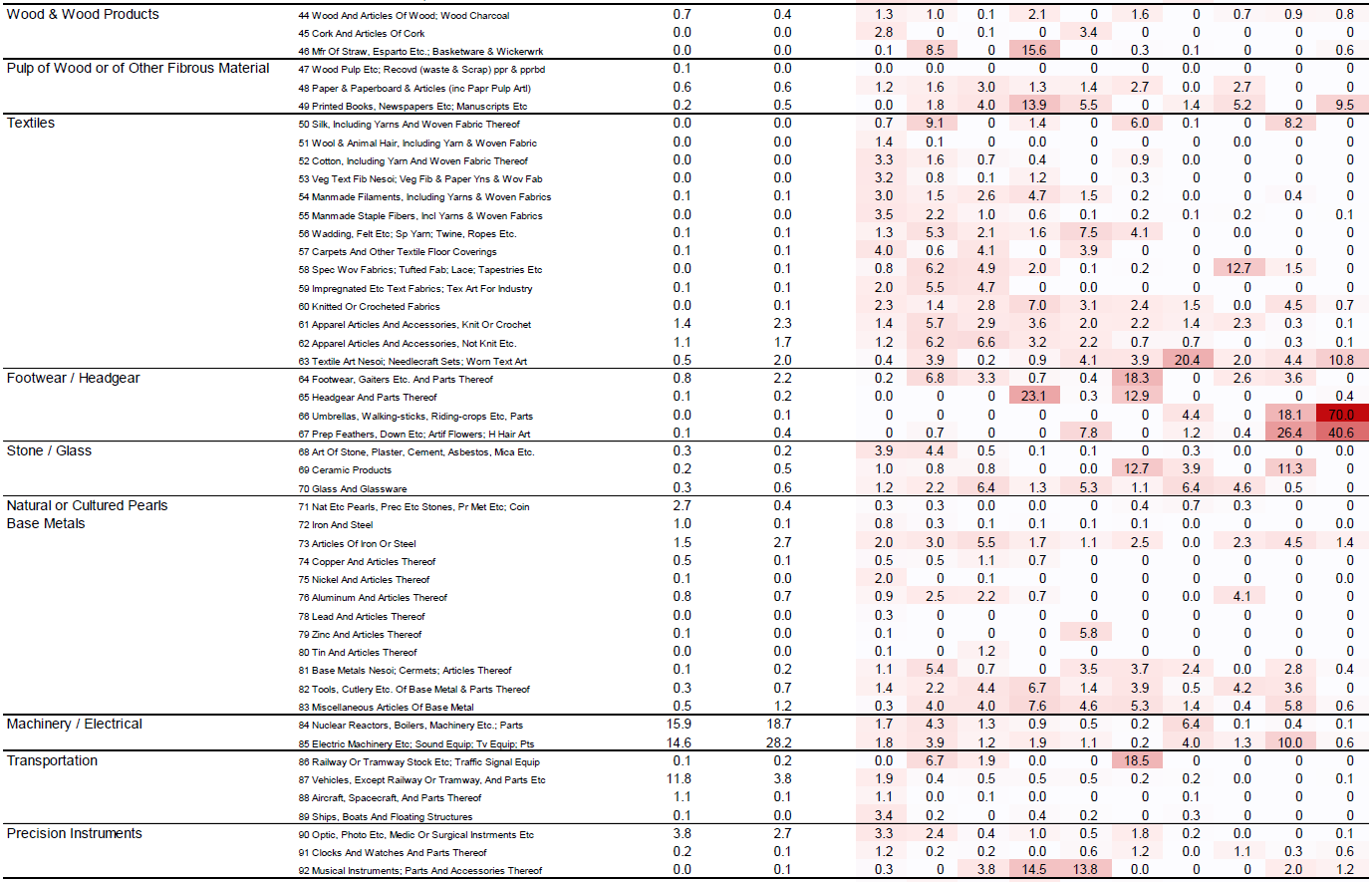
We can see the importance of imports from China by looking US imports at a very detailed level (5,495 different types of goods imports). Using this fine disaggregation, for half of the total value of US goods imports, over half of US imports are from China (Table 1). For almost 20% of goods, China supplies over 80% of US imports. It won't be possible to find alternative suppliers for most of these goods at remotely similar costs, if at all.
For finished consumer goods with very high import shares from China, large price increases and stock shortages will be disruptive to consumers and impact consumer sentiment and support for tariffs. The economic impact will be even greater for those imports predominantly sourced from China that are used as inputs in US production, such as explosives, machinery and various chemicals. For example, China is also a key source for base ingredients used in manufacturing medicines and finished medicines. Not being able to cost-effectively import those goods will be very disruptive to US economic output.
The US tariff regime is already unravelling with holes poked in the tariff wall.
However, don't expect tariffs to return to their previous low levels. President Trump strongly believes in the benefits of tariffs for promoting US manufacturing and he needs the revenue. He has committed to using tariffs to reduce income taxes, even musing that income taxes could be eradicated. But a 10% uniform tariff has been estimated to raise just $1.7 trillion over 10 years, a 20% tariff $2.6 trillion. This is substantially less than the estimated cost of $5 to 11 trillion of the tax cuts already promised by President Trump.
There will be many more turns in the road with further 'clarifications', some reduced tariffs for goods that the US will never produce such as textiles, and some new tariffs, such as movies and potentially for semiconductors and pharmaceuticals. Importantly there will be plenty of 'deals' struck with individual countries that will reduce (but not eliminate) reciprocal tariffs with countries committing to reduce trade barriers and import more US goods (much of which may not happen, given the example of China in Trump's first term).
The pause in reciprocal tariffs, just one week after they were announced to great fanfare, was reportedly triggered by the turmoil in bond markets. If it had continued bond volatility could well have precipitated a financial crisis. Based on his first term, there was an expectation Trump would pull back when equity markets fell. But this term he displayed greater resolve in the face of the large fall in equity prices. But the risk of a financial crisis, or severe recession, and sharp falls in approval ratings are likely to remain red lines that would result in some tariff pull-back.
With power machinations inside the Trump administration, and with the President responding to headlines and risk of a financial crisis, I expect ongoing tariff uncertainty and hence further volatility in markets. Aggregate tariffs will never get to the levels initially announced, but they will also be much higher than before, reducing US and global growth. Tariffs will add to US inflation, reducing the ability of the Fed to ease to support economic activity. Market pricing is for almost 100 basis points of cuts this year, but there's a good chance the Fed does not even cut this year.
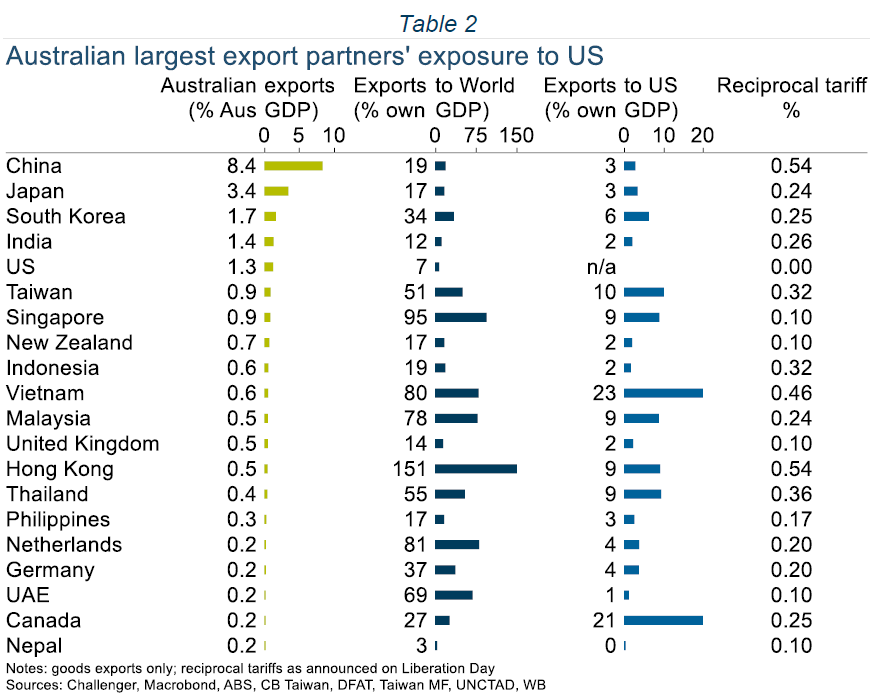
Australia will also see slower growth. While we have limited direct exposure to the US economy, our largest trading partners are more exposed (Table 1). The IMF downgraded its GDP growth forecasts for 2025 by 0.5%. Slower growth, and China's surplus manufacturing capacity reducing Australian import prices, will lower inflation opening the path to RBA rate cuts. However, market pricing for a cash rate below 3% by December is overdone. With the worst case for US tariffs unlikely to play out, three cuts bringing the cash rate to 3.35%, around its neutral level, seems more likely.