Thinking alternatively - Part four
Introduction
We are strong believers in the value of diversification in investment portfolios. Historically, fixed income has been viewed as an effective portfolio counterweight to more growth-oriented equity allocations. However, it’s worth remembering that a secular bull-market for bonds from the early 1980s until the COVID-induced lows in yield in 2020 – a period encompassing the vast majority of investors’ experience – has been a strong tailwind for fixed income allocations, and there’s no guarantee that will persist. In 2022, for example, both bonds and equities posted double-digit losses, and investors who relied solely on fixed income to diversify their equity holdings had a sorry time of it that year.
While fixed income can undoubtedly serve a role in a diversified portfolio, we believe additional diversification should be sought from elsewhere. This is where alternative investments come in. In Thinking alternatively - Part three we identified four main use cases for alternative investments, namely: diversification, boosting returns, defensiveness and macro exposure management. Diversification is arguably the most important of those, however, we believe it is often under-appreciated.
We believe the key elements of a successful diversifying alternative investment are consistent (not lumpy) returns and consistently low correlation. Investments which deliver short bursts of outsized returns, or which exhibit high variability in correlation, are less reliable diversifiers.
A diversifying alternative can have the following benefits:
- Deliver positive investment returns in up, down and range-bound markets.
- Reduce overall portfolio volatility.
- Enhance risk-adjusted portfolio returns.
- Reduce portfolio drawdowns.
Diversification benefits
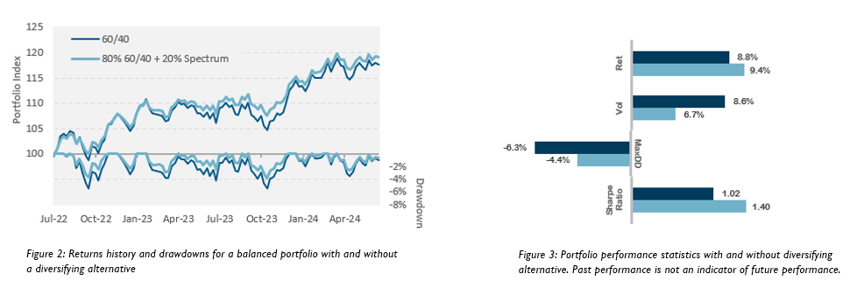
An alternative investment with low correlation to traditional betas such as equities and fixed income can serve an important role as a diversifier in most investment portfolios. To illustrate the value of a low correlation profile, figure 1 below shows the risk versus return for a 100% equity portfolio, a 100% fixed income portfolio, and a balanced '60/40' portfolio1. In all three instances, a 20% allocation to a diversifying alternative2 can potentially both decrease the risk of the portfolio and increase the return.