While requirements will vary depending on the terms and conditions of an investment, this guide gives you general information on what to expect.
If at any stage you’d like to speak with someone about what needs to be done, please call us on 13 35 66 or send an email to deceasedestates@challenger.com.au.

If you are sending an email to deceasedestates@challenger.com.au to notify us that an investor has passed away, please include the following details:
| Email subject: | Notification of investor’s death |
| Email body: | Details of the deceased investor:
Details of the notifier:
|
When we’re notified of a sole investor’s death, we put a hold on their account and stop making regular payments from it.
When we’re notified of a joint account holder’s death, we continue to make regular payments to the surviving owner. Any suspended payments for the deceased investor will be paid to the joint owner when the death benefit process is completed.
If there is an eligible reversionary nomination, regular payments will be made to the reversionary once the death benefit process is completed. We will also pay any suspended regular payments to the reversionary at that time.
We’ll always ask for a certified copy of the death certificate and in many cases a certified copy of the Will (see ‘What is a ‘certified copy’ of a document?'). If the investor had more than one account, we’ll only need one copy of these documents.
If a death benefit of $500,000 or more is payable to the investor’s Estate (and not to one or more individuals), we’ll also ask you to provide a Grant of Probate.
Where an investor died without leaving a will, you may need to provide Letters of Administration.
When a benefit is payable, we’ll issue separate benefit payment forms for each account and ask each beneficiary or executor to complete the form(s) and provide proof of their identity.
Superannuation investments can have additional requirements to confirm eligibility to a benefit and we’ll let you know if these apply to your case.
We’ll give you a unique link to securely upload any documents we request.
If there is any remaining amount payable under the terms and conditions of an investment, we will pay a death benefit.
Sometimes an investment will end on death and there is no death benefit payable. Once we receive a certified copy of the death certificate and the other initial documents we ask you to provide, we’ll let you know if a death benefit is payable.
The time required to finalise an account can vary depending on the type of investment, the documents required and whether a benefit is payable.
We’ll generally contact you within 5 days of being notified of the investor’s death to let you know the initial documents required and in most cases will follow up within 10 days of receiving your response to let you know of any remaining requirements.
When all necessary documents are received, we aim to finalise accounts within 10 business days.
Death benefits are paid by electronic funds transfer (EFT) to the beneficiary’s bank account.
If the beneficiary is the investor’s estate, we will pay by EFT to a bank account set up in the estate’s name. (The account name must begin with ‘Estate of’ or ‘The Estate of…’)
Under certain circumstances we will pay death benefits to a solicitor’s trust account to be distributed to the nominated beneficiaries. Additional documentation is required to enable us to pay trust accounts, and this can prolong the benefit finalisation process.
Term | Definition |
|---|---|
| Administrator | An Administrator is a Person appointed by the Supreme Court to deal with the estate when the deceased has died without leaving a valid will (intestate). See Letters of administration |
| Death benefit | A death benefit is the amount, if any, payable on death. |
| Executor | An executor is a person appointed by the deceased in their will to carry out their wishes after they die, including distributing the assets to the beneficiaries in accordance with the will. |
| Financial dependant | A person is a financial dependant of the deceased, if they relied on them for necessary financial support. A beneficiary claiming financial dependence will need to provide proof of dependence. This may include a bank statement showing regular deposits to their account or evidence of being a student, living at the same address as the deceased and in receipt of a Centrelink payment. |
| Interdependency relationship | An Interdependency relationship is a close personal relationship between two people who lived together where one or both provided for the financial, domestic and personal support of the other (or who would have met these conditions except they were temporarily living apart due to a physical, intellectual, psychiatric or other disability). |
| Intestate | Intestate means dying without a valid will. It can mean that the deceased didn’t have a will, or that their will was invalid. |
| Investment | Terminology used broadly to refer to any product the deceased held with Challenger and can include annuities, pensions and superannuation. |
| Legal personal representative | Executor or administrator of the estate |
| Letters of administration | Court authority to manage an estate, generally when there is no valid Will (intestate). |
| Nominated beneficiary | A nominated beneficiary is the beneficiary named on the account to receive any remaining benefits from the investment, on the death of the investor. An investment can have one or more beneficiaries and a beneficiary can be an individual or the investor’s estate. |
| Probate | Probate is a legal document issued by the Supreme Court which validates the will and confirms the appointment of an executor(s) to administer the deceased estate. |
| Reversionary | A Reversionary is the person nominated at the commencement of the investment to continue to receive regular payments from the investment, on the death of the investor. |
If a death benefit is payable, we’ll let you know the beneficiaries nominated on the account and the information needed to confirm eligibility to receive a benefit.
The type of money invested (whether super or non-super/ ordinary money) affects who can receive the benefit. Super money investments can have additional requirements to confirm eligibility and we’ll let you know when these apply.
You can check the type of money invested on the investor’s Annual Statements.
A person is a dependant under superannuation law if, at the time of the death of the investor, they were either:
A person is a dependant under taxation law if, at the time of the death of the investor, they were either:
Note - a dependant for tax purposes is not the same as a dependant for superannuation purposes. (See ‘Who is a dependant under superannuation law?').
When a beneficiary receives a superannuation death benefit as an income stream or a reversionary continues regular payments, the income stream is classed under superannuation law as a ‘death benefit income stream’.
A death benefit income stream can be rolled over to commence a new death benefit income stream, but the funds cannot be rolled over to a superannuation account in accumulation phase or mixed with any of the beneficiary’s own superannuation interests in either pension or accumulation phase.
The tax treatment of a death benefit depends on whether the benefit is paid from superannuation money or non-superannuation money. The amount payable may also vary depending on:
As death benefits and their tax consequences can be complex, we recommend that you seek financial and tax advice relating to your own circumstances.
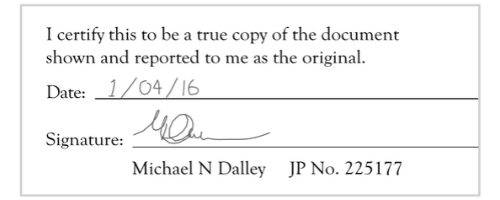
A certified copy is a document that an authorised person has verified as a true and accurate copy of the original.
To certify a copy of a document, an authorized person must:
1. Write or stamp on the copy that it is a true and correct copy of the original document they have sighted.
2. Include their signature.
3. Print their name.
4. State their qualification (e.g., Justice of the Peace).
5. Add the date.
Here's an example of what the certification might look like:
You can have copies of original documents certified by any of the authorised people listed below. The person certifying the document must not be a family member or relative.
For a complete list of people authorised to certify documents in Australia, see: Statutory Declarations Regulations 2023 - Federal Register of Legislation
If you don’t live in Australia, see ‘Who can certify a document overseas’ under ‘I don’t live in Australia; do I need to do anything differently?
Anti-Money Laundering and Counter-Terrorism Financing legislation requires us to verify the identity of a beneficiary or legal personal representative before paying a death benefit. In accordance with this legislation, we may pass any information we collect and hold to relevant government authorities.
Any personal information you provide is collected and managed in accordance with Challenger’s Privacy policy.
The reporting requirements for a death benefit depend on whether the benefit is paid from superannuation money or non-superannuation money, and who ultimately receives the benefit.
A PAYG payment summary may be required and reported to the ATO when:
A PAYG payment summary is generally not required when a superannuation death benefit is paid to a tax dependant.
We are also required to report superannuation income streams that continue for a beneficiary.
Generally, asset test exemptions applied to certain annuities purchased before September 2007. The applicable exemption percentage (either 50% or 100%) was determined when the annuity was purchased.
If the deceased investor had an asset test exempt annuity, the exemption is only continued for ongoing payments made to a beneficiary or reversionary under the following circumstances:
% exempt | Does the beneficiary retain the exemption? |
|---|---|
100% asset test exempt
| For Term (life expectancy) annuities:
For Lifetime annuities: The exemption applies if the annuity is continued by a reversionary beneficiary. It does not apply if the annuity is continued by a nominated beneficiary. |
50% or 100% asset test exempt
| Term and Lifetime annuities: The exemption applies if the annuity is continued by a reversionary beneficiary. It does not apply if the annuity is continued by a nominated beneficiary. |
We collect, use and disclose personal information to:
We collect personal information about a beneficiary from the beneficiary or a legal personal representative and, if relevant, from the financial adviser or solicitor who is looking after the estate. We will typically correspond with the legal personal representative (executor or administrator) of the estate with matters relating to processing any death benefit.
We may also collect personal information if the annuity was purchased via a platform. We may take steps to verify the information collected. Where personal information is provided about someone else (for example, if you are a legal personal representative of an estate and you are providing us with information about a beneficiary), you must have their consent to provide their personal information to us and you must have shown them this section on ‘Privacy and personal information’.
If you choose not to provide some of the personal information to us, the following may apply (depending on the type of information):
We disclose information to the appointed financial adviser.
In addition, we may disclose information we hold about a beneficiary or legal personal representative, as relevant:
We do not generally disclose personal information to recipients in foreign jurisdictions. However, in some cases (such as where the annuity was purchased via a Platform) personal information may be used (or accessed) by third party service providers located overseas to perform administrative functions in relation to your annuity. For more information, please refer to our privacy policy at challenger.com.au or by contacting our Investor Services team on 13 35 66. If a beneficiary, a legal personal representative or a solicitor (who is looking after the estate) is overseas, it may be necessary to provide personal information to them in order to process the death benefits.
From time to time we or our related companies may contact a person who continues an investment with us to tell them about other products and services that might be useful to them, including financial, superannuation, investment, insurance and funds management products and services. Please contact us or, if relevant, the platform provider if you do not want to receive any of this kind of marketing material.
To correct, update or access personal information we hold, please contact our Investor Services team on 13 35 66 or, if relevant, the platform provider.
You can also contact us or, if relevant, the platform provider if you believe personal information has been misused and you would like to make a complaint.
Our privacy policy also contains this information as well as further details about our handling of personal information.
You can obtain a copy of our privacy policy at challenger.com.au or by contacting our Investor Services team on 13 35 66. Please contact the relevant platform provider for a copy of the platform provider’s privacy policy.