

For adviser use only
Taxation benefits of lifetime annuities
Minh Ly
30 September 2023
Download the full article below.
Information on the technicalities of Challenger’s lifetime annuity including its social security treatment can be found in Challenger’s lifetime annuities technical guide on AdviserOnline.
An investment into a lifetime annuity can also help diversify the defensive component of a retiree’s investment portfolio and help provide tax effective retirement income.
This month’s article discusses in detail how a lifetime annuity’s regular payments and lump sum death benefits are taxed.
Lifetime annuities referred to in this article are for Challenger’s Lifetime Annuity (Liquid Lifetime) – Flexible Income option.
A Challenger lifetime annuity can generally only be commenced with superannuation money for investors age 60 and over. For these investors, the regular payments are tax free. Any lump sum death benefit payable is subject to superannuation death benefit tax rules – tax-free if paid to a tax dependent and up to 15% tax on the taxable component (element taxed) if paid to a non-tax dependent, plus Medicare Levy (where applicable).
For transfer balance cap considerations, the purchase price of a superannuation lifetime annuity will be a credit towards the investor’s personal transfer balance account and a lump sum commutation will be a debit.
Unlike other non-superannuation investments, the regular payments from a non-superannuation sourced lifetime annuity are afforded a deductible amount. Only the portion of the annuity’s regular payments that are above the deductible amount are subject to tax. The deductible amount also plays a role in determining whether a lump sum death benefit is subject to tax for the beneficiaries or estate.
The tax treatment of a lifetime annuity’s regular payment is as follows:
The deductible amount is the part of each regular payment that broadly represents the return of the original investment capital. This amount is tax free.
The deductible amount is calculated as follows:
For lifetime annuities commenced from 1 January 2020 the Australian Life Tables 2015-2017 is used to determine life expectancy. For policies with a reversionary beneficiary, the longest life expectancy of the investor and beneficiary is used to calculate the deductible amount.
The deductible amount does not change and continues for the life of the policy even if the investor lives past their life expectancy. Where the regular payment from the annuity is less than the deductible amount, there is no assessable income for tax purposes. The excess deductible amount does not reduce other assessable income of the individual.
The excess deductible amount is carried forward and may be used to offset assessable income from the same lifetime annuity in future years (if any). This can occur where payments have been indexed over time.
Melissa (age 75) is a single homeowner who has recently sold her investment property for $1 million to continue to fund the retirement lifestyle she desires. She has been spending $60,000 p.a. over the last few years and expects this to continue into the foreseeable future.
She now has $1.1 million invested in a range of cash and term deposit investments (which are currently earning 4% p.a.) and does not see a need or have a desire to invest in growth assets.
As an alternative to her cash and term deposit investments, Melissa can consider investing a portion of her portfolio into another defensive asset – a lifetime annuity – which can provide her with more tax effective income.
Based on a Challenger quote as at 24 October 2023, an investment of $220,000 (20%) into a lifetime annuity provides Melissa with regular payments of $15,436 p.a. indexed to CPI or $19,268 p.a. without any indexation.
The deductible amount for Melissa’s lifetime annuity will be $220,000 / 14.15 = $15,548 p.a.
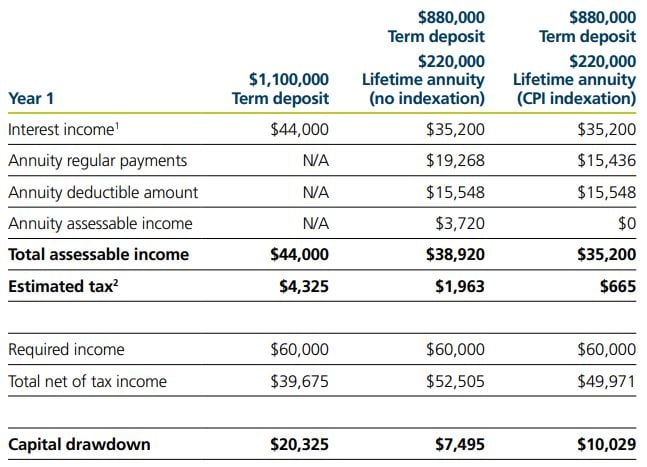
Table 1 below compares Melissa’s year 1 income and tax position for the following scenarios:
In Melissa’s example, her life expectancy based on the Australian Government Actuary’s 2015-2017 Life Tables (which is currently being used to calculate deductible amounts for tax purposes for income streams that commence from 1 January 2020) is 14.15 years.
However, medical improvements and healthier lifestyle choices mean that mortality rates have been constantly declining and can be expected to continue to do so in the future. The Australian Government Actuary also publishes the 25-year mortality improvement factors, and applying these factors to the 2015-2017 Life Tables we can work out the likelihood of Melissa being alive at certain ages (see chart 1 below).
This chart was obtained from Challenger’s Retirement Illustrator available to advisers on AdviserOnline. Advisers can use the Retirement illustrator to work out life expectancies that factors in these 25 year mortality improvement factors specific to clients based on their age.
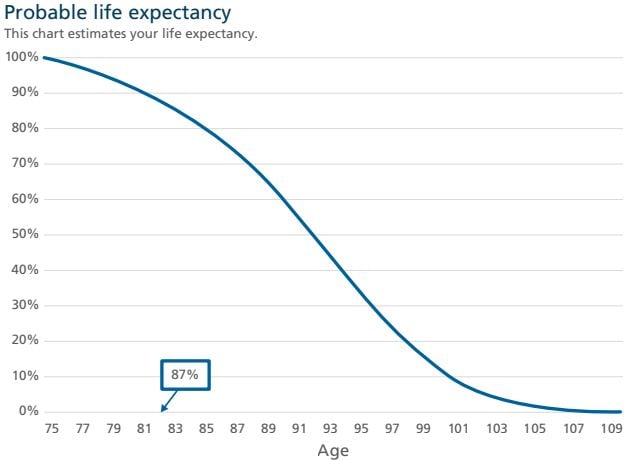
Whilst there are tax considerations for Melissa’s beneficiaries or estate during the first 7 years where the non-superannuation lifetime annuity’s lump sum death benefit can be subject to tax, the likelihood of this occurring is low based on life expectancy estimates in the chart above.
Melissa can reduce her tax liability by $2,362 in the first year if she invests in a Challenger lifetime annuity with no indexation or by $3,660 in the first year if she chooses CPI indexation.
While Challenger’s lifetime annuity is designed to provide income for life, there is flexibility to withdraw from the investment if circumstances change.3 The maximum voluntary withdrawal benefit reduces gradually from 100% of the investment amount at commencement to zero at the end of the withdrawal period.4 Refer to the Product Disclosure Statement for further information on withdrawal periods and voluntary withdrawal benefits.
The voluntary withdrawal benefit generally represents a return of the remaining capital and is not subject to tax.
Challenger’s lifetime annuity also pays a lump sum death benefit during the withdrawal period. For the first half of the withdrawal period (rounded down to the nearest whole number) a death benefit equal to 100% of the investment amount is payable. During the second half of the withdrawal period, a reducing death benefit is payable until it reduces to zero at the end of the withdrawal period. For further information on lump sum death benefits, refer to the Product Disclosure Statement.
Death benefits paid from a Challenger lifetime annuity during the first half of the withdrawal period will comprise of an income component and a component representing a return of the remaining capital.
Death benefits paid during the second half of the annuity’s withdrawal period generally represents only a return of the remaining capital and is not subject to tax. The income component is assessable for tax purposes to the beneficiaries or estate and is worked out as the sum of all the deductible amounts used to reduce the assessable income of the regular payments up to the time of death.
In Melissa’s example, her annuity’s withdrawal period is 14 years and during the first 7 years, a death benefit equal to 100% of her investment amount is payable.
If she chose to invest in the non-indexed annuity and passed away after 2 years, she would have used 2 years of deductible amounts ($15,548 x 2 = $31,096) to offset the assessable income from her regular payments up to her time of death. Therefore, of her $220,000 death benefit, the income component will be $31,096 and the balance of $188,904 will represent a return of the remaining capital and is not subject to tax.
If she chose to invest in the CPI indexed annuity, and if we assume CPI increases by 2.5% p.a., her first and second year’s regular payments will be $15,436 and $15,822 respectively. The deductible amount used in the first year would be $15,436 and the unused deductible amount of $112 would be carried forward and used to offset assessable income from the annuity in the second year. In the second year she would use a deductible amount $15,548 + $112 = $15,660 to offset assessable income. After 2 years, she would have used a total of $31,096 to reduce assessable income and in the event of her death, this amount will be the income component of her death benefit.
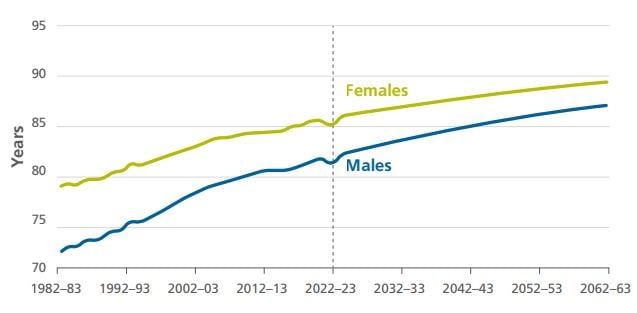
Statistics have shown that life expectancies have increased significantly over the last 40 years and is expected to increase further over the next 40 years. Based on the Government’s most recent Intergenerational Report published in August this year, life expectancy at age 65 is expected to continue increasing from 20.1 years for men and 22.7 years for women in 2022–23, to 24.7 years for men and 26.2 years for women by 2062–63 (see Chart 2.5 from the report replicated below).