
Loading component...
Loading component...
Loading component...
Tax on income stream payments
Loading component...


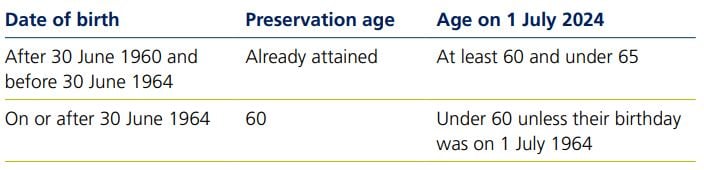
1 July 2024 heralds an important change to preservation age. In this article, we take you through discussion of some common issues which are impacted by preservation age increasing to age 60 from 1 July 2024.
Since 1 July 2015, we have seen a gradual increase in preservation age from 55 to 60 so that anyone born after 30 June 1964 has a preservation age of 60. This gradual increase effectively means that anyone who was under age 60 on 1 July 2024 has a preservation age of 60 whereas clients born before 30 June 1964 have already reached their preservation age.
Unique rules relating to certain defined benefit schemes aside, in relation to accessing super as a lump sum or as an income stream on the basis of retirement, the client at the minimum needs to have reached their preservation age. At age 65, super is accessible irrespective of whether the client is working.
1.Not working and has no intention to be gainfully employed.
Retirement condition of release is met if:
Advisers often ask whether retail super funds require any proof around termination of employment and clients’ intention to no longer be gainfully employed. Unique rules aside, most super funds simply require a member to make a declaration, often by indicating on the withdrawal form that they are retired.
2. Still working or intends to be gainfully employed in the future and is age 60 or over.
Retirement condition of release is met upon simply terminating a gainful employment arrangement on or after reaching age 60. The client is not required to make a declaration that they don’t intend to be gainfully employed in the future. It is of no consequence that the client may still intend to be gainfully employed in the future or indeed where the client had multiple employment arrangements, continues to work. Importantly, in this circumstance, the amount of funds which can be accessed are the accrued entitlements on the day of termination of gainful employment. Any further contributions and earnings after the termination of gainful employment are required to be preserved and a subsequent condition of release is required for access to those funds.
From a practical perspective, some retail super funds may not enquire about the termination date. Where no termination date is required by the super fund for their withdrawal process, practically, the super fund may unrestrict the entire balance at the time the withdrawal form is completed. Where super funds do require a termination date, they may only allow access to the balance at the termination date, with any new contributions and earnings after that date still being preserved until any future condition of release is met.
Tip – If an employee client wishes to change jobs just before turning 60, it may be worthwhile to consider postponing termination to after the client has reached age 60. This may be helpful in meeting the retirement definition which could allow opportunities to make lump sum withdrawals, including re-contribution strategies and commence retirement phase income streams.
Jasprit (61), a full-time employee, is going to change jobs and enjoy a three-month break before starting part-time work of 16 hours per week with the new employer. At the point of terminating employment, he would have $600,000 in his super. He intends to make $360,000 non-concessional contributions from his employment termination payment and non-super savings so that with earnings and contributions, he would have $960,000 in super soon after. His adviser is wanting to convert his super benefits to a combination of an account-based pension and a lifetime annuity to benefit from tax-free earnings within the income stream as well as tax-free payments due to him being age 60 and over.
At a high level, contribution splitting allows spouses to transfer up to 85% of concessional contributions within the transferring spouse’s concessional contributions cap, including the use of catch-up concessional contributions, if eligible. Contributions can only be split to the other spouse if at the time of application, the receiving spouse:
The Severe Financial Hardship condition of release may be relevant for those on eligible social security payments who don’t meet any other condition of release and wish to access their super.
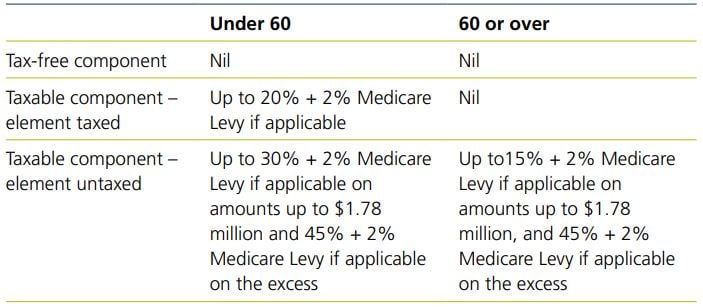
Prior to 1 July 2024, tax on super lump withdrawals was based on tax-components as well as three different age-based tax rates:
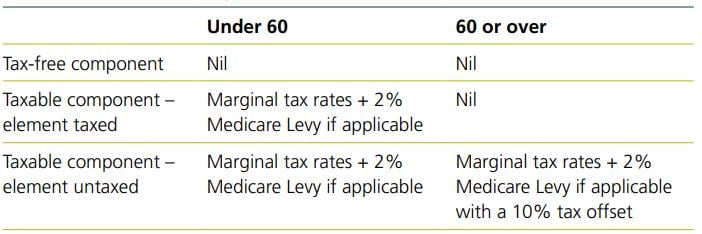
Income stream payments received as a result of disability attract a 15% tax-offset if sourced from taxable component – element taxed even if the client is under age 60. Please note, different rules apply to capped defined benefit income stream payments in excess of the defined benefit income cap ($118,750 in 2024-25) as well as death benefit income stream payments.
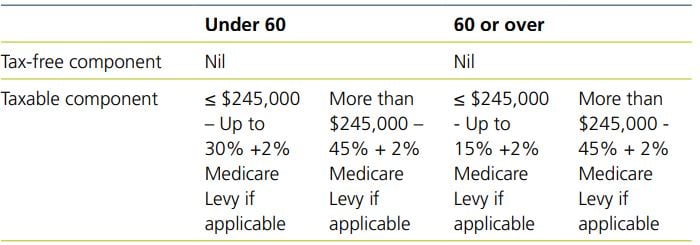
Similar to the above discussion on super lump sum withdrawals, prior to 1 July 2024, there were three different age-based tax rates. From 1 July 2024, the tax rates on employment termination payments (ETPs) are dependent on whether the client is under or over age 60 as well as the amount including whether it is impacted by the whole of income cap of $180,000.
One key difference between taxation of super lump sums and ETPs is that unlike super where the tax rate is based on age at the time of payment, for ETPs, the client’s age and whether they are under or over 60 on the last day of the financial year in the year of receipt determines the tax rate.
A Transition to Retirement income stream (TRIS) can only be commenced by those who have reached their preservation age. Effectively, from 1 July 2024, this means that anyone who hasn’t yet reached their preservation age can only commence a TRIS at the earliest from age 60.
65 continues to be the age at which super is accessible irrespective of work. There is no legislated correlation between preservation age (60), the upper age at which super is accessible irrespective of work (65) and Age Pension age (67).
At a high level, small business capital gains tax (SBCGT) concessions can assist with capital gains tax relief and then contributing sale proceeds to super for eligible small business owners. For SBCGT concessions and the CGT Cap ($1.78 million in 2024-25), age 55 continues to be the eligibility requirement, when relevant. For example, relating to the CGT retirement exemption, the requirement to compulsorily contribute the amount disregarded under the retirement exemption to super continues to be age 55.
Despite the age-based requirement reducing initially from 65 to 60 on 1 July 2022 and then 55 from 1 January 2023, preservation age does not affect the ability to contribute sale proceeds to super. However, if a client in the 55 to 64 age cohort does make a downsizer contribution, they may need to consider any access restrictions until they meet a condition of release.