

1 July 2024 - what it means for various issues relating to preservation age
.png?h=540&iar=0&w=680)
Reaching preservation age is a key concept as it relates to a number of key financial planning issues such as accessing super, tax on super lump sum withdrawals and income stream payments, tax on employment termination payments and the commencement of Transition to Retirement income streams.
1 July 2024 heralds an important change to preservation age. In this article, we take you through discussion of some common issues which are impacted by preservation age increasing to age 60 from 1 July 2024.
Preservation age
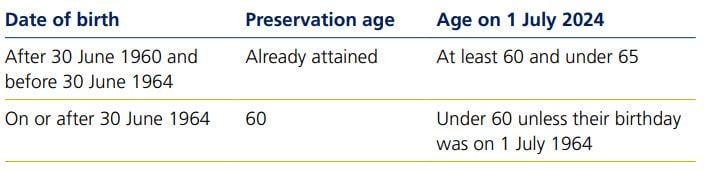
Since 1 July 2015, we have seen a gradual increase in preservation age from 55 to 60 so that anyone born after 30 June 1964 has a preservation age of 60. This gradual increase effectively means that anyone who was under age 60 on 1 July 2024 has a preservation age of 60 whereas clients born before 30 June 1964 have already reached their preservation age.
Retirement condition of release
Unique rules relating to certain defined benefit schemes aside, in relation to accessing super as a lump sum or as an income stream on the basis of retirement, the client at the minimum needs to have reached their preservation age. At age 65, super is accessible irrespective of whether the client is working.
The retirement condition of release can be met under two definitions:
1.Not working and has no intention to be gainfully employed.
Retirement condition of release is met if:
- the client has reached their preservation age;
- an arrangement under which the client was gainfully employed has come to an end and
- the super trustee is reasonably satisfied that the client intends never to be gainfully employed for ten hours or more per week in the future.
Advisers often ask whether retail super funds require any proof around termination of employment and clients’ intention to no longer be gainfully employed. Unique rules aside, most super funds simply require a member to make a declaration, often by indicating on the withdrawal form that they are retired.
2. Still working or intends to be gainfully employed in the future and is age 60 or over.
Retirement condition of release is met upon simply terminating a gainful employment arrangement on or after reaching age 60. The client is not required to make a declaration that they don’t intend to be gainfully employed in the future. It is of no consequence that the client may still intend to be gainfully employed in the future or indeed where the client had multiple employment arrangements, continues to work. Importantly, in this circumstance, the amount of funds which can be accessed are the accrued entitlements on the day of termination of gainful employment. Any further contributions and earnings after the termination of gainful employment are required to be preserved and a subsequent condition of release is required for access to those funds.
From a practical perspective, some retail super funds may not enquire about the termination date. Where no termination date is required by the super fund for their withdrawal process, practically, the super fund may unrestrict the entire balance at the time the withdrawal form is completed. Where super funds do require a termination date, they may only allow access to the balance at the termination date, with any new contributions and earnings after that date still being preserved until any future condition of release is met.
Tip – If an employee client wishes to change jobs just before turning 60, it may be worthwhile to consider postponing termination to after the client has reached age 60. This may be helpful in meeting the retirement definition which could allow opportunities to make lump sum withdrawals, including re-contribution strategies and commence retirement phase income streams.
Example
Jasprit (61), a full-time employee, is going to change jobs and enjoy a three-month break before starting part-time work of 16 hours per week with the new employer. At the point of terminating employment, he would have $600,000 in his super. He intends to make $360,000 non-concessional contributions from his employment termination payment and non-super savings so that with earnings and contributions, he would have $960,000 in super soon after. His adviser is wanting to convert his super benefits to a combination of an account-based pension and a lifetime annuity to benefit from tax-free earnings within the income stream as well as tax-free payments due to him being age 60 and over.
Issues to consider for Jasprit
- Even though Jasprit is intending to work in the future, he can meet the retirement condition of release on the basis that he is terminating a gainful employment arrangement on or after turning age 60. Critically, assuming that the super fund asks for the termination date and only unrestricts the balance as at the termination date, Jasprit can only commence retirement-phase income streams with the balance as at the termination date which is $600,000 rather than $960,000 post contribution.
- From a timing perspective, he could still meet the retirement definition even if he has commenced new employment on the basis that he terminated employment on or after turning age 60. Any contributions and earnings after termination of employment are preserved and a subsequent condition of release needs to be met to unrestrict the post termination balance.
- Jasprit could have considered contributing the non-super savings prior to termination so that it forms part of the pre-termination balance which is accessible under the retirement condition of release simply upon terminating employment.
- If Jasprit had been under age 60, he would not have met the retirement condition of release as he intends to be gainfully employed for 10 hours or more per week.
- If Jasprit was turning age 60 soon, with the agreement of his employer, he could have considered going on leave, whether paid or unpaid, to assist him with terminating employment on or after turning age 60. Rather than changing jobs, if Jasprit had gone from full-time to part-time employment with the same employer, he would be unlikely to meet the retirement condition of release, as changing hours with the same employer is usually done as a variation to work arrangements rather than the required cessation of a gainful employment arrangement.
Contribution splitting application
At a high level, contribution splitting allows spouses to transfer up to 85% of concessional contributions within the transferring spouse’s concessional contributions cap, including the use of catch-up concessional contributions, if eligible. Contributions can only be split to the other spouse if at the time of application, the receiving spouse:
- has not yet reached their preservation age, therefore being under age 60;
- has reached their preservation age but is under age 65 and does not meet the retirement condition of release;
- subject to the governing rules of the fund, a client who satisfies the retirement definition can declare that they don’t meet the retirement condition of release. Making this declaration could potentially interfere with future access to super under the retirement condition of release.
Severe Financial Hardship condition of release
The Severe Financial Hardship condition of release may be relevant for those on eligible social security payments who don’t meet any other condition of release and wish to access their super.
- Under preservation age; Eligible clients who haven’t yet reached their preservation age could apply for release of super benefits if they have been in receipt of an eligible social security payment for a continuous period of 26 weeks and the super trustee is satisfied that the client is unable to meet reasonable and immediate family living expenses. The maximum amount that can be released is $10,000 in a 12-month period.
- Reached preservation age; The conditions for severe financial hardship application are more relaxed when the client is over their preservation age. As long as the client is not gainfully employed for 10 hours or more per week and can confirm they have been in receipt of an eligible social security payment for a cumulative period of 39 weeks since attaining their preservation age, there is no requirement to prove their hardship and there is no maximum amount restriction
Tax on super lump sum withdrawals and income stream payments
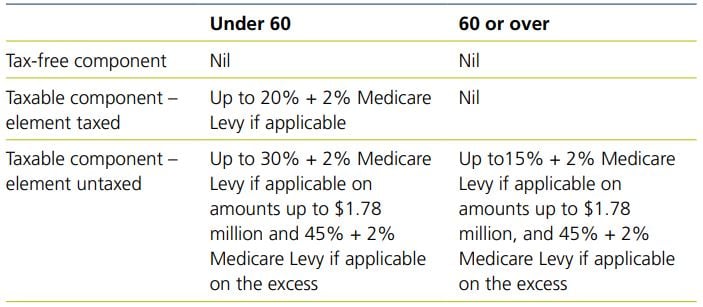
Prior to 1 July 2024, tax on super lump withdrawals was based on tax-components as well as three different age-based tax rates:
- Under preservation age.
- Preservation age and under age 60 with the application of a low-rate cap for super lump sum withdrawals and 15% tax offset on income stream payments.
- Age 60 or over. From 1 July 2024, given that anyone who has already reached their preservation age is now over age 60, there are only two taxing points based on age, dependent on whether the client is under or over 60 at the time of payment.
Tax on super lump sum withdrawals in 2024-25
Tax on income stream payments
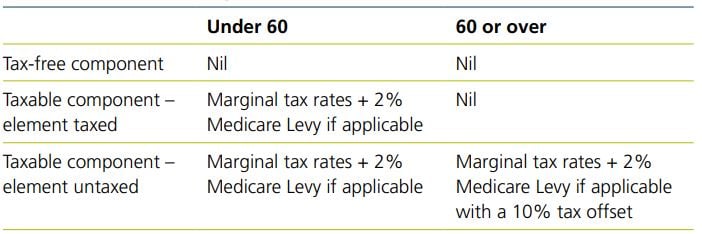
Income stream payments received as a result of disability attract a 15% tax-offset if sourced from taxable component – element taxed even if the client is under age 60. Please note, different rules apply to capped defined benefit income stream payments in excess of the defined benefit income cap ($118,750 in 2024-25) as well as death benefit income stream payments.
Tax on employment termination payments
Similar to the above discussion on super lump sum withdrawals, prior to 1 July 2024, there were three different age-based tax rates. From 1 July 2024, the tax rates on employment termination payments (ETPs) are dependent on whether the client is under or over age 60 as well as the amount including whether it is impacted by the whole of income cap of $180,000.
Tax on employment termination payments in 2024-25
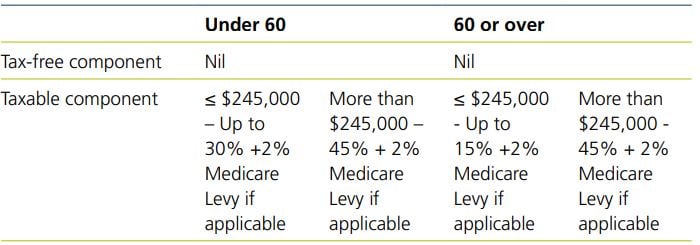
One key difference between taxation of super lump sums and ETPs is that unlike super where the tax rate is based on age at the time of payment, for ETPs, the client’s age and whether they are under or over 60 on the last day of the financial year in the year of receipt determines the tax rate.
Transition to Retirement income stream commencements
A Transition to Retirement income stream (TRIS) can only be commenced by those who have reached their preservation age. Effectively, from 1 July 2024, this means that anyone who hasn’t yet reached their preservation age can only commence a TRIS at the earliest from age 60.
What other age-based rules don’t change?
Age at which superannuation is fully accessible irrespective of work
65 continues to be the age at which super is accessible irrespective of work. There is no legislated correlation between preservation age (60), the upper age at which super is accessible irrespective of work (65) and Age Pension age (67).
Small business capital gains tax concessions and the CGT cap
At a high level, small business capital gains tax (SBCGT) concessions can assist with capital gains tax relief and then contributing sale proceeds to super for eligible small business owners. For SBCGT concessions and the CGT Cap ($1.78 million in 2024-25), age 55 continues to be the eligibility requirement, when relevant. For example, relating to the CGT retirement exemption, the requirement to compulsorily contribute the amount disregarded under the retirement exemption to super continues to be age 55.
Downsizer contribution
Despite the age-based requirement reducing initially from 65 to 60 on 1 July 2022 and then 55 from 1 January 2023, preservation age does not affect the ability to contribute sale proceeds to super. However, if a client in the 55 to 64 age cohort does make a downsizer contribution, they may need to consider any access restrictions until they meet a condition of release.
Related content
The information in this article is current as at 1 July 2024 unless otherwise specified and is provided by Challenger Life Company Limited ABN 44 072 486 938, AFSL 234670 (Challenger, our, we), the issuer of the Challenger annuities (Annuity(ies)) and Challenger Retirement and Investment Services Limited ABN 80 115 534 453, AFSL 295642 (CRISL). The information in this article is general information only about our financial products and is intended solely for licensed financial advisers or authorised representatives of licensed financial advisers, and is provided to them on a confidential basis. It is not intended to constitute financial product advice. This information must not be distributed, delivered, disclosed or otherwise disseminated to any investor, without our express prior approval. Investors should consider the applicable Annuity Target Market Determination (TMD) and Product Disclosure Statement (PDS) available at challenger.com.au and the appropriateness of the applicable product to their circumstances before making an investment decision. This information has been prepared without taking into account any person’s objectives, financial situation or needs. Neither Challenger and/or CRISL, nor any of its officers or employees, are a registered tax agent or a registered tax (financial) adviser under the Tax Agent Services Act 2009 (Cth) and none of them is licensed or authorised to provide tax or social security advice. Before acting, we strongly recommend that prospective investors obtain financial product advice, as well as taxation and applicable social security advice, from qualified professional advisers who are able to take into account the investor’s individual circumstances. Each person should, therefore, consider its appropriateness having regard to these matters and the information in the Target Market Determination (TMD) and Product Disclosure Statement (PDS) for the applicable Annuity before deciding whether to acquire or continue to hold the product. A copy of the TMD and PDS is available at challenger.com.au or by contacting our Adviser Services Team on 13 35 66. Any examples shown in this article are for illustrative purposes only and are not a prediction or guarantee of any particular outcome. Age Pension benefits described in this article will not apply to all individuals. Age Pension outcomes depend on an individual (or couple’s) personal circumstances and may change over time. This article may include statements of opinion, forward looking statements, forecasts or predictions based on current expectations about future events and results. Actual results may be materially different from those shown. This is because outcomes reflect the assumptions made and may be affected by known or unknown risks and uncertainties that are not able to be presently identified. Where information about our products is past performance information, past performance is not a reliable indicator of future performance. Challenger and CRISL relied on publicly available information and sources believed to be reliable, however, the information has not been independently verified by Challenger and CRISL. While due care and attention has been exercised in the preparation of this information, Challenger and CRISL gives no representation or warranty (express or implied) as to its accuracy, completeness or reliability. The information presented in this article is not intended to be a complete statement or summary of the matters to which reference is made in this article. To the maximum extent permissible under law, neither Challenger, CRISL, nor its related entities, nor any of their directors, employees or agents, accept any liability for any loss or damage in connection with the use of or reliance on all or part of, or any omission inadequacy or inaccuracy in, the information in this article.
Stay informed
Sign up to our free monthly adviser newsletter, Tech news containing the latest technical articles, economic updates, retirement insights, product news and events.