

Download the full article below.
Yet for many retirees, that flexibility creates a new challenge: determining how much income they can or should spend each year.
The evidence suggests that a large proportion of retirees solve this challenge by doing the simplest thing possible and drawing the legislated minimum pension amount each year.
According to the Grattan Institute1, around half of retirees using account-based pensions draw only the minimum required amount, despite many having substantial retirement savings. Grattan estimates that drawing only the minimum could leave a typical retiree with approximately 65% of their super balance remaining when they reach an average retiree’s life expectancy.
The question for advisers is whether drawing the minimum represents good retirement planning.
In the absence of advice many retirees treat the SIS minimum as a recommendation. Several behavioural factors help explain why including:
Fear of running out of money – Retirement is unique because clients must fund an unknown lifespan. Without certainty around longevity, many retirees respond by spending conservatively.
Lack of confidence to spend – The transition from saving to spending is psychologically difficult. Clients often tell advisers:
The result is an understandable tendency to underspend.
The SIS minimum appears to have Government endorsement – In the absence of any retirement spending roadmap, clients often view the minimum pension percentage as implicit Government guidance. If the law says a 67-year-old must withdraw at least 5%, many assume 5% must somehow be the “right” amount.
Sequencing risk and market uncertainty – Clients understand intuitively that poor investment returns early in retirement can permanently reduce future income. Drawing only the minimum can feel safer because it preserves more capital during periods of market volatility.
There can be genuine advantages to drawing only the minimum required pension from an ABP, particularly where a client values flexibility, capital preservation or leaving an inheritance.
Capital preservation – Where investment returns exceed the minimum pension withdrawal rate, the account balance may remain relatively stable or continue to grow over time.
Greater liquidity – Retirement savings remain readily accessible to meet unexpected expenses, aged care costs, health needs or financial assistance for family members.
Larger estate outcomes – Clients with strong bequest objectives may prefer to preserve a larger proportion of their retirement capital for beneficiaries.
Some protection against longevity risk – Drawing income conservatively may reduce the risk of exhausting retirement savings during a long retirement.
The drawbacks of choosing to draw the minimum from an ABP may be outnumbered by the advantages, but the potential impact of this disadvantage can be significant.
Lower lifestyle and retirement enjoyment – Many retirees spend less than they could comfortably afford. For many retirees this represents a lost (and potentially very significant) opportunity.
Rather than viewing retirement as a choice between spending more and preserving capital, advisers can reframe the problem.
The real issue is that clients are trying to manage:
Managing these risks and objectives with an ABP can be difficult and, for many clients, the combination of ABP and lifetime income stream can improve retirement outcomes for clients.
In such cases the allocation to an ABP provides:
The lifetime income stream provides secure income for life regardless of investment markets (depending on the type of lifetime income stream) or how long the client lives.
When essential expenses are covered by guaranteed income sources (Age Pension plus lifetime income stream), clients are often more willing to spend from their ABP.
Research and retirement modelling show that guaranteed income allows retirees to draw more confidently from their retirement savings because their priority expenditure (and the retirement lifestyle it supports) is protected.
Rin and Ren are a 67-year-old couple. They have recently retired. They’ve worked hard and are now looking forward to having a whole lot more time to do the things they love. They are active, interested and involved.
Rin and Ren own their own home and are free of debt. They have $500,000 each in superannuation invested in accordance with their 50/50 growth/ defensive risk profile. They have $50,000 in cash and term deposits and $20,000 worth of personal assets.
Rin and Ren are concerned about running out of income during their lifetimes. On rolling over their accumulated superannuation to ABPs they choose to draw the minimum required payments.
Retirement income from all sources for Rin and Ren is shown in the projection (from the Challenger retirement Illustrator2) below:
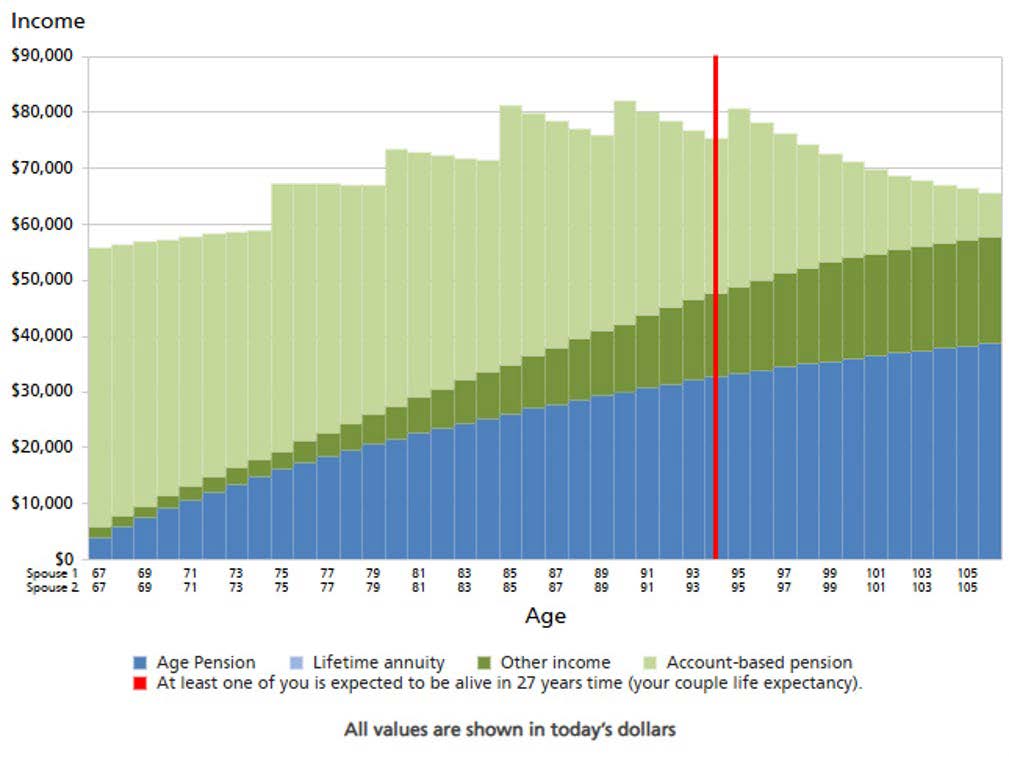
As can be seen in the chart above, despite Rin and Ren’s combined accrued retirement savings of $1,000,000 their total retirement income from all sources when drawing the minimums from their ABPs is modest. In year 1 Rin and Ren’s combined retirement income from all sources is just $55,728 (including $50,000 minimum payment from their ABPs). This level of income is just above the ASFA Retirement Standard for a modest lifestyle ($52,690 p.a.3) and well below the ASFA Retirement Standard for a comfortable lifestyle ($78,998 p.a.3).
It is also interesting to note the profile of real income Rin and Ren will experience over their lifetimes. Real income starts low in early retirement and jumps up following the SIS minimum age increases. By drawing minimum payments from their ABPs, Rin and Ren’s real income is projected to peak in their 90’s at more than $80,000 p.a. in today’s dollars. While this income profile may be desirable for some clients it is not typically preferred with many advisers noting that clients may preference higher income early in retirement when clients may be more active and may be wanting to spend more.
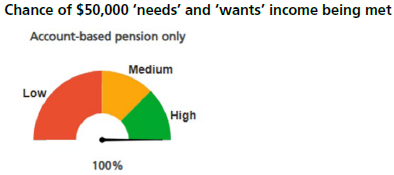
Unsurprisingly, when Rin and Ren draw such a modest level of income from their retirement savings there is a very high probability that such payments can be sustained over their lifetime. Using the stochastic modelling functionality of the Challenger Retirement Illustrator using 2,000 market scenarios provided by Moody’s Analytics and generated using the Moody’s Analytics Scenario Generator we see Rin and Ren’s income requirement (set at their year 1 minimum from their ABPs – $50,000 p.a.) met in 100% of modelled scenarios.
Alternate modelling 1: Improving retirement outcomes with a 20% allocation to a CPI-linked lifetime annuity
An appropriate allocation to a lifetime income stream can help improve retirement outcomes for many clients.
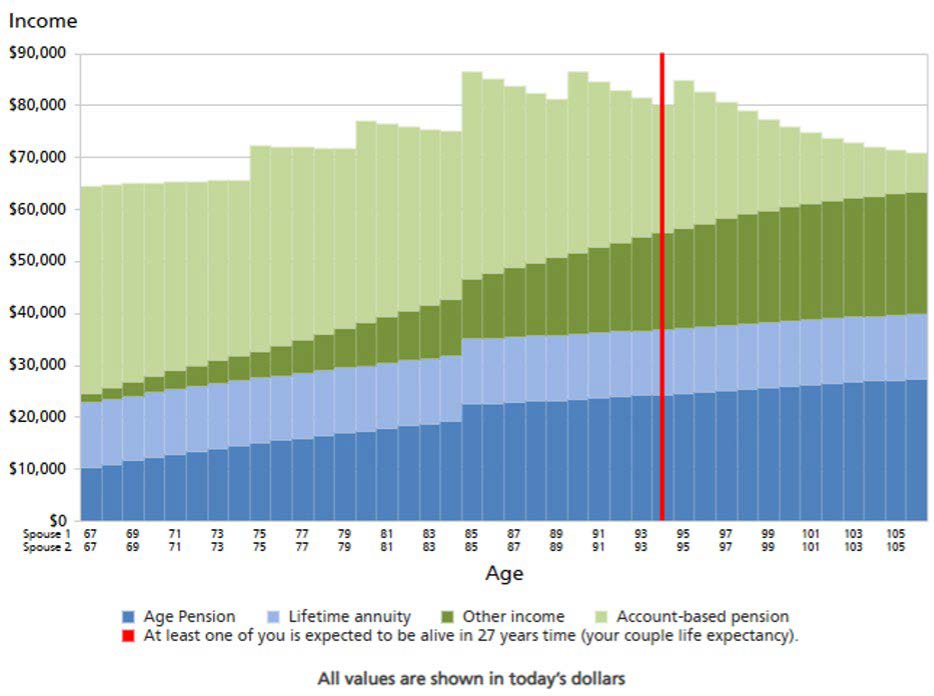
A 20% allocation for Rin and Ren to a CPI-linked lifetime annuity is illustrated below:
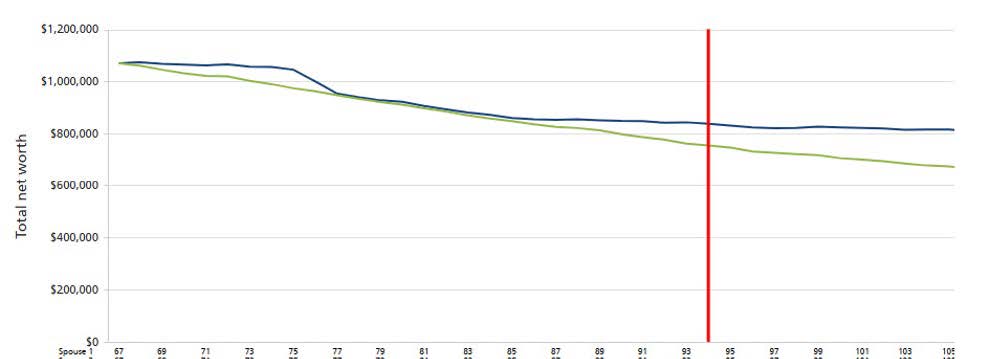
Interestingly, despite the strategy allocating 20% to lifetime annuities providing increased income, this strategy does not compromise Rin and Ren’s estate values, shown in the graph below:
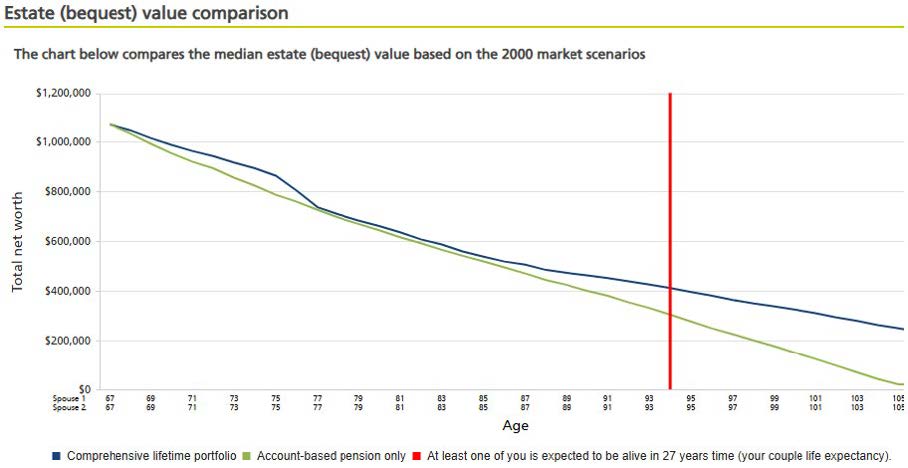
As can be seen in the chart above, the 20% allocation to lifetime annuities increases Rin and Ren’s starting retirement income. In this case their combined retirement income from all sources now starts at $64,504 p.a. (an increase of $8,776 p.a. (or more than 15.7%) over the starting income from the ABP-only strategy). This increased income comes from a combination of the rate on the lifetime annuity being higher than the SIS minimum on the ABP and increased Age Pension (due to the concessional assets test assessment of the lifetime annuity).
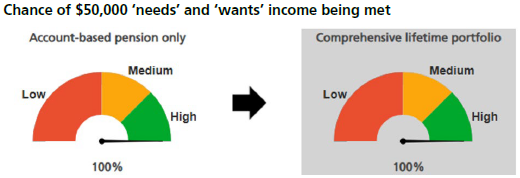
The likelihood of Rin and Ren meeting their spending goal is unchanged.
In summary, the 20% allocation to lifetime annuities for Rin and Ren provides:
Alternate modelling 2: Increasing income beyond the SIS minimums (to a still “safe” level of income) with and without a guaranteed
CPI-linked lifetime annuity
As described above, Rin and Ren are concerned about running out of income during their lifetimes. However, when reviewing the modelling above, they are concerned about the modest level of income they will be required to live on if they choose to draw the SIS minimum payments from their ABPs.
Challenger has previously written on the concept of “safe” retirement spending (“How much can a client afford to spend in retirement?”) and that analysis can be found here: https://www.challenger.com.au/adviser/knowledge-hub/Articles/How-much-can-a-client-afford-to-spend-in-retirement.
Using the methodology described in the above paper (and current Social Security rates and thresholds), we calculate that Rin and Ren can (with a 90% level of confidence) spend $76,900 p.a. in the first year with this income indexed by inflation each year thereafter.
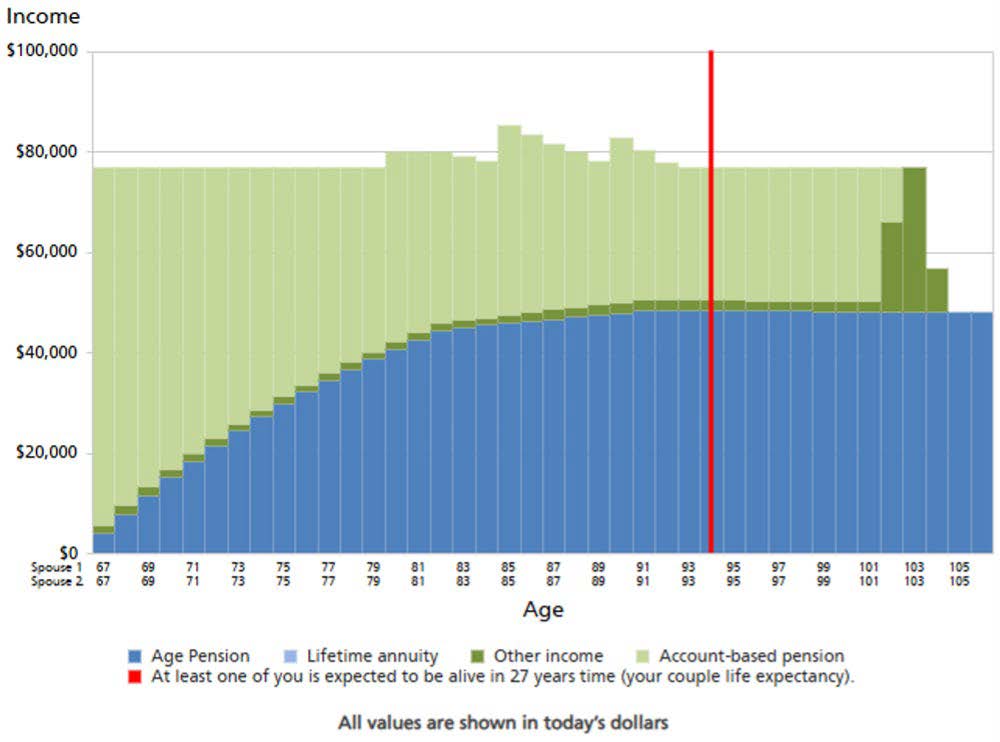
Retirement income from all sources (without lifetime annuities) for Rin and Ren is shown in the projection (from the Challenger retirement Illustrator4) below.
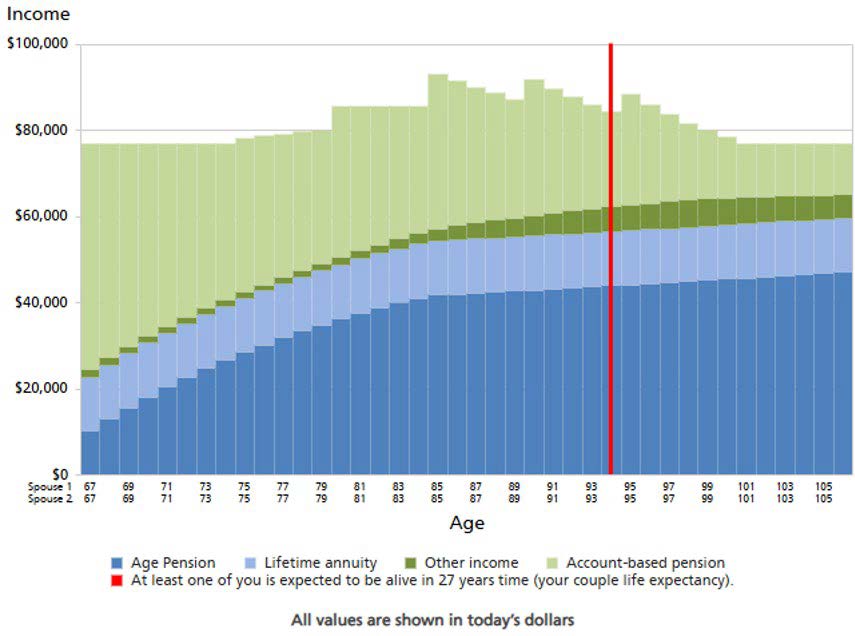
It is easy to observe the higher starting level of income ($76,900 p.a. compared to $55,728 p.a.) and the flatter real income profile over retirement (with some modest increases to meet SIS minimums later in retirement). This higher level of real income (particularly in the early years of retirement) may appeal to many retiree clients.
If Rin and Ren were to prefer this higher level of starting income and then allocate 20% of their retirement savings to a CPI-linked lifetime annuity, their retirement income is projected in the graph below.
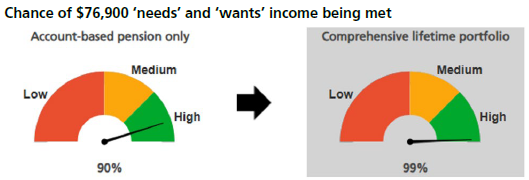
A 20% allocation to a CPI-linked lifetime annuity for both Rin and Ren specifically addresses their concern about running out of income in retirement. Using the stochastic modelling functionality of the Challenger Retirement Illustrator we see Rin and Ren’s income requirement (set at their revised retirement spending of $76,900 p.a. and adjusted for inflation each year) is met in an increased percentage of modelled outcomes (99% compared to 90%).
We see a similar story to the earlier analysis in terms of the relative impact of the alternative strategies considered. The strateg allocating 20% to lifetime annuities does not compromise Rin and Ren’s estate values, shown in the graph below (though it is important to note that both of these alternative strategies with their significantly higher levels of income do consume more of Rin and Ren’s retirement savings over their lifetime, albeit still leaving projected positive estate values beyond age 100) and as shown below.
In summary, at the higher level of projected retirement income, the 20% allocation to lifetime annuities for Rin and Ren provides:
The widespread use of minimum ABP drawdowns is understandable. Clients fear running out of money, receive little practical spending guidance and often mistake the SIS minimum for a recommended spending rate.
For many retirees, the minimum drawdown approach results in unnecessary underspending, variable real income and large balances remaining unspent at death.
A more effective retirement strategy focuses on spending confidence rather than capital preservation alone. By combining an ABP with a lifetime income stream, advisers can help clients convert more of their super into lifestyle, while simultaneously managing longevity risk and maintaining confidence that their income will last as long as they do.
For many in retirement, success should not be measured by how much super is left behind. It should be measured by how effectively retirement savings are converted into a secure and enjoyable standard of living.
1https://grattan.edu.au/report/simpler-super/
2Source: Challenger Retirement Illustrator, 5 October 2026. RIC261005000133.
See Challenger Retirement Illustrator for all assumptions.
3ASFA Retirement Standard for those aged 65-84 (June quarter 2026).
Source: https://www.superannuation.asn.au/consumers/retirement-standard/
4Source: Challenger Retirement Illustrator, 5 October 2026. RIC261006000484.
See Challenger Retirement Illustrator for all assumptions.
