

7 commonly asked aged care questions in 2026

7 commonly asked aged care questions in 2026
Download the full article below.
The aged care landscape has undergone significant change following the introduction of the Hotelling Contribution (HC), Non-Clinical Care Contribution (NCCC), retention amounts and indexed Daily Accommodation Payments (DAPs).
This article answers seven of the commonly asked aged care questions advisers are asking in 2026 with a focus on planning implications, cashflow trade-offs and strategies that may help clients make more informed decisions. Unless otherwise stated, rates and thresholds used in this article are as at 1 July 2026.
Can a client pay a RAD before their means assessment is finalised?
Under the new rules, residents cannot pay a refundable accommodation deposit (RAD) or refundable accommodation contribution (RAC) unless the resident has met all the following conditions:
- has entered an accommodation agreement;
- entered care entered care; and
- had their means assessment finalised (or means not disclosed status set).
However, these rules may change going forward. A bill1 has been introduced on 1 July 2026 that restores the resident’s choice to pay a RAD, DAP or a combination of both during the interim period prior to the finalisation of means assessment. This bill is currently in the House of Representatives and has not yet been legislated.
Until the proposed changes become law, residents who do not wish to disclose their means will still need to be classified as “means not disclosed” residents before they can pay the RAD. They could elect to do so by indicating in the relevant means assessment form (SA487 form) that they do not wish to disclose their means.
The DAP amount payable prior to the means assessment being finalised/means not disclosed status being set cannot be higher than the agreed accommodation payment amount. If it is later established that the resident has a low means status by Services Australia, the provider must refund any overpaid amounts. The resident’s means status and accommodation costs can be backdated to the day they entered care.
However, if they elect to not disclose their means and subsequently decide to complete a means assessment, their assessment will not be backdated to their date of entry. It will commence from the date their means are assessed.
Should high-means clients disclose their means?
For clients entering care under the post-1 November 2025 rules, they are liable for the maximum HC and NCCC limit per day if:
- their assessable assets for aged care is over $1,048,710 for singles or $2,097,421 combined for members of a couple;
- their assessable income for aged care is over $220,213 p.a. for singles or $434,603 p.a. combined for members of a couple; or
- a combination of both assessable income and assets that will result in a Means-tested Amount (MTA) greater than $201.76 or more per day.
For these clients, whether they disclose their means or not, they still end up paying:
- their agreed accommodation price;
- maximum daily HC (capped at a daily amount of $22.15);
- maximum daily NCCC (capped at a daily amount of $107.32).
However, a resident’s liability to pay the NCCC will cease once the earlier of the following occurs:
- they have paid the NCCC for 4 years; or
- they have paid a total of $137,917 in NCCC (indexed).
How do retention amounts apply to a RAD?
My client entered residential care under the post-1 November 2025 rules and paid a RAD. For residents entering care under the new regime, aged care facilities are required to deduct a retention amount from RADs and RACs.
The retention amount:
- is calculated daily at 2% per annum of the RAD or RAC balance;
- is deducted no more than once per month and no less than once every three months;
- applies for a maximum of 5 years from when a RAD/RAC is first paid;
- the 5 year period does not restart when moving between facilities
Importantly, retention amounts reduce the balance that is ultimately refunded to the resident or their estate. However, retention amounts do not increase the outstanding accommodation amount and therefore do not increase the DAP unless other fees, including the DAP, is deducted from the RAD.
Rent or sell the former home?
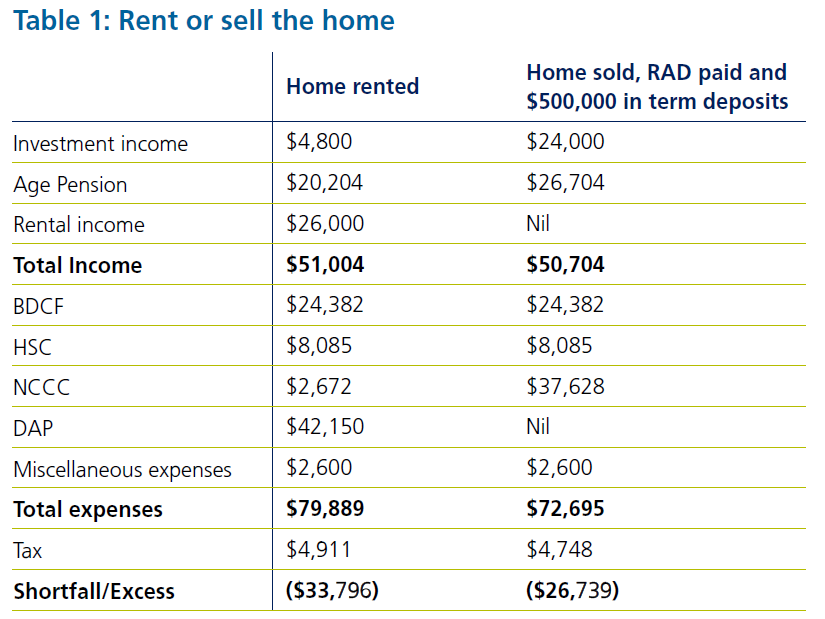
Depending on the value of the home, tax implications, amount of rental income, cashflow considerations and investment alternatives, selling the property may improve outcomes in some situations, while retaining it may remain preferable in others. This means the outcome still depends on individual circumstances and modelling each of these scenarios can help clients understand the outcomes of each option. For example, consider the following case study comparing both the scenarios.
Case Study:
Joanna, age 85, is currently residing in an aged care home under the post -1 November 2025 rules. She has an outstanding RAD liability of $500,000. She is renting out her former home (worth $900,000) which is not occupied by a protected person and she is receiving net rental income of $500 per week.
Her other assets include $100,000 in a bank account and $10,000 in personal effects. She also has $50 per week in other expenses outside of aged care costs. How will Joanna’s situation differ if she decides to sell the home and pay the RAD.
Table 1 summarises Joanna’s cashflow across the two scenarios. With the home being sold and the DAP being paid, Joanna’s cashflow is relatively better by $7,057 in the first year.
Joanna can further improve her cashflow position by allocating $400,000 to Challenger CarePlus (CarePlus) from her term deposits of $500,000 as outlined in Table 2. CarePlus is a combined lifetime annuity (CarePlus Annuity) and life insurance policy (CarePlus Insurance) which can be purchased by aged care clients. CarePlus Annuity provides guaranteed regular payments for life and CarePlus Insurance provides a guaranteed death benefit, up to 100% of the amount invested, payable to nominated beneficiaries or the estate in the event of the client’s death2.
By investing in CarePlus, Joanna has reduced her NCCC fees and reduced her tax liability to nil. Joanna’s cashflow is better by $10,941 in the first year. Refer to the CarePlus PDS or you can contact your BDM for more information on Challenger’s CarePlus.
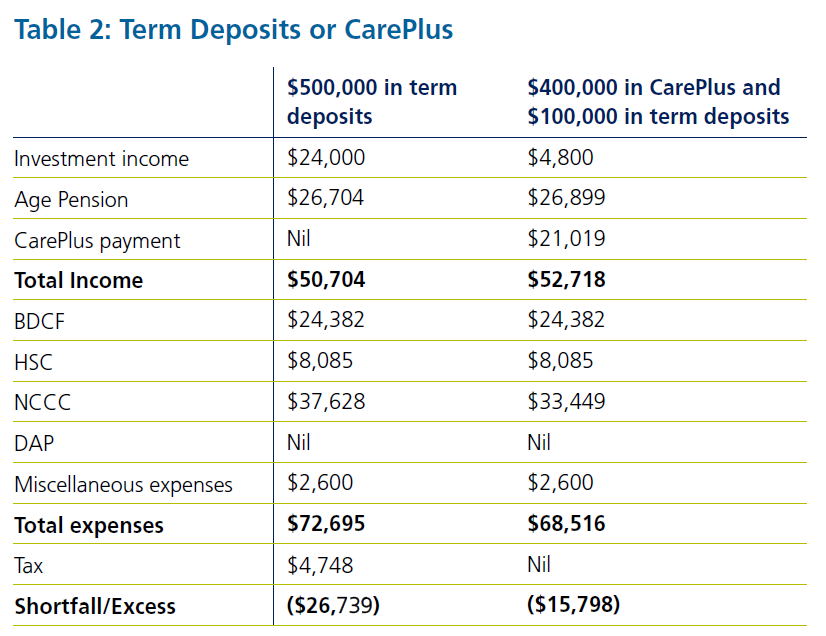
Assumptions: Term deposit assumed interest rate of 4.8%. Centrelink and aged care rates and thresholds as at 1 July 2026. Based on Challenger’s Aged Care Calculator as at 2 July 2026. Refer to the tool’s user guide for details of default assumptions used.
Is DAP indexation pro-rated?
No. Based on the current rules, DAP indexation is not calculated by reference to the number of days a resident has been in care. DAP indexation numbers are published twice a year on 20 March and 20 September. When a resident enters residential aged care, the most recently published DAP indexation number becomes their ‘reference indexation factor’. On each indexation date (20 March and 20 September), the newly published DAP index number is compared to the resident’s reference indexation factor to calculate the amount of indexation applied to their DAP.
For instance, a resident enters an aged care facility on 19 March 2026 (one day before the next indexation date). The resident’s reference indexation factor would be the DAP indexation factor (1.00) as at 20 September 2025. The resident’s next indexation would occur on 20 March 2026 based on the indexation factor at that time calculated as follows:
Marie
- Enters residential aged care on 19 March 2026
- DAP index number at entry = 1.00
- DAP indexation factor on 20 March 2026 = 1.02
- Has been in care for only 1 day when indexation occurs on 20 March 2026
Calculation
DAP indexation factor = 1.02 ÷ 1.00 = 1.02
If Marie’s DAP at entry was $100 per day, Indexed DAP = $100 × 1.02
= $102 per day
My client was approved for a Home Care Package before 12 September 2024 but never accepted the package when it became available. If they enter a residential aged care facility on or after 1 November 2025, will they be grandfathered for their residential
aged care costs?
The key factor is the approval date, irrespective of whether the package is subsequently utilised. This means the previous means tested care fee (MTCF) will apply and not the new HC and NCCC. However, they will still be subject to the post 1 November 2025 rules for accommodation costs (retention amounts and DAP indexation).
Is it still worth paying a RAC or RAD after retention amounts were introduced?
Although the introduction of the 2% retention amount may reduce the financial advantage of paying accommodation costs as a lump sum as compared to pre 1 November 2025 rules, there can still be benefits including:
- reducing or eliminating DAP liability;
- exempt asset and no income assessed for social security purposes;
- improving cash flow due to reduced DAP cost, and
- reducing exposure to DAP indexation.
For example, if we assume a resident pays a RAD of $750,000 and the applicable first-year retention amount being approximately $15,000 (2% of $750,0003), the avoided DAP cost at an accommodation payment rate of 8.43% would be $63,225 per annum. This results in a net benefit of $48,225 in the first year after allowing for the retention amount.
Where a RAD is not preferred to be paid, a client retaining the $750,000 may need to consider a risk-free net return of approximately 6.43% per annum ($48,225 ÷ $750,000) to achieve a comparable outcome. When making this comparison, advisers should also consider investment-related costs such as platform fees, and tax on investment earnings. Another consideration is that retention amounts only apply for 5 years. If the resident remains in care after this period, the returns on the alternative investment would need to be 8.43% (the applicable MPIR at entry).
Additional benefits may arise where paying the RAD increases Age Pension entitlements due to the amount becoming an exempt asset, while also avoiding the impact of future DAP indexation.
On the other hand, a few reasons where a RAD may not be preferred to be paid includes:
- client having a short life expectancy – paying a RAD may be a greater burden administratively than it might be a benefit financially;
- client having large, unrealised capital gains on existing investments – selling assets in order to pay the RAD may create large capital gains tax; or
- client not wanting to sell their former home for emotional reasons and has enough cashflow to fund the DAP.
Advisers are recommended to take all these factors into consideration before recommending whether a RAD or a RAC should be paid in full or part.
1 Aged Care Legislation Amendment (Aboriginal and Torres Strait Islander Aged Care Commissioner and Other Measures) Bill 2026
2 Stamp duty (1.5% of CarePlus Insurance premium) will be deducted from the death benefit for SA residents.
3 The facility can deduct a retention amount for a maximum of once in any one month period and a minimum of once every 3 months. The 2% retention amount is based on the RAD balance – therefore in practice, the retention amounts reduce progressively as the RAD balance reduces and would not be exactly 2% of the initial RAD paid.
The information in this article is current as at 2 July 2026 unless otherwise specified and is provided by Challenger Life Company Limited ABN 44 072 486 938, AFSL 234670 (Challenger, our, we), the issuer of the Challenger annuities (Annuity(ies)), the issuer of CarePlus Annuity and CarePlus Insurance, together referred to as Challenger CarePlus and Challenger Retirement and Investment Services Limited ABN 80 115 534 453, AFSL 295642 (CRISL). The information in this article is general information and is intended solely for licensed financial advisers or authorised representatives of licensed financial advisers, and is provided to them on a confidential basis. It is not intended to constitute financial product advice. This information must not be distributed, delivered, disclosed or otherwise disseminated to any investor, without our express prior approval. Investors should consider the applicable Annuity Target Market Determination (TMD) and Product Disclosure Statement (PDS) available at challenger.com.au and the appropriateness of the applicable product to their circumstances before making an investment decision. This information has been prepared without taking into account any person’s objectives, financial situation or needs. Neither Challenger and/or CRISL, nor any of its officers or employees, are a registered tax agent or a registered tax (financial) adviser under the Tax Agent Services Act 2009 (Cth) and none of them is licensed or authorised to provide tax or social security advice. Before acting, we strongly recommend that prospective investors obtain financial product advice, as well as taxation and applicable social security advice, from qualified professional advisers who are able to take into account the investor’s individual circumstances. Each person should, therefore, consider its appropriateness having regard to these matters and the information in the TMD and PDS for the applicable Annuity before deciding whether to acquire or continue to hold the product. A copy of the TMD and PDS is available at challenger.com.au or by contacting our Adviser Services Team on 13 35 66. Any examples shown in this article are for illustrative purposes only and are not a prediction or guarantee of any particular outcome. Age Pension benefits described in this article will not apply to all individuals. Age Pension outcomes depend on an individual (or couple’s) personal circumstances and may change over time. This article may include statements of opinion, forward looking statements, forecasts or predictions based on current expectations about future events and results. Actual results may be materially different from those shown. This is because outcomes reflect the assumptions made and may be affected by known or unknown risks and uncertainties that are not able to be presently identified. Challenger and CRISL relied on publicly available information and sources believed to be reliable, however, the information has not been independently verified by Challenger and CRISL. While due care and attention has been exercised in the preparation of this information, Challenger and CRISL gives no representation or warranty (express or implied) as to its accuracy, completeness or reliability. The information presented in this article is not intended to be a complete statement or summary of the matters to which reference is made in this article. To the maximum extent permissible under law, neither Challenger, CRISL, nor its related entities, nor any of their directors, employees or agents, accept any liability for any loss or damage in connection with the use of or reliance on all or part of, or any omission inadequacy or inaccuracy in, the information in this article.
Related content
Stay informed
Sign up to our free monthly adviser newsletter, Tech news containing the latest technical articles, economic updates, retirement insights, product news and events.