

Download the full article below.
Furthermore, as clients typically have a combination of both income and assets, it can be difficult to identify when a change in their financial circumstances will materially alter their aged care costs. This article follows Margaret’s aged care journey and translates three key milestones into practical income and asset reference points, helping advisers identify where advice can positively influence aged care outcomes.
Margaret’s journey can be viewed through three distinct milestones:
Together, these milestones provide practical reference points for identifying when changes in a client’s financial position are most likely to alter aged care outcomes. To illustrate how aged care costs change as means increase, each milestone is shown using three simplified scenarios for a single homeowner - income only, assets only and financial assets only. In practice, most clients will have a combination of both income and assets, meaning their results are likely to fall somewhere between the examples shown. Any calculated income thresholds are rounded to the nearest $10 and asset thresholds are rounded to the nearest $100 (e.g. financial assets subject to deeming).
This article assumes a working understanding of the aged care reforms introduced from 1 November 2025. These rules are outlined in our comprehensive Aged care guide.
The examples in this article assume Margaret, aged 80:
Margaret’s first milestone occurs while she is receiving services under Support at Home.
Support at Home participant contributions are determined by assessable income and assets. Based on Margaret’s circumstances, she is assessed as a part-pensioner and commonwealth seniors health care card holder (means-tested participant). As a result, her participant contribution is determined by a percentage of the cost for independence and everyday living services.
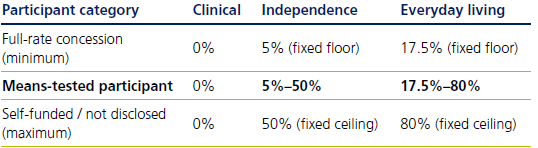
While the minimum and maximum contribution rates are fixed, the means-tested category is where a participant’s income and assets determine the contribution percentage. Participants who do not disclose their means are assessed at the maximum contribution rates.
For a single homeowner means-tested participant, the key thresholds are:

Financial assets are assessed under both the assets test and the deeming rules used in the income test. As a result, individuals with financial assets exceeding $192,400 may be assessed as means-tested participants, even though this threshold remains well below the $333,000 asset free area.
This first milestone highlights the range where a participant’s assessable income and assets can affect their Support at Home contribution rates. Understanding these thresholds can help advisers identify when strategies that alter assessable income or assets may influence contribution outcomes.
Refer to the table 1 in the Appendix for couple thresholds.
At age 85, Margaret’s care needs increase and she moves into residential aged care. The aged care facility has an advertised accommodation price of $750,000. She keeps her former home which remains vacant. At this point, the focus shifts from Support at Home participant contributions to the means tested assessment (MTA). Under the residential aged care rules, the MTA becomes the key measure used to determine accommodation payments and ongoing contributions. The first important threshold represents when the MTA equals the Maximum Accommodation Supplement (MAS) of $73.73 per day, at which point a resident is classified as a RAD payer. HC does not begin immediately when a resident becomes a RAD payer. HC only starts once the MTA exceeds the MAS ($73.73 per day). The second stage represents the range over which HC applies and increases as a resident’s means increase. The third threshold occurs when the MTA reaches $95.88 per day, at which point the HC reaches its maximum daily amount of $22.15 and caps out.
For a single resident, the key thresholds are:
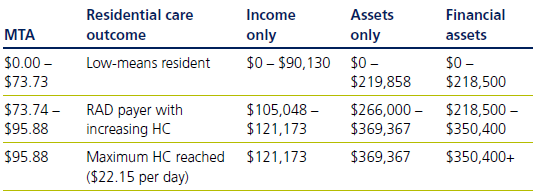
For Margaret, this milestone confirms that she is not classified as low means. Even before taking deemed income into account, her assessable assets of approximately $739,858 (comprising $520,000 of financial assets and the capped value of $219,859 for her former home) exceed the thresholds for both RAD payer status and the maximum HC. As a result, Margaret would:
Understanding the underlying income and asset levels provides a practical reference point for identifying when an individual is likely to be assessed as low means or RAD payer before they enter residential care. This milestone therefore establishes a resident’s status upon entry into an aged care facility and provides the foundation for understanding further ongoing costs, where the focus shifts from
accommodation payments to liability for the HC and NCCC.
Refer to the table 2 in the Appendix for illness separated couple thresholds.
The first two milestones focus on the points at which means testing starts to affect a client’s contributions under Support at Home and residential aged care. This final milestone focuses on when NCCC liability begins and the interaction between the three limits that apply to the NCCC:
For a single homeowner resident, the key thresholds are:
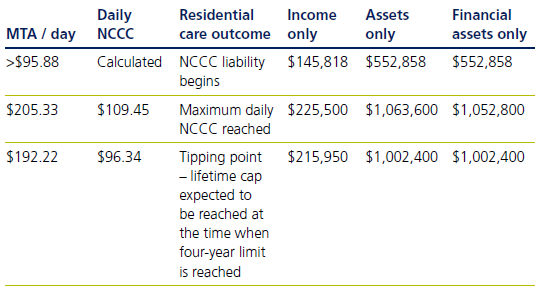
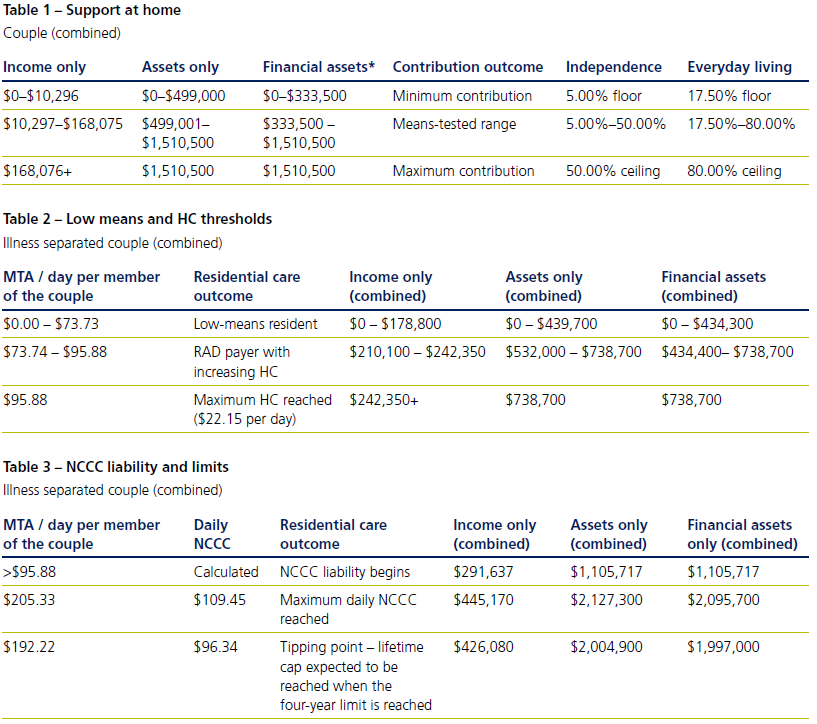
The first threshold represents the point at which NCCC liability begins, The NCCC begins once the HC has reached its maximum and continues to increase as the resident’s means increase, up to the maximum daily NCCC of $109.45 per day. In addition to the daily cap, a resident ceases paying the NCCC when the earlier of the lifetime cap (currently $140,652.80) or paying NCCC for a minimum of four years is reached. For RAD paying residents, understanding which limit is likely to apply first becomes increasingly important.
The second threshold is particularly important when considering whether disclosure of means is likely to influence aged care costs. At this point, the interaction between the daily cap, lifetime cap and four-year limit no longer changes the resident’s daily NCCC outcome, as the maximum daily contribution has already been reached. This makes the threshold a useful reference point when assessing whether disclosure of means is likely to change the resident’s aged care outcome. Clients whose means already place them at the maximum HC and maximum NCCC generally arrive at the same fee outcome regardless of whether they disclose their means.
The third threshold represents the tipping point between the lifetime cap and the four-year contribution limit. At this approximate point, both limits are expected to be reached at the same time.
Below the tipping point:
Above the tipping point:
In practical terms, increasing a resident’s means beyond this point is unlikely to increase the total NCCC ultimately paid.
Refer to the table 3 in the Appendix for illness separated couple thresholds.
Margaret sells her former home for $1.6 million after entering residential aged care. Combined with her existing financial assets of $520,000, she now has total financial assets of approximately $2.12 million. Based on the thresholds identified above, Margaret’s financial assets significantly exceed the level required to reach the maximum daily HC and NCCC. Further increases in her assessable income and assets will not increase her ongoing contributions because she has already reached the legislated maximum contribution.
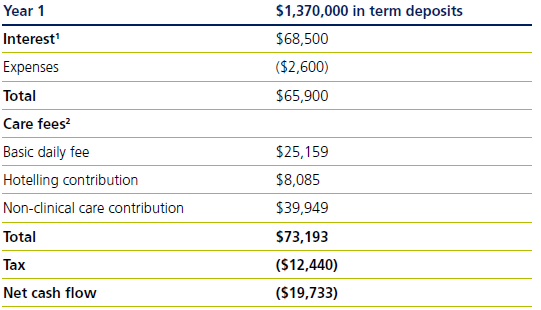
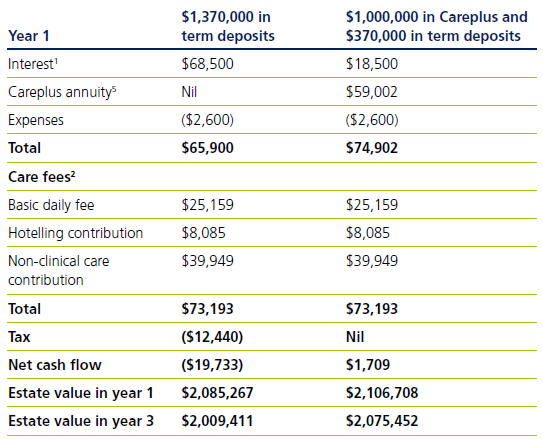
Margaret decides to pay a $750,000 RAD and invest $1.37 million in term deposits. She will have expenses of $50 per week while living in residential aged care. The following table provides her cash flow in year 1.
Margaret wants to address her cash flow deficit and maximise her estate in the event of her death. The following table compares her cash flow and estate value in year 1 if $1 million is invested in Challenger CarePlus (CarePlus). CarePlus is a combined lifetime annuity (CarePlus Annuity) and life insurance policy (CarePlus Insurance) which can be purchased by aged care clients3. CarePlus Annuity provides guaranteed regular payments for life and CarePlus Insurance provides a guaranteed death benefit of 100% of the amount invested, payable to nominated beneficiaries or the estate in the event of the client’s death4.
The comparison outlines that for a resident already paying the maximum HC and NCCC, the key consideration becomes improving after-tax cash flow rather than reducing aged care fees. Both strategies result in the same HC and NCCC liability, however the CarePlus strategy produces a materially better after-tax outcome. Under the term deposit strategy, Margaret incurs $12,440 of tax and experiences a first-year cash flow shortfall of $19,733. On the other hand, the CarePlus strategy results in no tax liability and a first-year cash flow surplus of $1,709, improving Margaret’s cash flow position by $21,442.
The improvement is also reflected in Margaret’s projected estate value. In year 1, the CarePlus strategy increases the value of Margaret’s estate by $21,441 ($2,106,708 less $2,085,267). By year 3, the projected benefit in estate value under the CarePlus strategy improves to $66,041 ($2,075,452 less $2,009,411).
1Term deposit assumed interest rate of 5%.
2Aged care rates and thresholds as at 20 September 2026.
3Clients can invest in CarePlus if they are aged 18+ and currently receiving, or requiring, Government-subsidised (or equivalent privately-funded) aged care services.
4Stamp duty (1.5% of CarePlus Insurance premium) will be deducted from the death benefit for SA residents.
5Challenger Aged Care Calculator 28/09/2026, 85 year old female, NSW resident, nil adviser fees.
