

For adviser use only
CGT changes - what retirees need to know
By Minh Ly, Technical Services Manager
01 August 2026
Download the full article below.
In the 2026-27 Budget, the Government announced reforms to capital gains tax (CGT) to help improve the fairness of the tax system, support home ownership and help fund new tax cuts for workers. The proposals are now legislated, receiving royal assent on 26 June 2026, with the new rules commencing from 1 July 2027.
The reforms made three key changes:
bring pre-CGT assets into the tax base and tax capital gains accrued from 1 July 2027.
In this month’s article, we unpack these changes and discuss how these apply to retiree clients holding CGT assets. For the purposes of this article, we will limit the discussion to how these changes impact retiree individuals and exclude other entities and innovative start-ups.
Unless otherwise specified, rates and thresholds used in this article are as at 1 July 2026.
Broadly, the new capital gains tax (CGT) rules apply to realised capital gains from 1 July 2027.
The new cost base indexation regime applies to capital gains on all eligible assets made by Australian resident individuals (including individual partners in a partnership) and trusts.
A minimum 30% tax on capital gains will also apply to certain Australian resident individuals. The Government has also announced a minimum tax of 30% for discretionary trusts from 1 July 2028. This is currently in consultation phase and is not yet law.
These changes do not apply to capital gains made by foreign residents and temporary residents; or companies, superannuation funds and life insurance companies. These entities were either not previously entitled to the CGT discount or have their own CGT treatment and therefore will not be affected by the changes (for example, one third CGT discount for complying super funds that hold assets for more than 12 months continues to apply).
The new rules also bring pre-CGT assets into the CGT regime from 1 July 2027 for all entities (including companies) and is not limited to entities that are subject to cost base indexation and the minimum 30% tax.
CGT assets acquired and disposed of before 1 July 2027 continue to be treated under the old rules, including pre-CGT assets continuing to be exempt from CGT.
For CGT assets acquired before 1 July 2027 and disposed of on or after 1 July 2027, there will be two components of a capital gain or loss going forward:
CGT assets acquired before 1 July 2027 are deemed to be disposed of just before 1 July 2027 and reacquired on 1 July 2027. Any gain or loss from the deemed disposal will then be deferred until a later realisation event occurs. The deemed disposal and reacquisition is ignored for the purposes of working out the 12-month holding period in relation to accessing the CGT discount.
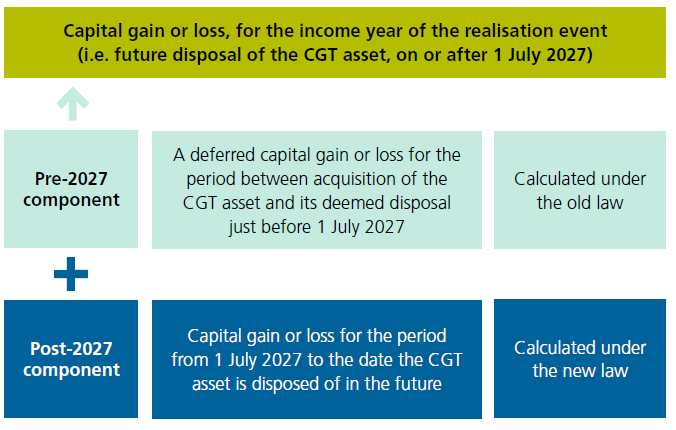
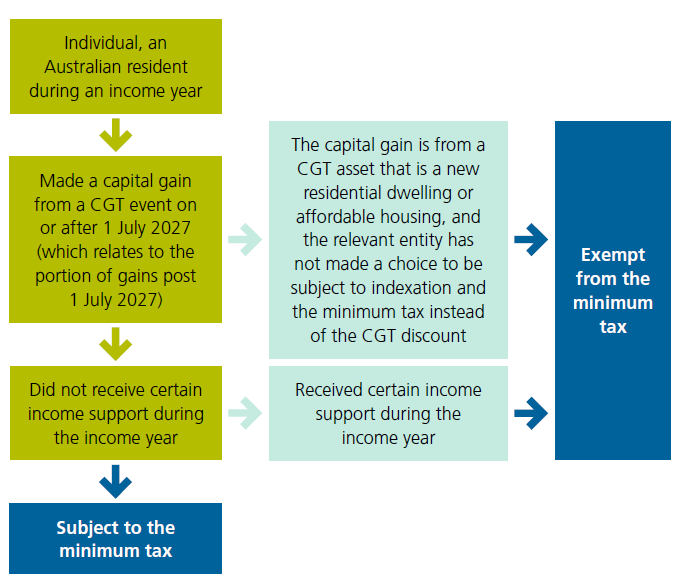
Source: Explanatory Memorandum to the amending Bill
To determine the value of assets as at 1 July 2027, the Government has provided in their Budget factsheets that:
“An asset’s value at 1 July 2027 will be determined by taxpayers as part of their tax return in the year the asset is realised. Taxpayers can either:
As at the time of writing, the ATO has not yet provided details of the apportionment formula.
Otis, an Australian resident, purchases shares in January 2020 for $100,000 and sells them on 1 March 2029 for $160,000.
The shares are deemed to be disposed of on 30 June 2027 and reacquired on 1 July 2027. The market value of the shares as at 1 July 2027 is $120,000.
The deemed disposal has resulted in a notional gain of $20,000 (assuming Otis elects to value his shares as at 1 July 2027 using the market value method). The taxing point is deferred until the shares are sold in the future.
Otis sells the shares on 1 March 2029 for $160,000. This is the realisation event. In working out the capital gain for this realisation event, the cost base of the shares is determined by taking the market value of the shares at the time of their deemed acquisition on 1 July 2027 and applying indexation (that is, indexation is applied to $120,000).
Both the deferred gain from the deemed disposal just before 1 July 2027, and the separate capital gain for the sale (the realisation event) on 1 March 2029, are included in working out Otis’ net capital gain for the 2028-29 income year.
Assuming Otis has no capital losses to offset his gains, the $20,000 gain would qualify for the 50% CGT discount as Otis has held the shares for more than 12 months (January 2020 until March 2029). The capital gain associated with the period 1 July 2027 until 1 March 2029 may be subject to the 30% minimum tax.
Whilst the new rules are designed to capture all CGT assets, there are situations where they won’t apply. These are broadly2:
It is also worth noting that apart from the increase to the active assets aggregated turnover threshold to $10 million from $2 million, there are no other changes to the operation of the small business CGT concessions or the main residence CGT exemption.
Individuals and trusts that hold new residential dwellings or affordable housing after 1 July 2027 will have a choice between applying the CGT discount or cost base indexation in respect of the period after 1 July 2027 and the minimum tax. The chosen treatment will apply to the whole holding period, even if the asset is purchased before and sold after 1 July 2027.
In relation to beneficiaries of a trust, the choice between indexation and the CGT discount is made by the trustee of the trust. It cannot be altered by the beneficiary.
The definition of a new residential dwelling will be confirmed by a legislative instrument. As at the time of writing, the legislative instrument has not been released. However, the intent of the definitions and requirements will be to assist in adding to the supply of residential dwellings in Australia.
The Budget factsheets provide some indication of what’s considered to be a new residential dwelling:
| Eligible new build | Not an eligible new build |
|---|---|
| A newly constructed apartment bought off-the-plan. | An established property that has recently been extended to add additional bedrooms. |
| A duplex constructed through a knock-down rebuild replacing a single, free-standing house. | A free-standing house through a knock-down rebuild replacing an older, smaller free-standing house. |
| Any residential construction on previously vacated land. | A granny flat built adjacent to an established property that is not eligible for negative gearing. |
| A newly built property which is occupied for less than 12 months before being first sold. | A newly built property which is occupied for more than 12 months before being sold to a subsequent investor. |
The 30% minimum tax does not apply to an individual if they were in receipt of an eligible social security payment such as the Age Pension (a list of eligible payments can be found in the appendix at the end of this paper). The rules appear to also include those receiving the maximum rate of pension due to blindness without the need for them to have their means assessed.
Individuals do not need to be in receipt of an eligible social security payment before the CGT event occurs. They can qualify for payment at any time during the year as long as it is in the same financial year as the CGT realisation event.
This provides advisers with an opportunity to consider appropriate asset test and/or income test friendly investments and strategies, such as lifetime annuities, that may help clients qualify for an eligible social security payment and avoid the minimum 30% tax on capital gains, where relevant.
George age 67 is a single homeowner who has recently retired. He has accumulated $500,000 in super and $250,000 in a share portfolio. He also has $10,000 in personal assets and $20,000 in savings. His total assets of $780,000 exceed the assets test cut-off limit and as such does not qualify for the Age Pension or any other social security payment.
George is looking to sell down his share portfolio and contribute the proceeds to super to fund his retirement. His share portfolio has $50,000 in real capital gains, all subject to the minimum 30% (gains accrued from 1 July 2027 based on cost base indexation method). George also has $20,000 in other taxable income for the financial year.
Using legislated marginal tax rates that will take effect from 1 July 2027, George will need to pay minimum CGT ‘top-up’ tax of $4,000 calculated3 as follows:
| Taxable income including capital gain | $70,000 |
| Tax based on ordinary marginal tax rate | $11,252 |
| Medicare Levy | $1,400 |
| Tax attributable to capital gain4 | $11,000 |
| Minimum tax on capital gain (30% of $50,000) | $15,000 |
| Minimum CGT top-up ($15,000 - $11,000) | $4,000 |
| Total tax incl. Medicare Levy ($11,252 + $1,400 + $4,000) | $16,652 |
If George invests $200,000 into a Challenger lifetime annuity, he will receive $12,2415 p.a. indexed to CPI for life to help fund his retirement and help address longevity risk. As Challenger’s lifetime annuity is concessionally assessed under the Age Pension assets test – only 60% of the investment amount is assessed under the assets test until age 85 and then 30% of the investment amount thereafter – George can reduce his assessable assets by $80,000 to $700,000. This helps him fall below the assets test cut-off threshold and qualify for $2,597 p.a. in Age Pension.
If George invests in Challenger’s lifetime annuity and qualifies for the Age Pension in the same financial year, whether this is before or after he realises his capital gain, he would be exempt from the minimum CGT top-up tax of $4,000.
Cost base indexation will broadly operate in a similar manner to arrangements previously in place between 1985 and 1999, including indexation being calculated using CPI. The Government has stated that the ATO will provide guidance and tools to support calculations.
Additionally, the new rules do not change the methodology for calculating capital losses. Capital losses will continue to be calculated using the reduced cost base of a CGT asset, rather than the asset’s cost base that is used when calculating a gain.
Individuals will need to be Australian tax residents for the entire holding period to be eligible to apply indexation. If at any point they were a foreign or temporary resident, the individual cannot apply indexation to the cost base under the new rules. Similar rules apply to beneficiaries of a trust.
The previous rule that indexation is only available if the asset has been owned for at least 12 months continues to apply. However, the deemed sale and reacquisition on 1 July 2027 is ignored for the purposes of applying the 12-month rule.
John acquires a parcel of shares on 1 September 2025 and sells those shares on 1 January 2028. Although the period between 1 July 2027 and 1 January 2028 is less than 12 months, indexation is available as the new rules considers John’s continuous period of ownership between 1 September 2025 and 1 January 2028.
The introduction of the minimum tax reduces the benefit of taxpayers deferring the realisation of capital gains to years where their marginal tax rates are low, for instance after retirement.
The minimum tax of 30% applies to Australian tax residents (including being an Australian tax resident for part of the year), who are not in receipt of an eligible income support payment, for CGT events occurring on or after 1 July 2027, and levied on real capital gains accrued after 1 July 2027 (that is, those that are not subject to the discount method).
Source: Explanatory Memorandum to the amending Bill
A key aspect of the minimum tax is that it is levied on relevant taxable capital gains before deductions6. This will affect the effectiveness of strategies such as personal deductible contributions (PDCs) to reduce CGT liabilities – a common strategy consideration for clients who are looking to sell down assets to fund retirement.
The introduction of the minimum tax will reduce the benefits of personal deductible contributions in certain situations going forward, and in some cases can put clients in a worse position from a tax perspective.
Consider a simple scenario where an individual only has capital gains subject to the minimum tax and no other taxable income. Under these conditions there are very limited situations where a PDC would put the client in a better position.
For example, an individual who is making a PDC of $20,000 will need capital gains subject to the minimum tax of more than $247,000 for the PDC to provide a tax benefit. See calculations below.
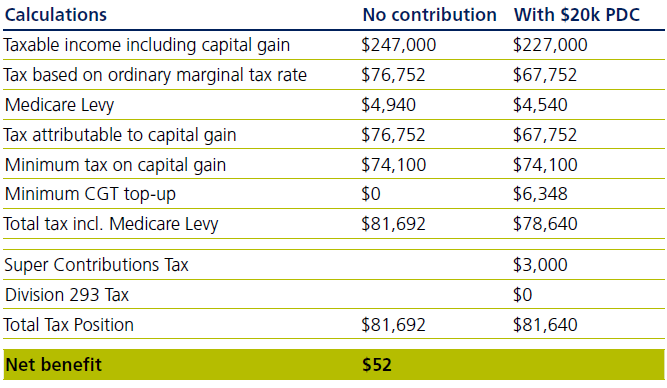
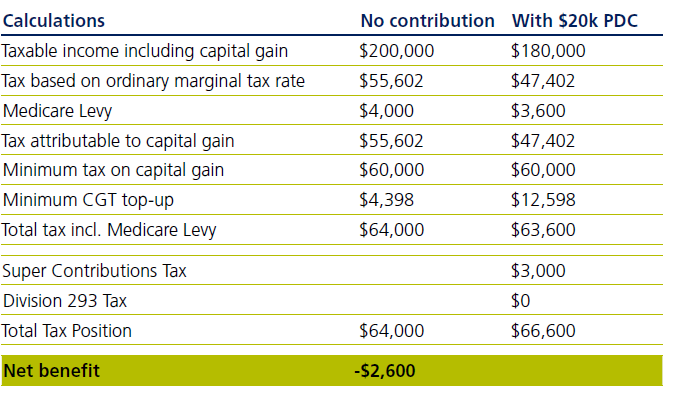
If the taxable gain was less, say $200,000 instead of $247,000, the $20,000 PDC would put the client in a worse tax position. See below:
Where clients have other taxable income, PDCs can still help reduce tax attributed to that income. For example, consider a client with $150,000 taxable capital gains subject to the minimum tax and $50,000 of other taxable income. The $20,000 PDC can help reduce tax by $5,600.
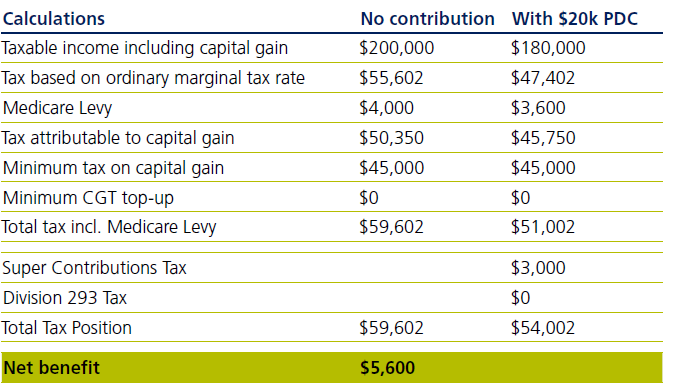
Going forward, advisers will need to carefully assess whether PDCs can help reduce tax on realised capital gains subject to the minimum tax. While PDCs can still help to reduce overall tax in some situations, particularly where there is other taxable income,
they cannot reduce the tax on capital gains below the 30% minimum. In other cases, PDCs can increase the client’s overall tax position.
A consequence of the new capital gains tax rules (and new negative gearing rules) is a new methodology for calculating net capital gains. The main changes are:
applying capital losses against each category in a particular order.
This means individuals won’t be able to pick and choose which gains to offset first, for example, they won’t be able to choose to offset gains with cost base indexation before gains eligible for the CGT discount.
It is expected that clients will seek appropriate tax advice to correctly calculate and categorise their capital gains but for discussion purposes the four categories are:
| Category type | Category order | Description |
|---|---|---|
| Deferred non-residential capital gains | 1 | Gains arising from the deemed sale (on 30 June 2027) where the CGT asset is not a residential dwelling to the extent it has been used or held to provide residential accommodation. |
| Deferred residential capital gains | 2 | Gains arising from the deemed sale (on 30 June 2027) where the CGT asset is a residential dwelling to the extent it has been used or held to provide residential accommodation. |
| Non-residential capital gains | 3 | Gains arising from a CGT event where the CGT asset is not a residential dwelling to the extent it has been used or held to provide residential accommodation. |
| Residential capital gains | 4 | Gains arising from a CGT event where the CGT asset is a residential dwelling to the extent it has been used or held to provide residential accommodation. |
Once an individual has identified the different categories of capital gains, they then apply any capital losses in the current year against each category in the order noted in the above table. Once current year losses are exhausted, the individual can then apply their carried forward losses in a similar way.
Youth allowance
Disability Compensation Payment paid at certain rates (intermediate rate, special rate, and temporary payment at special rate)