

Consumer sentiment at an all time low

Subscribe to Macro Musing
To stay up to date on the latest economic insights, subscribe to Macro Musing on LinkedIn.
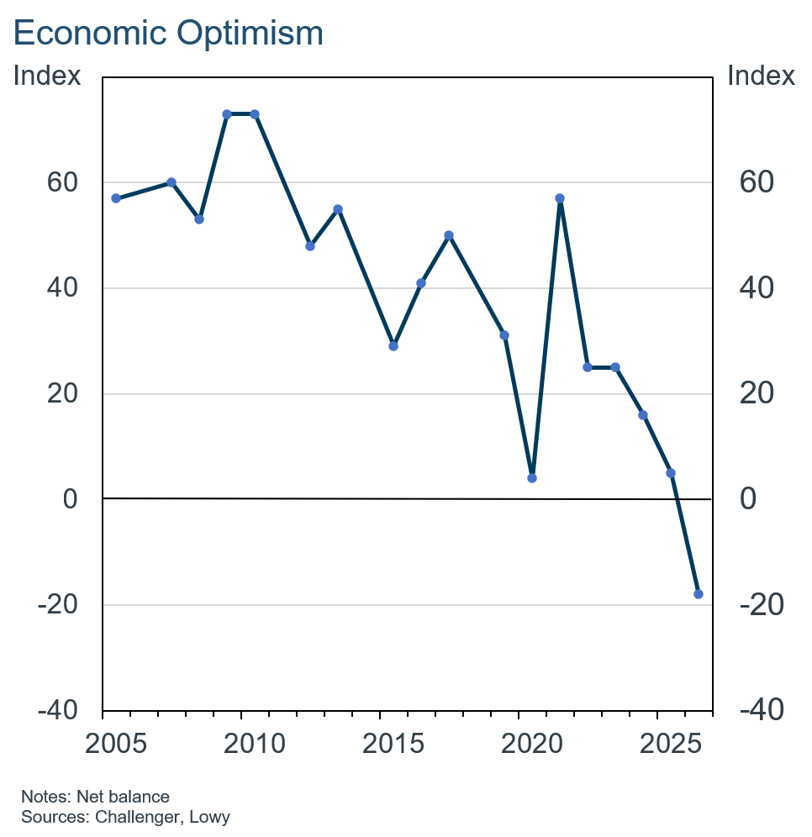
The 2026 Lowy Institute poll shows that over the past two decades Australians have become increasingly pessimistic about Australia’s economic performance. Optimism about Australia’s place in the world over the next five years fell sharply in 2020 with the onset of the Covid pandemic, then rebounded the following year with the development of vaccines and the economic recovery. These abrupt moves temporarily distracted from growing pessimism over time, with this year recording greater economic pessimism than even in the pandemic, the lowest optimism in the history of the survey. Where has the lucky country’s optimism gone?
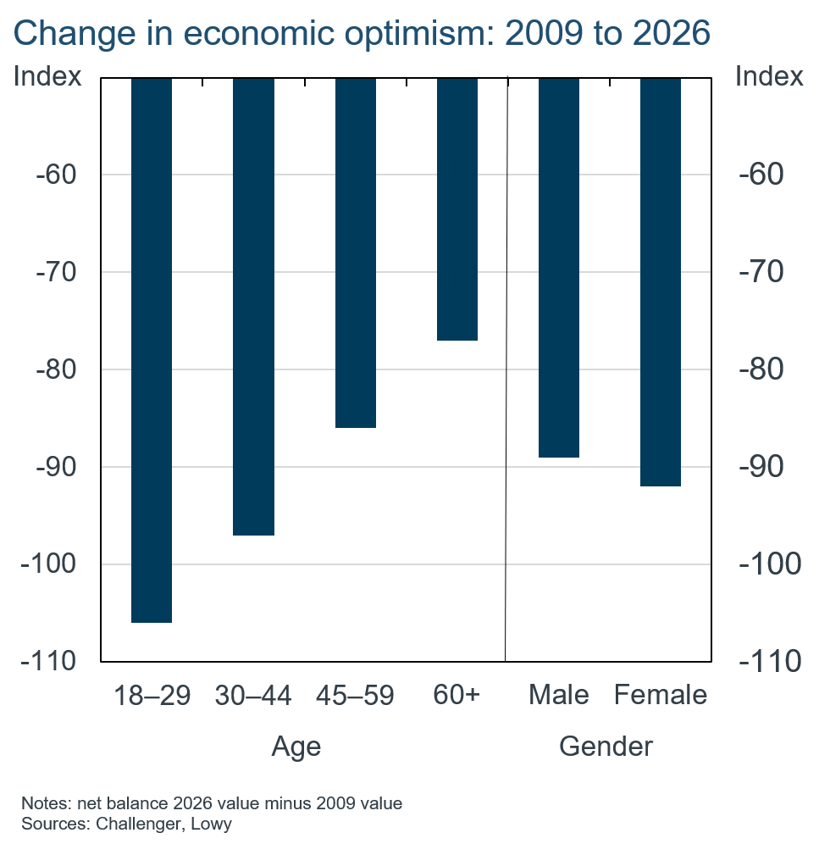
Taking the change from the 2009 peak to now, the fall in optimism has been greatest for younger cohorts. However, there has been a broad fall in the net balance of respondents reporting they are optimistic or very optimistic relative to pessimistic or very pessimistic. Even the most optimistic cohort, those aged over 60, had a 77 percentage point decline in optimism. The largest falls being for younger generations suggest that challenges close to home, such as housing affordability and inter-generational wealth inequality may have contributed to falling optimism. Women and men experienced similar falls in optimism.
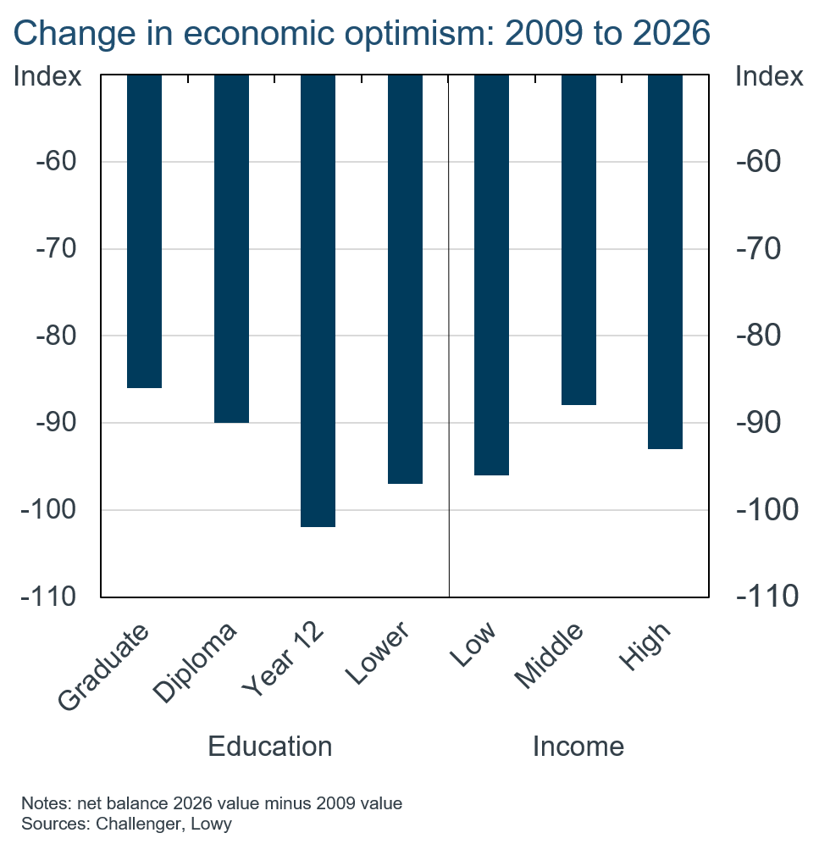
The fall in optimism has been greater for those with lower levels of education. Over the past two decades there has been significant structural change in the Australian economy including the decline in manufacturing, the growth of trade and rising income inequality. Lower skilled workers report a larger decline, although even highly skilled workers are feeling much less optimistic. Interestingly, there is not a strong relationship between income levels and views on economic optimism despite the increase in income inequality over the two decades.
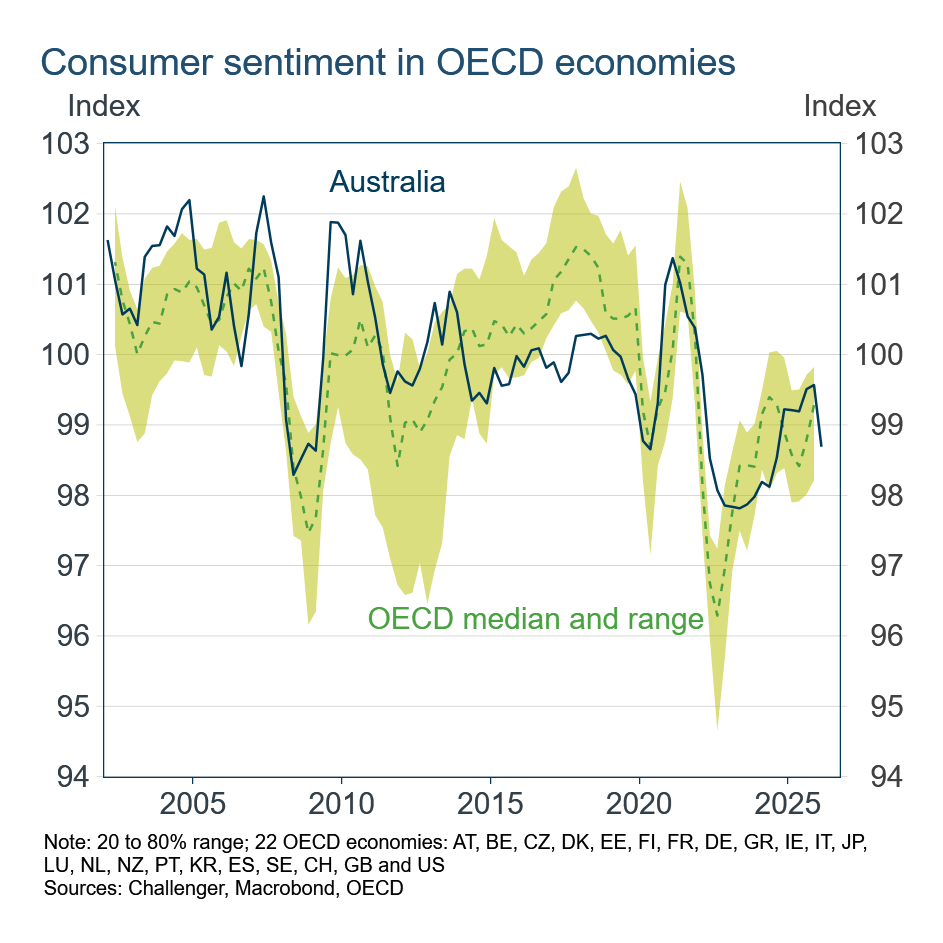
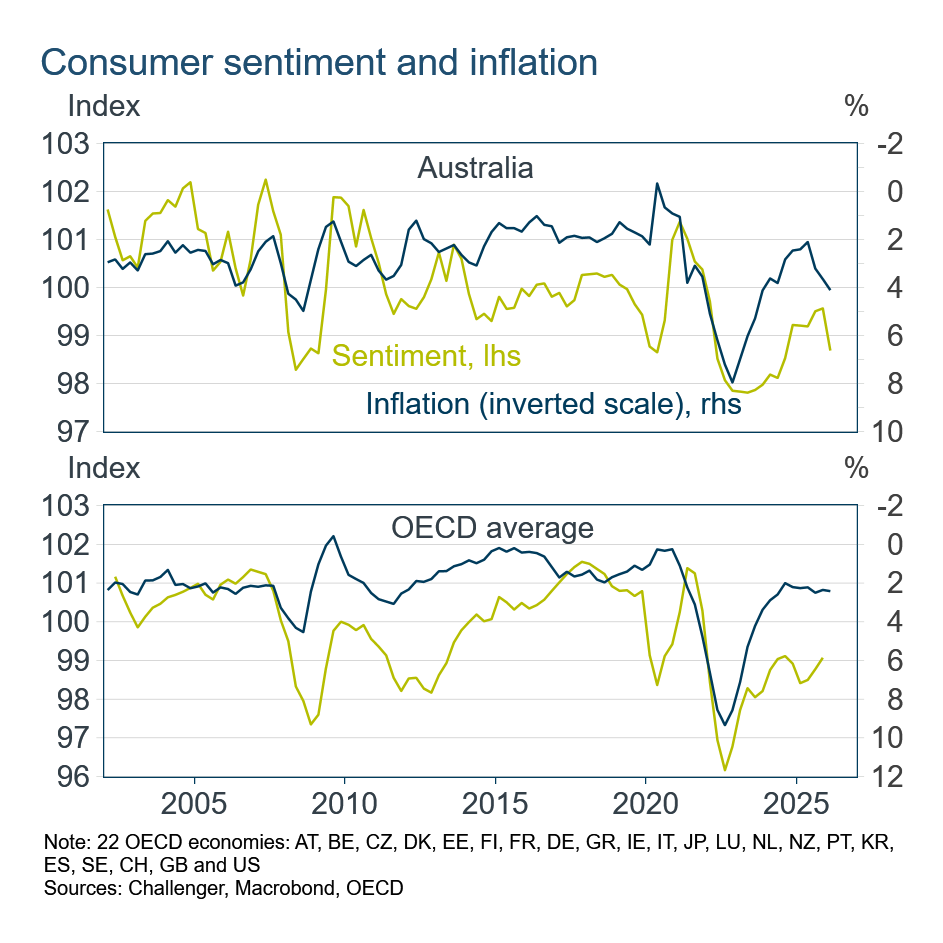
The fall in optimism about Australia’s economic performance in the world mirrors a decline in consumer sentiment over the same period. Australia is not alone on that front. Consumer sentiment in Australia has followed a similar path to other rich economies. Sentiment fell sharply and recovered with the Global Financial Crisis (GFC) in 2008, again plunged and bounced back around Covid, before plummeting with the surge in inflation in 2022. Notably, across countries the fall in sentiment with the 2022 inflation breakout was greater than either the GFC or the pandemic. This time has, however, been different, with no sharp bounce after the fall. Inflation, it seems, has a large impact on consumers’ sentiment.
In Australia, and other countries, there appears to be a negative relationship between inflation and consumer sentiment. Consumer sentiment fell in early 2008 as inflation increased, before the negative growth and unemployment effects of the GFC. Similarly, the sharp fall in sentiment from late 2021 to mid-2022 aligned with the surge in inflation. Of course, in both episodes there was a lot happening and simultaneous changes in sentiment and inflation does not mean that rising inflation caused the fall in sentiment.
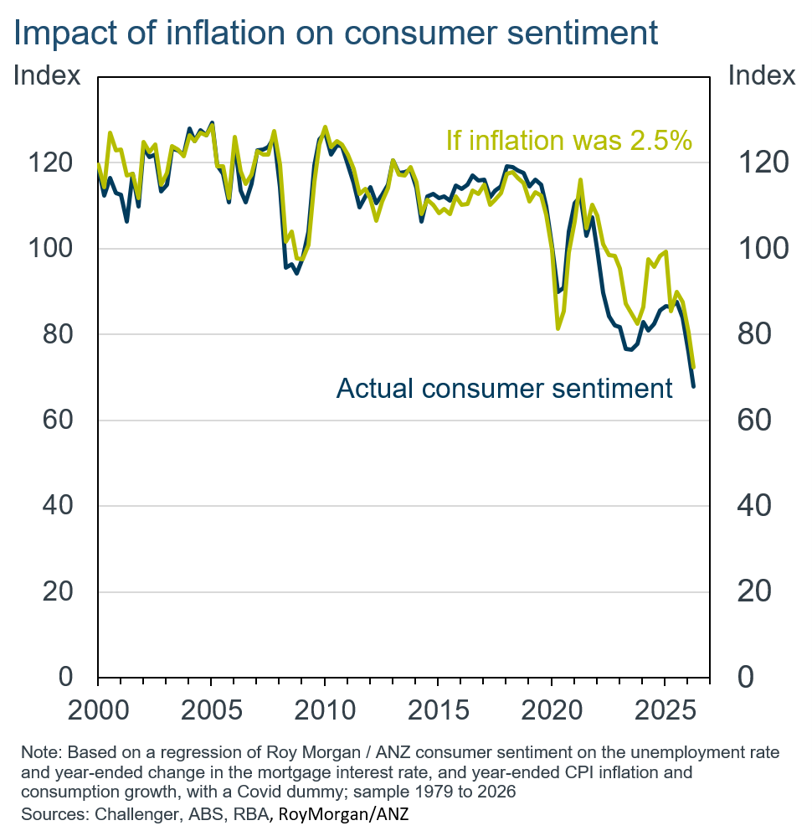
To test this relationship further, a model of consumer sentiment is estimated along the lines of recent work at think tank e61. The model attempts to explain consumer sentiment with the unemployment rate, along with year-ended inflation, consumption growth and change in the mortgage rate. The strongest, and only consistently statistically significant, variable explaining sentiment is inflation. High inflation does sink moods.
The figure below shows what consumer sentiment might have been if inflation had been at the RBA’s 2.5% target rather than its actual value. Notably, consumers would have been substantially more optimistic through 2022 to 2025. However, lagged inflation is not significant in this model and so, in this model at least, the recent inflation surge is unable to explain the fall in sentiment this year. Perhaps that is because this model doesn’t consider highly visible prices, such as petrol, or more explicitly account for the cumulative impact of inflation pushing price levels higher. Time will tell how quickly the RBA can bring inflation back to 2.5% and whether this leads to consumers having a bit more spring in their step.
The drivers of the decades long decline in economic optimism are complex and intertwined. A range of factors likely include structural trends and cyclical effects, such as rising income inequality, housing affordability, weak productivity and so growth of standards of living, as well as inflation. While the drivers may be economic, the consequences could end up being political.
Related content
Stay informed
Sign up to our free monthly adviser newsletter, Tech news containing the latest technical articles, economic updates, retirement insights, product news and events.