
.png?h=720&iar=0&w=1280)
Division 296 tax: what changes once super balances exceed $3 million

Division 296 tax: what changes once super balances exceed $3 million
Download the full article below.
From 1 July 2026, Division 296 becomes an advice issue for clients with high superannuation balances. For affected clients, the task is not just identifying whether they exceed a threshold, but understanding total superannuation balance (TSB), attributed earnings, the tax calculation, funding options and the strategy considerations that may follow.
This first article in a two-part series outlines how Division 296 works. In the second edition, we will consider how lifetime income streams, including annuities, may fit into the strategy mix.
What changes from 1 July 2026
Division 296 commenced on 1 July 2026, with the first assessments expected to be issued in the second half of the 2027-28 financial year.
The rules introduce a framework for calculating and attributing superannuation earnings to individuals whose TSB exceeds the $3 million or $10 million thresholds. The calculation can differ across SMSFs, small APRA funds, large APRA-regulated funds, defined benefit interests and certain non-account based income streams. The rules also change how TSB is measured for some non-account based income streams, including by moving away from transfer balance account values in some cases.
How does Division 296 tax work
Division 296 tax is an additional personal tax on the part of a client’s superannuation earnings that corresponds to their TSB above either $3 million or $10 million.
Division 296 tax rate structure
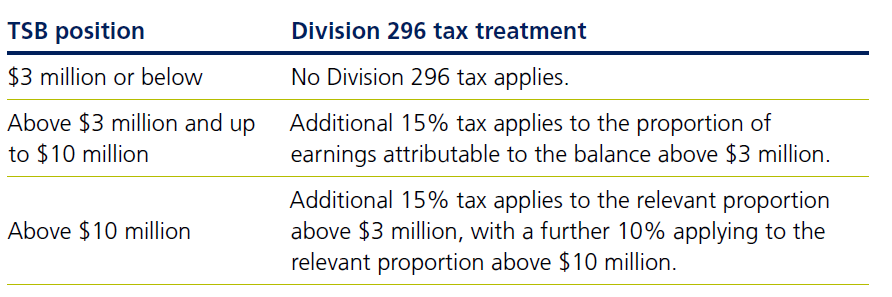
Division 296 tax is separate from the ordinary tax position of the superannuation fund and from the tax treatment of benefits paid to the client. Fund earnings may still be taxed, exempt or partly exempt depending on the fund’s ordinary tax position, including whether assets support retirement phase interests.
Unlike earlier policy settings, the final design provides for indexation of both thresholds in later income years. The $3 million threshold is indexed to CPI in $150,000 increments and the $10 million threshold is indexed in $500,000 increments.
For 2026–27, the threshold test is based on the client’s TSB on 30 June 2027. From 2027–28, the threshold test is based on the greater of the client’s TSB at the start and end of the income year. This makes the first year unique, as clients who can access benefits may still have time before 30 June 2027 to consider whether any restructuring is appropriate.
The liability is generally payable within 84 days of the ATO issuing the assessment. A client may pay personally or elect to release an amount from super. Where a release election is available, it generally needs to be made within 60 days of the assessment being issued.
Tax in respect of defined benefits which are not in payment phase is generally deferred until a benefit is payable from the fund for the first time.
There are unique rules relating to death and family law splits which are outside the scope of this article.
Example: Division 296 tax at different TSB levels
To highlight the quantum involved, the below table assumes taxable earnings of 5% on the client’s TSB. It illustrates the proportional nature of the calculation: the Division 296 tax is not imposed on the whole balance, but on the part of earnings attributable to the amount above the relevant threshold.
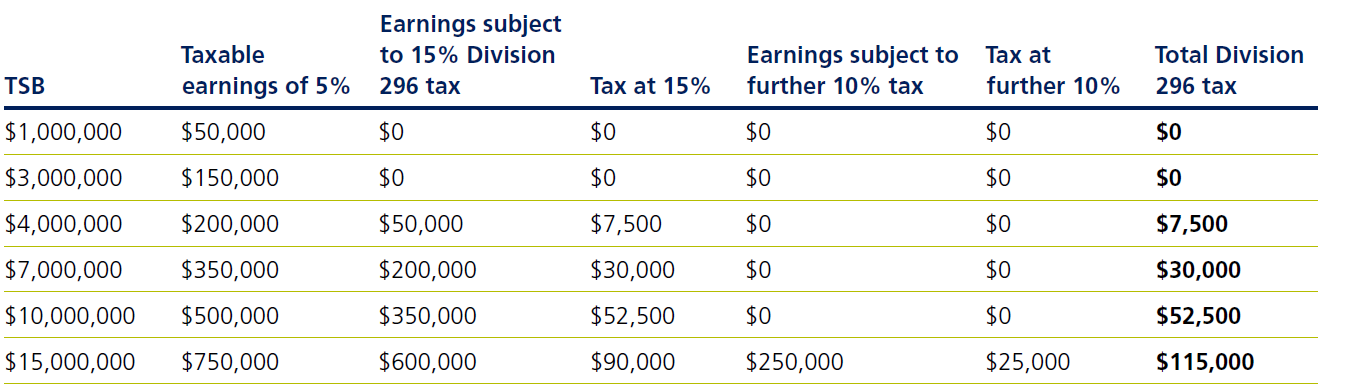
The example illustrates that Division 296 tax is driven by attributed taxable earnings, not simply the size of the client’s TSB. A high-balance client with lower attributed earnings may have a lower Division 296 liability than a client with a lower balance but higher attributed earnings.
Relevant considerations in deciding whether to keep excess super balances in super or cash out may include the client’s marginal and average tax rates outside super, taxable earnings within the fund, realised capital gains, liquidity to meet any tax liabilities and the ability to recontribute amounts withdrawn from super. Decision to cash out excess super balance and the ability to contribute to a spouse’s account, when relevant, may be restricted by age, TSB and contribution cap limits.
Fund reporting and attribution will drive the calculation
As the examples below show, taxable superannuation earnings may be calculated differently depending on the type of fund and the nature of the member’s interest. Account-based and non-account-based interests can follow different methodologies, while SMSFs, small APRA funds, master trusts and wrap platforms may apply different attribution processes. Advisers should therefore obtain fund-specific information on TSB values, attributed earnings and reporting methodology before estimating a client’s Division 296 liability or responding to an ATO assessment.
From fund earnings to member earnings
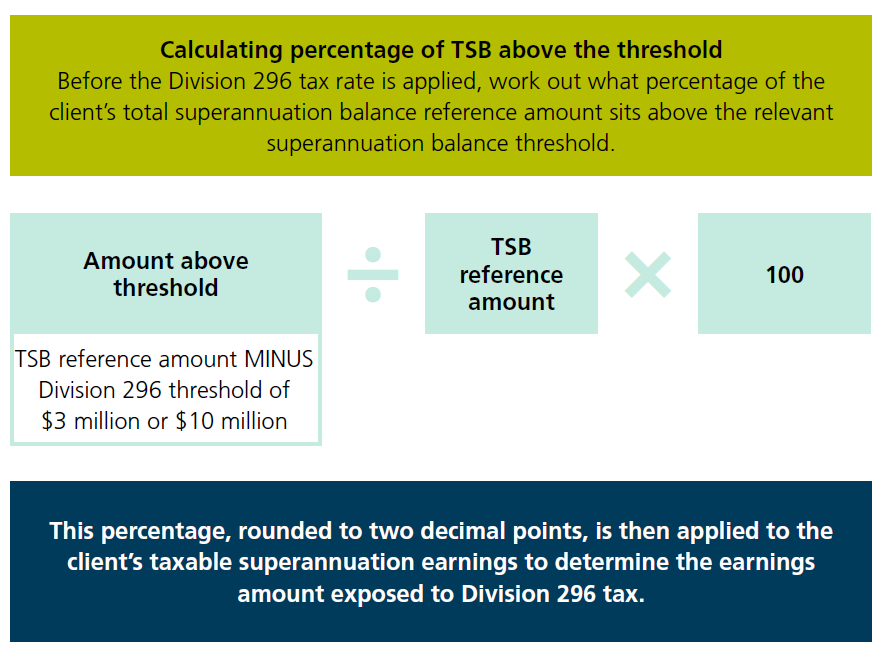
The example above shows the tax rate structure in simple terms, but the actual calculation depends on more than the closing balance. To work out the Division 296 amount, advisers need to identify the client’s TSB, relevant taxable superannuation earnings and the contribution and withdrawal adjustments that form part of the formula. The source of the earnings also matters: SMSFs and small APRA funds may use a more prescriptive attribution methodology, while master trusts, wrap accounts and other large funds may attribute earnings under fund-specific processes that can produce different reported outcomes.
General rule for non-defined benefit interests
For non-defined benefit interests, a superannuation entity generally works out Division 296 fund earnings and attributes that amount to each in-scope member on a fair and reasonable basis.

The following examples, adapted from the Explanatory Statement to the accompanying regulations, show how earnings may be attributed across different types of superannuation interests.
Example — pooled investment option in a large APRA fund
Indi has a TSB of $4 million at the end of the 2026-27 income year. She is a member of Pentland Super, which is a large APRA-regulated superannuation fund. As Indi’s TSB at the end of the 2026-27 income year is greater than the $3 million threshold, she is in-scope for Division 296 tax.
Indi’s superannuation was invested entirely for the full year in a high-growth accumulation investment option of Pentland Super, and she makes a total of $30,000 in contributions to the fund across the year. Pentland Super also offers other pooled investment options and direct investment options to members to invest in. Pentland Super’s Division 296 fund earnings are $10 million for the year (inclusive of any CGT transitional arrangements).
As Indi is in-scope for Division 296, the ATO sends a request for information to Pentland Super to collect additional information relating to Indi’s superannuation interest, including the relevant superannuation earnings for her interest in the fund.
To attribute a share of Pentland Super’s Division 296 fund earnings to Indi’s interest on a fair and reasonable basis, her super fund considers various factors, including her member balance, contributions made, time and period in which she was invested in the particular investment options, the relative performance of her investment options, and whether the assets and earnings of her investments are identifiable.
Pentland Super attributes 1.01%, or $101,000, of its Division 296 fund earnings to Indi’s superannuation interest. This is based on her balance, period and time held, and performance of the high-growth investment option relative to other investment options of Pentland Super. |
Example — direct investment option in a large APRA fund
Samantha has a TSB of $4 million at the end of the 2026-27 income year. She is a member of Success Super, which is a large APRA-regulated superannuation fund. As Samantha’s TSB at the end of the 2026-27 income year is greater than the $3 million threshold, she is in-scope for Division 296 tax.
Samantha’s superannuation was invested entirely for the full year in a direct (non-pooled) investment option. Success Super’s Division 296 fund earnings are $10 million for the year (inclusive of any CGT transitional arrangements).
To attribute a share of Success Super’s Division 296 fund earnings to Samantha’s interest on a fair and reasonable basis, her superannuation fund considers various factors including her member balance, contributions made, time and period in which she was invested in the particular investment options, the relative performance of her investment, and whether the assets and earnings of her investments are identifiable.
As Samantha is invested in a direct investment option, Success Super is able to identify particular investments attributable to her and therefore her earnings for Division 296 purposes. Her fund attributes $50,000 of its Division 296 fund earnings to her superannuation interest. |
Example — member attribution in an SMSF
For SMSFs with multiple members, an actuarial certificate may be required to verify the Division 296 fund earnings attributed to members.
Jack and Jill are members of an SMSF on 1 July 2028. The SMSF only holds non-excluded superannuation interests. The TSB value of Jack’s interest in the SMSF was $9.8 million just before the start of the income year, while the TSB value of Jill’s interest was $4.2 million.
Jack and Jill have not made any contributions or received any benefit payments over the year. The SMSF’s investment returns are allocated to them in proportion to their balances.
The SMSF’s Division 296 fund earnings for the 2028-29 income year are $800,000. Jack and Jill have held their interests in the SMSF for the full income year.
The SMSF obtains an actuary’s certificate that determines the relevant superannuation earnings for Jack and Jill’s interests using the prescribed methodology.
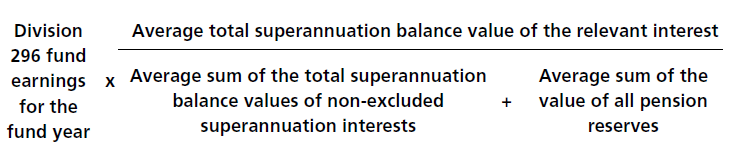
This results in $560,000, or 70%, of the SMSF’s Division 296 fund earnings attributed to Jack’s interest and $240,000, or 30%, attributed to Jill’s interest, reflecting the size of their interests and the proportion of the year they held those interests in the SMSF.
|
Alternative method for certain defined benefit and non-account-based interests
For certain non-account-based income streams, attributed earnings are worked out using an alternative method and a prescribed factor of 82.5%.
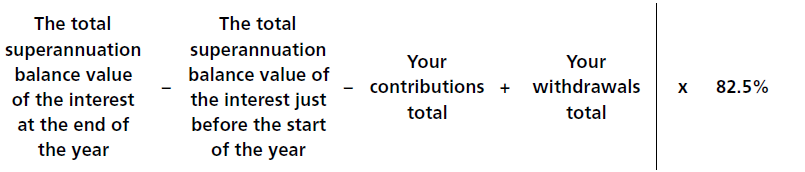
The TSB value of the interest depends on the type of income stream, including whether it has a family law value, scheme-specific value, innovative retirement income stream value or deferred superannuation income stream value. As noted above, advisers may need to obtain fund-specific information on both TSB value and attributed earnings.
Example — attributing earnings for an innovative retirement income stream
Richard (67) purchases a lifetime annuity on 1 July 2027 with $200,000. The lifetime annuity meets the requirements for an innovative retirement income stream and therefore its total super balance is based on the maximum commutation amount. The maximum commutation amount declines in line with the capital access schedule and on 30 June 2028 is calculated to be $189,293. The payments which are included as withdrawals are $12,514.56. The taxable super earnings in 2027–28 are $1,807.56, calculated as [$189,293 - $200,000 + $12,514.56] × 82.5%. |
Attributing earnings on a fair and reasonable basis
For large APRA-regulated funds, Division 296 fund earnings are attributed to in-scope members on a fair and reasonable basis. The regulations direct trustees to consider the characteristics and duration of the interest, associated investments and reserves, changes in value, investment-option switches, consistency between comparable products and fairness to beneficiaries. Funds are expected to draw on existing attribution practices, such as unit pricing or remediation methodologies, where those approaches are fair and reasonable having regard to the prescribed matters.
Funds are expected to develop and maintain a written attribution policy and make that policy available to members or the ATO on request. This should help members understand how relevant superannuation earnings have been attributed to them.
CGT transitional rules
Because taxable superannuation earnings can include capital gains, the rules include transitional adjustments for gains accrued before 1 July 2026. The method differs for SMSFs, small APRA funds and larger funds. The adjustment applies only for Division 296 purposes and does not alter the ordinary taxation of capital gains when an asset is disposed of.
SMSFs and small APRA funds
SMSFs and small APRA funds can choose to adjust the Division 296 cost base of CGT assets held on 30 June 2026 to market value. The choice applies to all CGT assets held by the fund at that time.
The election must be made in the approved form by the due date for the fund’s 2026–27 income tax return and cannot be revoked. Trustees need to retain records of the choice and the adjusted cost base and reduced cost base for each affected asset until five years after the last affected CGT event.
When a CGT event is triggered for an adjusted CGT asset, a modified net capital gain will be calculated when working out Division 296 fund earnings.
Large APRA-regulated funds
For larger funds, relevant net capital gains are multiplied by prescribed transitional factors when working out Division 296 fund earnings. The factors are intended to approximate the share of gains accruing from 1 July 2026.
The factors are 0.2 for 2026–27, 0.4 for 2027–28, 0.6 for 2028–29 and 0.8 for 2029–30.
TSB changes
The rules also change how TSB is calculated for certain non-account based income streams. This is relevant not only for Division 296, but also for contribution rules that depend on TSB thresholds, including non-concessional contribution eligibility.
In broad terms, for defined benefits in payment phase, the TSB value is generally the family law value, unless an alternative valuation method applies. If neither the family law value nor an alternative valuation method applies, then generally, TSB value is the amount payable as a lump sum.
Innovative retirement income streams such as Challenger’s Lifetime Annuity (Liquid Lifetime) have their own unique valuation method and are assessed based on the maximum commutation value under the capital access schedule, which is generally a linear reduction based on life expectancy so that the value is nil if the client outlives their life expectancy. Generally, the TSB for innovative retirement income streams is lower under the new TSB methodology compared to the previous methodology where the purchase price was assessed.
Deferred lifetime income streams not in payment phase are assessed on the lump sum value payable from the interest increased by each instalment compounded by the upper social security deeming rate less any withdrawals. Once in payment phase, the valuation reverts to the maximum commutation amount under the capital access schedule.
Given the interest-specific nature of the TSB rules, advisers may need to contact the relevant super fund to confirm the valuation basis for the client’s interest. These valuation rules can affect both whether a client is in scope for Division 296 and whether they remain eligible for contributions or other TSB-tested strategies.
Example — TSB value for an innovative retirement income stream
Richard, age 70, purchased a lifetime annuity that meets the capital access schedule requirements on 1 July 2019 for $250,000. Until 30 June 2026, its TSB value was generally based on its transfer balance account value, being the original purchase price of $250,000. On 30 June 2026, the TSB value under the maximum commutation method may be $154,044, which may affect contribution eligibility where TSB thresholds apply.
For non-account based income streams, the revised TSB methodology may change the value reported for contribution and Division 296 purposes. Advisers may need to review affected interests where indexation of payments, age-based valuation factors or the applicable valuation method could materially change the client’s TSB position. |
What advisers may need to review
For affected clients, Division 296 is unlikely to be considered in isolation. The tax calculation may prompt a broader review of how wealth is held, how earnings are generated, how any liability would be funded and how superannuation interacts with estate planning, ownership structures, contribution strategy, retirement income design and liquidity needs. This places Division 296 within the broader financial planning conversation, rather than treating the assessment as a standalone tax event.
The information in this article is current as at 1 September 2026 unless otherwise specified and is provided by Challenger Life Company Limited ABN 44 072 486 938, AFSL 234670 (Challenger, our, we), the issuer of the Challenger annuities (Annuity(ies)). The information in this article is general information and is intended solely for licensed financial advisers or authorised representatives of licensed financial advisers, and is provided to them on a confidential basis. It is not intended to constitute financial product advice. This information must not be distributed, delivered, disclosed or otherwise disseminated to any investor, without our express prior approval. Investors should consider the applicable Annuity Target Market Determination (TMD) and Product Disclosure Statement (PDS) available at challenger.com.au and the appropriateness of the applicable product to their circumstances before making an investment decision. This information has been prepared without taking into account any person’s objectives, financial situation or needs. Neither Challenger and/or CRISL, nor any of its officers or employees, are a registered tax agent or a registered tax (financial) adviser under the Tax Agent Services Act 2009 (Cth) and none of them is licensed or authorised to provide tax or social security advice. Before acting, we strongly recommend that prospective investors obtain financial product advice, as well as taxation and applicable social security advice, from qualified professional advisers who are able to take into account the investor’s individual circumstances. Each person should, therefore, consider its appropriateness having regard to these matters and the information in the TMD and PDS for the applicable Annuity before deciding whether to acquire or continue to hold the product. A copy of the TMD and PDS is available at challenger.com.au or by contacting our Adviser Services Team on 13 35 66. Any examples shown in this article are for illustrative purposes only and are not a prediction or guarantee of any particular outcome. Age Pension benefits described in this article will not apply to all individuals. Age Pension outcomes depend on an individual (or couple’s) personal circumstances and may change over time. This article may include statements of opinion, forward looking statements, forecasts or predictions based on current expectations about future events and results. Actual results may be materially different from those shown. This is because outcomes reflect the assumptions made and may be affected by known or unknown risks and uncertainties that are not able to be presently identified. Challenger and CRISL relied on publicly available information and sources believed to be reliable, however, the information has not been independently verified by Challenger and CRISL. While due care and attention has been exercised in the preparation of this information, Challenger and CRISL gives no representation or warranty (express or implied) as to its accuracy, completeness or reliability. The information presented in this article is not intended to be a complete statement or summary of the matters to which reference is made in this article. To the maximum extent permissible under law, neither Challenger, CRISL, nor its related entities, nor any of their directors, employees or agents, accept any liability for any loss or damage in connection with the use of or reliance on all or part of, or any omission inadequacy or inaccuracy in, the information in this article.
Related content
Stay informed
Sign up to our free monthly adviser newsletter, Tech news containing the latest technical articles, economic updates, retirement insights, product news and events.