
.png?h=720&iar=0&w=1280)
Five aged care practicalities

Five aged care practicalities
Download the full article below.
The Challenger Tech team has previously written on the technicalities and strategic considerations for residential aged care and the new Support at Home program. This month, we share some of the common practical issues raised by advisers and aged care specialists that the team has spoken to.
Advisers can access the technical articles on residential aged care and the Support at Home program that the team has previously written on from the team’s knowledge hub located here.
Unless otherwise stated, any rates and thresholds used in this article are as at 1 July 2026.
How can clients find out their remaining lifetime cap?
For planning and cash flow purposes, it can be important for advisers to understand how much of a client’s lifetime cap is remaining. For many clients, aged care costs are highest during the early years whilst they are still liable for means tested fees and contributions.
For residential aged care, means tested fees subject to the lifetime cap (non-clinical care contribution or NCCC) can be up to $107.32 per day ($39,172 p.a.) or 4 years of paying an NCCC, whichever occurs first. This is in addition to the basic daily care fee of $66.80 per day ($24,382 p.a.) and a hotelling supplement contribution (HSC) of up to $22.15 per day ($8,085 p.a.). Once aged care recipients reach their lifetime cap, they will no longer be liable for the NCCC for their remaining time in aged care.
For those accessing home care under the Support at Home Program, reaching their lifetime cap means they will no longer need to contribute towards any services they access. At that point, the government will effectively fully subsidise their home care services going forward.
Understanding the means tested fees a client is liable for and what their remaining cap is allows advisers to work out how long they will be subject to these fees. This helps with developing appropriate funding strategies during these periods.
For example, a fixed term annuity strategy with nil residual capital value can be implemented to have a term that matches the period the client is liable for means tested fees. For clients who are simply drawing down capital to fund costs, knowing when they will reach their lifetime cap will allow advisers to determine the amount of liquidity required to keep aside.
For clients accessing Support at Home or entering residential care for the first time today, their remaining lifetime cap is the full cap, currently $137,917, subject to indexation.
However, it is not uncommon for a client to be seeking advice after accessing home care or residential care for a few years. For these clients, information on their remaining lifetime cap can be obtained from Services Australia. Staff at Services Australia have access to their internal Aged Care Staff Portal which contains various information including accrued amounts of means tested fees and contributions paid by the client and the number of days they have paid a NCCC for the purposes of determining the 4-year period.
Practically, once a client has reached their lifetime cap (or have paid the NCCC for 4 years), Services Australia will write to the aged care or Support at Home provider to let them know to stop charging relevant means tested fees.
How can clients find their Home Care Package approval date if they no longer have a copy of their approval letter?
The aged care reforms introduced new accommodation fees and means tested fees for residential aged care from 1 November 2025. These changes resulted in comparatively higher costs for most people entering care from this date.
Those who entered care prior to this date were grandfathered under the previous accommodation and ongoing means tested fee arrangements.
However, those entering from 1 November 2025 may still be able to access the previous ongoing means tested fee arrangements (means tested care fee or MTCF) including the lower lifetime cap of $86,185 (compared to $137,917 under the new rules). To qualify for the previous MTCF arrangement, the person would need to have been approved or accessing a Home Care Package (does not include approvals for the Commonwealth Home Support Program) on or before 12 September 2024 and have not elected to be under the new Support at Home rules from 1 November 2025.
The rules do not require that they were utilising the home care package. Having an active approval is sufficient.
Clients who still have a copy of their approval letter can find the date of approval on that letter. However, for clients who no longer have a copy of this letter, they can obtain this information by contacting My Aged Care on 1800 200 422.
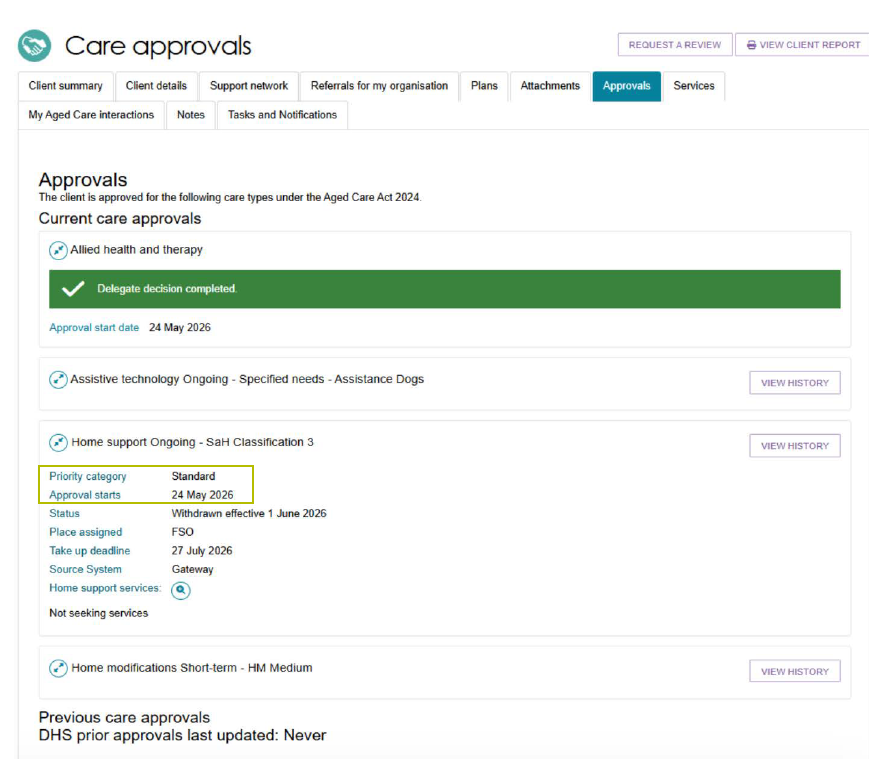
Staff members can access details of current and previously approved aged care programs within the My Aged Care Service and Support Portal. An example of the types of information that can be accessed through that portal, obtained from their user guide, is shown below.
My client has paid a RAC in full, why does Services Australia’s aged care fee letter still show a DAC amount?
Unlike RAD payers, a low means resident’s accommodation costs are calculated based on their assessable income and assets. Practically, advisers can quickly rule out a resident being ‘low means’ if they have assessable assets of $214,884 or more for singles or $429,768 or more for couples combined at the time they entered care. However, once a client enters care as a low means resident, they retain their ‘low means’ status for their entire tenure in that facility even if they later have assessable assets that exceed the limits above.
The higher a resident’s income and assets are, the higher their daily accommodation contribution (DAC), but subject to a cap equal to the facility’s applicable accommodation supplement1. What accommodation supplement a facility receives from the Government depends on whether the aged care facility meets certain building requirements and if the facility currently accommodates more than 40% of their residents as ‘low means’. The maximum a facility can receive currently is $72.30 per day.
A low means resident’s DAC will typically reach the maximum amount of $72.30 per day if the resident’s assessable assets subsequently increase to $214,884 ($429,768 for couples combined) or more.
Once a resident discloses their income and assets, Services Australia will calculate their maximum DAC and provide this information (fee letter) to the resident and the aged care facility. The facility will use this information to charge the resident.
Low means residents can then choose to convert the DAC into a lump sum (Refundable Accommodation Contribution or RAC) and pay a lump sum instead of daily amounts. They can also choose to pay a combination of daily amounts and lump sum.
The equivalent RAC is calculated as the DAC, expressed as an annual amount, divided by the maximum permissible interest rate (MPIR) applicable at the time they entered care.
For example, a DAC of $72.30 per day would have an equivalent RAC, based on today’s MPIR of 8.43%, of ($72.30 × 365) ÷ 8.43% = $313,043.
If the resident in this example pays $313,043 as a RAC, they will no longer be liable for a DAC of $72.30 per day.
However, when Services Australia issues updated fee letters, they do not consider:
- whether the aged care home meets the 40% supported resident ratio
- the agreed room price
if the resident has paid any amount of their contribution as a RAC.
It is the facility’s responsibility to take these factors into account when charging residents. This may mean the facility can only charge less than the maximum DAC advised by Services Australia particularly where a RAC has been paid.
This can confuse residents who have paid a RAC and are expecting Services Australia to calculate a DAC of nil.
Can RAD/RACs be paid to a third-party after the resident dies?
Paying a lump sum accommodation payment (refundable accommodation deposits or RADs and refundable accommodation contributions or RACs) can make a lot of sense for aged care residents. Typically, the main reason behind a resident or their family members paying a RAD/RAC is so they can avoid paying daily payments at a rate equal to their applicable MPIR (currently 8.43%). This is despite the introduction of a 2% retention ‘cost’ on RAD/RAC balances deducted by facilities for those who enter residential aged care from 1 November 2026.
Paying a RAD/RAC in full or in part can provide residents another option to manage cash flow – residents can choose to have any outstanding daily accommodation payments (DAPs) and contributions (DACs) deducted from a RAD/RAC. Additionally, subject to the facility’s discretion, residents can also request to have other fees (basic daily care fee, means tested fees, higher everyday living fees) deducted from the RAD/RAC to improve their cash flow positions further.
On the resident’s passing, facilities must refund any remaining RAD/RAC balance within 14 days of sighting probate, letters of administration, or other satisfactory evidence. Facilities must also pay interest at the base interest rate (equal to the upper deeming rate – currently 3.25%) from the date of death up to the end of the 14-day period. If the RAD/RAC balance has not been refunded after this period, an interest rate equal to the MPIR (currently 8.43%) applies until it is paid.
However, facilities typically refund any remaining RAD/RAC balance to the resident’s estate or their legal personal representative as stipulated in the resident’s accommodation agreement. If a third party/family member has paid the RAD and their expectation is to receive it back, it is very important to seek legal advice to ensure (using a formal loan agreement for example) the deceased estate can be bound to make a payment back to them before distributing the resident’s estate to other beneficiaries.
Who pays what under the Support at Home program?
Support at Home is a program to help older people remain at home as they age by delivering coordinated care and services to meet their assessed care needs. The program provides government funding across 8 classifications to fund ongoing services and 3 short-term pathways to fund assistive technology and home modifications, restorative care and end-of-life care. The amount of government funding for each classification and short-term pathway can be found on the My Aged Care website. We’ve replicated the latest funding amounts for the 8 ongoing classifications below.
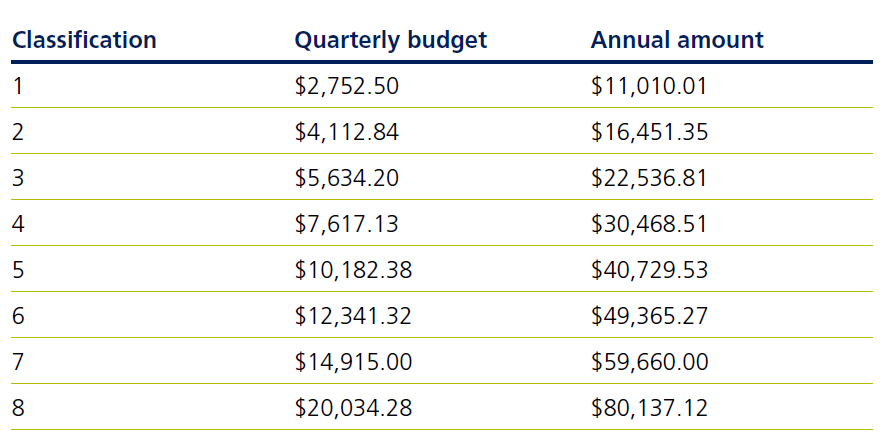
Current as of 1 July 2026. Funding amounts are indexed on 1 July each year.
Once funding is available and allocated, participants can find a suitable service provider and agree on the services to be delivered. 10% of an ongoing classification’s funding is set aside by Services Australia to cover the providers’ care management costs with the remaining amount of funding available for agreed services.
Participants would enter into a service agreement with the provider detailing the services to be delivered and the prices for those services.
Participants can be asked to contribute towards the package funding amounts above based on their means. Any contributions participants are liable for reduces the amount that comes from the government. For how participant contributions are calculated refer to our Aged Care Guide.
Once services are delivered (either directly by the provider or through a third-party worker or organisation), the service provider will submit a claim to Services Australia via the Aged Care Provider Portal to receive payment (government funding component). Providers will then invoice the participant for their contributions (if any). Providers will detail how payment of contributions can be made, including the frequency, in their service agreement with the participant.
Where a third-party is engaged, the provider would typically pay the invoices once they’ve made a claim to Services Australia and receives payment. If participants prefer to pay for the invoices directly and seek a reimbursement, they can make a request to the provider to establish this arrangement.
Finally, providers will issue a monthly statement to participants that shows, for the previous calendar month:
- the total government funding that was available to them
- any participant contributions
- the services provided and the price charged for each of those services
- the amount of any unused funding
- the closing balance of their budget at the end of the month.
1 For residents that enter care from 1 November 2025, this cannot be higher than the agreed room price expressed as a daily rate.
The information in this article is current as at 1 August 2026 unless otherwise specified and is provided by Challenger Life Company Limited ABN 44 072 486 938, AFSL 234670 (Challenger, our, we), the issuer of the Challenger annuities (Annuity(ies)). The information in this article is general information and is intended solely for licensed financial advisers or authorised representatives of licensed financial advisers, and is provided to them on a confidential basis. It is not intended to constitute financial product advice. This information must not be distributed, delivered, disclosed or otherwise disseminated to any investor, without our express prior approval. Investors should consider the applicable Annuity Target Market Determination (TMD) and Product Disclosure Statement (PDS) available at challenger.com.au and the appropriateness of the applicable product to their circumstances before making an investment decision. This information has been prepared without taking into account any person’s objectives, financial situation or needs. Neither Challenger and/or CRISL, nor any of its officers or employees, are a registered tax agent or a registered tax (financial) adviser under the Tax Agent Services Act 2009 (Cth) and none of them is licensed or authorised to provide tax or social security advice. Before acting, we strongly recommend that prospective investors obtain financial product advice, as well as taxation and applicable social security advice, from qualified professional advisers who are able to take into account the investor’s individual circumstances. Each person should, therefore, consider its appropriateness having regard to these matters and the information in the TMD and PDS for the applicable Annuity before deciding whether to acquire or continue to hold the product. A copy of the TMD and PDS is available at challenger.com.au or by contacting our Adviser Services Team on 13 35 66. Any examples shown in this article are for illustrative purposes only and are not a prediction or guarantee of any particular outcome. Age Pension benefits described in this article will not apply to all individuals. Age Pension outcomes depend on an individual (or couple’s) personal circumstances and may change over time. This article may include statements of opinion, forward looking statements, forecasts or predictions based on current expectations about future events and results. Actual results may be materially different from those shown. This is because outcomes reflect the assumptions made and may be affected by known or unknown risks and uncertainties that are not able to be presently identified. Challenger and CRISL relied on publicly available information and sources believed to be reliable, however, the information has not been independently verified by Challenger and CRISL. While due care and attention has been exercised in the preparation of this information, Challenger and CRISL gives no representation or warranty (express or implied) as to its accuracy, completeness or reliability. The information presented in this article is not intended to be a complete statement or summary of the matters to which reference is made in this article. To the maximum extent permissible under law, neither Challenger, CRISL, nor its related entities, nor any of their directors, employees or agents, accept any liability for any loss or damage in connection with the use of or reliance on all or part of, or any omission inadequacy or inaccuracy in, the information in this article.
Related content
Stay informed
Sign up to our free monthly adviser newsletter, Tech news containing the latest technical articles, economic updates, retirement insights, product news and events.