

Four retirement personas every adviser should know

Four Ways Australians Navigate Retirement
Read the full report belowAs featured in The Australian Financial Review, this research report set out to better understand the psychology behind retirement decisions and outcomes.
Understanding the mindsets shaping modern retirement
For decades, retirement planning has focused on helping clients accumulate enough wealth to fund their future. Yet new research suggests that achieving a successful retirement involves much more than reaching a target balance.
The Institute for Lifetime Income's latest research found that retirees approach retirement in very different ways, even when they have similar levels of wealth. Confidence, mindset and expectations about the future all play a significant role in shaping how people spend, save and enjoy retirement.
The research identified four distinct retirement personas: Carefree, Content, Cautious and Concerned. Together, these personas provide advisers with a valuable framework for understanding client behaviours and tailoring retirement advice accordingly.
The retirement personas are illustrated below.
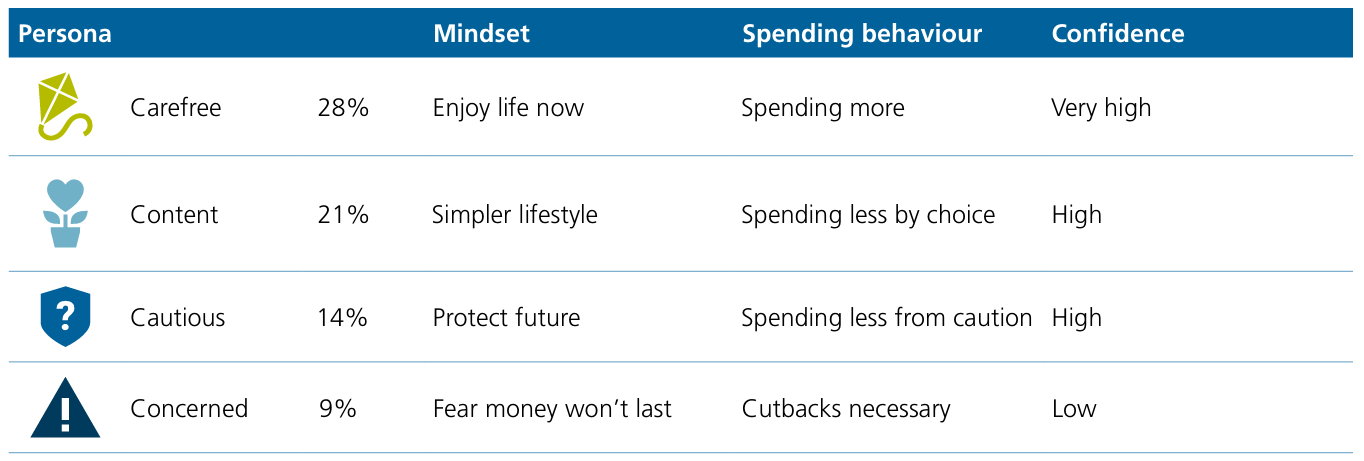
Understanding the retirement mindset spectrum
At one end of the spectrum are retirees with a positive outlook and strong confidence in their financial future. At the other are retirees who are more worried about uncertainty and the possibility of their money running out. Their mindset often influences spending behaviour as much as their financial position.
The Carefree retiree: focused on enjoying life
The Carefree retiree sees retirement as a reward for decades of hard work.
These retirees are focused on experiences and making the most of their newfound freedom. Travel, hobbies, family, dining out and ticking off bucket-list experiences are common priorities. They are generally comfortable spending money because they feel confident their finances can support their lifestyle.
The research found that Carefree retirees represent around 28% of retirees and report the highest levels of confidence, with more than nine in ten confident they can afford their desired retirement lifestyle. They are also more likely to have higher superannuation balances, although wealth is not the sole defining factor.
For advisers, these clients are often looking for reassurance that they can continue enjoying retirement while preserving long-term financial security.
The Content retiree: happy with a simpler lifestyle
Not every retiree wants to spend more.
Content retirees have consciously embraced a simpler way of life and are comfortable spending less than they did before retirement. Their lower spending is not driven by financial pressure. Rather, it reflects changing priorities and a belief that retirement happiness does not require constant consumption.
These retirees often value time, relationships and lifestyle over material purchases. Gardening, local travel, family time and everyday routines may replace more expensive pursuits.
Around 21% of retirees fit into the Content category. They remain highly confident about their retirement prospects and many expect their savings to last throughout retirement.
For advisers, these clients may require less encouragement to spend and more reassurance that their chosen lifestyle remains sustainable over the long term.
The Cautious retiree: financially secure but uncertain
The Cautious retiree highlights one of the most important findings from the research: confidence and wealth are not always the same thing.
These retirees often have the resources to support their lifestyle but remain worried about future uncertainty. Concerns about market volatility, rising living costs, health expenses or simply living longer than expected can cause them to hold back on spending.
As a result, they may reduce discretionary spending, continue budgeting tightly and feel reluctant to enjoy experiences they could otherwise afford.
The research found that about 14% of retirees fit this profile. Despite their caution, most still report confidence in their ability to maintain their lifestyle. Their challenge is less about financial capability and more about financial certainty.
This group may benefit significantly from advice that helps convert uncertainty into confidence and provides greater clarity around future income and spending.
The Concerned retiree: managing genuine financial pressure
The Concerned retiree faces a different reality.
Unlike the Cautious retiree, spending reductions are often driven by necessity rather than choice. Rising costs, limited resources and concerns about future affordability can result in meaningful lifestyle compromises.
Many Concerned retirees worry about running out of money, unexpected health expenses and aged care costs. They are more likely to report lower levels of confidence and greater financial stress than other groups.
The experiences of concerned retirees reinforce the importance of access to advice, education and retirement income solutions that can help improve financial resilience and confidence.
Why personas matter
One of the most compelling findings from the research is that retirement experiences cannot be explained by wealth alone.
Across every wealth band, retirees displayed different attitudes towards spending and saving. Some people with modest resources maintained a positive and confident outlook, while others with substantial savings remained highly cautious about spending.
This highlights why understanding a client's mindset is just as important as understanding their financial position.
Two clients with identical portfolios may require completely different advice conversations. One may need confidence to spend, while another may need strategies to improve financial security. One may be focused on enjoying retirement today, while another may be more concerned about preserving capital for future needs.
A new lens for retirement advice
The research suggests retirement planning should be about more than building wealth. It should also help clients develop the confidence to use their savings in ways that support the lifestyle they want to live.
By recognising whether a client is Carefree, Content, Cautious or Concerned, advisers can better understand what motivates retirement decisions and tailor advice to address not just financial circumstances, but the beliefs and behaviours that ultimately shape retirement outcomes.
Because while savings help fund retirement, confidence often determines how retirement is experienced.
Read the full research: https://www.challenger.com.au/about-us/Institute-for-Lifetime-Income/four-ways-australians-navigate-retirement
Speak to our Distribution team
Our Challenger distribution team are experienced in helping advisers develop strategies for their clients. Request a meeting with a Challenger BDM.
Source: Four Ways Australians Navigate Retirement, Institute for Lifetime Income, August 2026.