
Loading component...
Loading component...
Loading component...
The Challenger Investment Management (CIM) Fixed Income team is a leading alternative investment manager focussed on providing clients consistent income-based solutions across public and private credit markets.
However, these structures are not without drawbacks. Credit LITs in the Australian market have historically had periods of trading at significant and persistent discounts to their underlying asset value. In 2024 APRA announced2 that the listed bank hybrid market will be gradually phased out, meaning investors will eventually lose access to this source of income via the ASX.
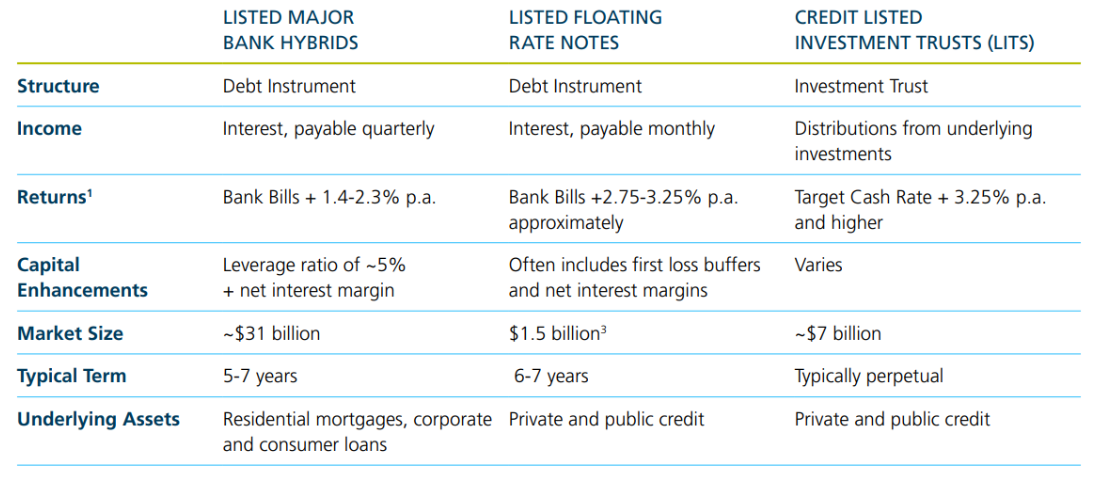
Listed floating rate notes have emerged as an alternative way for retail investors to access income-generating credit investments on the ASX. They retain many of the features of a LIT that investors value, such as regular income and daily liquidity, and may include a limited first loss protection feature which is intended to reduce investor’s downside exposure during times of volatility.
A floating rate note is an unsecured debt instrument where investors receive regular interest payments calculated relative to fluctuating short-term interest rates, rather than a fixed rate. It functions similarly to a listed hybrid issued by a bank, paying a regular floating interest payments at a pre-determined margin above a reference rate, such as the Bank Bill Swap Rate (BBSW). This means that when interest rates rise, income generally rises too; when rates fall, income adjusts downward.
Unlike shares or investment trusts, floating rate notes are debt investments rather than equity investments. Investors are lending money to a corporate issuer (who appoints a professional investment manager to invest the assets of the corporate) and are entitled to receive interest payments and the return of their capital at maturity.
The issuer uses the money raised from noteholders, often alongside its own equity capital, to invest in a diversified portfolio of income-producing assets such as public and private credit, property or infrastructure investments. The income generated by this underlying portfolio funds the interest payments from the issuer to noteholders.
Unlike most debt instruments which are traded over the counter and are only available to institutional investors, listed floating rate notes are ASX-listed and trade on the exchange. Once issued, a note’s market price will fluctuate according to buying and selling activity/demand and supply forces in the market. Accordingly, there may be times where the market price differs from the face value of the notes.
While structures vary by issuer, many listed floating rate notes share the following features:
Notes are issued with a defined maturity date, at which time investors should be repaid their face value. Some notes also include an optional early call date, allowing the issuer to repay investors earlier. In certain cases, the interest margin may increase if the note is not redeemed at the first call date, called a “step up” feature, which encourages repayment.
Note structures may include junior layers of debt or equity capital that sit below holders of listed notes. These junior layers are designed as a buffer to absorb losses first, helping to protect note investors and reduce the likelihood of capital loss to noteholders in periods of portfolio stress.
As a note approaches maturity, its market price typically moves closer to its face value, or “par”. This is because investors expect to be repaid the face value at maturity. This feature can help reduce price volatility over time compared with perpetual or equity‑style investments.
The income paid to investors is ultimately generated by the performance of the underlying investment portfolio. Portfolio composition, diversification, and risk profile can vary meaningfully between issuers and should be considered carefully by investors.
When compared with traditional bank hybrids and credit‑focused LITs, listed floating rate notes typically offer features of both:
Unlike LITs, they are debt instruments with a defined maturity date and carry the obligation to pay regular interest payments
While returns, risk and structure vary by issuer, listed floating rate notes are generally designed to provide regular income with more downside protection than equity‑style credit vehicles.
Investors are exposed to credit and default risk, as returns depend on the issuer’s ability to meet its obligations and the performance of the underlying credit portfolios, which may be affected by defaults or economic downturns. Market prices may fluctuate with changes in credit spreads and investor sentiment, meaning notes may trade above or below face value. While the notes are listed, liquidity can vary and investors seeking to exit quickly may need to accept a lower price. In addition, a decline in interest rates would reduce the level of income generated from the investment.
Challenger IM Capital Limited (a wholly owned subsidiary of Challenger Limited) issued unsecured notes quoted on the ASX known as the Challenger IM LiFTS 1 Notes (LiFTS) in September 2025. For further information and to subscribe to receive updates on the LiFTS, please visit Challenger IM LiFTS 1 Notes: Listed Floating Rate Term Securities (LiFTS) - Challenger Investment Management.