
Loading component...
Loading component...
Loading component...
Loading component...
Loading component...
Loading component...
Loading component...


To stay up to date on the latest economic insights, subscribe to Macro Musing on LinkedIn.
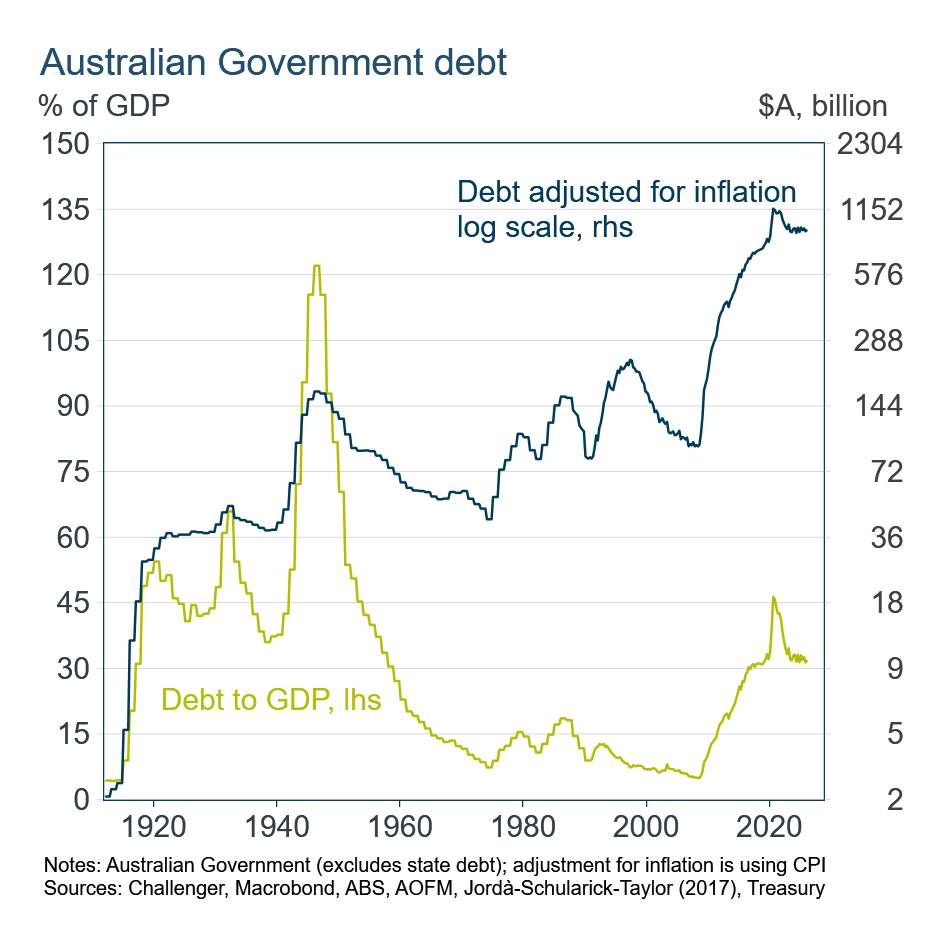
Australian Government debt hit the news as it ticked over $1 trillion for the first time. This raises questions about whether the risk of a downgrade is growing, whether debt-servicing costs will rise and whether the milestone is a symptom of profligate spending.
While this is the highest-ever nominal level of Australian Government debt, and only just below the Covid-19 peak in real terms, the economy is also larger than ever. The debt-to-GDP ratio is 33%, higher than at any time outside the Covid-19 episode in the past 75 years. Yet it pales beside the peaks of 55% to 120% associated with WWI, the Great Depression and WWII. However, the rise in debt from 2007 to 2019 is unprecedented outside war and depression.
Australia is one of only eleven, mostly small to medium-sized, countries with a AAA rating from at least two of the three major rating agencies. Australia and seven others have three AAA ratings: Denmark, Germany, the Netherlands, Norway, Sweden, Singapore, Switzerland and Luxembourg. Canada and New Zealand have two AAA ratings and one AA+ rating.
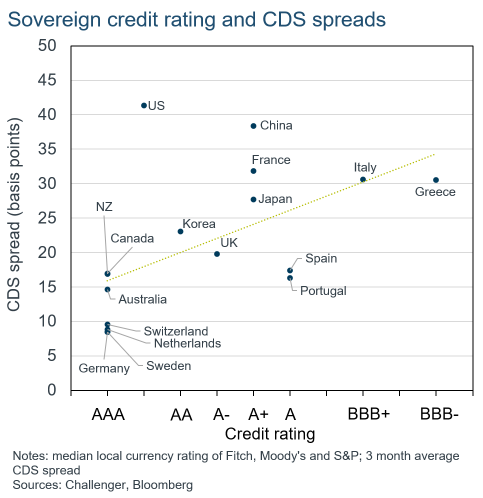
There is a loose relationship between a country’s credit rating and its local-currency credit default swap (CDS) spread, an indicator of borrowing costs. Several European countries have CDS spreads below what their ratings imply. This is not simply a euro effect, as the group includes non-euro Sweden and Switzerland. By contrast, three high-debt countries, the United States (AA+), China and France (both A+), have higher CDS spreads than their ratings alone would suggest. Japan, however, has the highest debt of any of these countries but a CDS spread consistent with its A+ rating. High debt might push CDS spreads higher, but it not the only contributing factor.
Overall, while the relationship is imprecise, it suggests that rising debt or a downgrade would likely increase Australia’s borrowing costs.
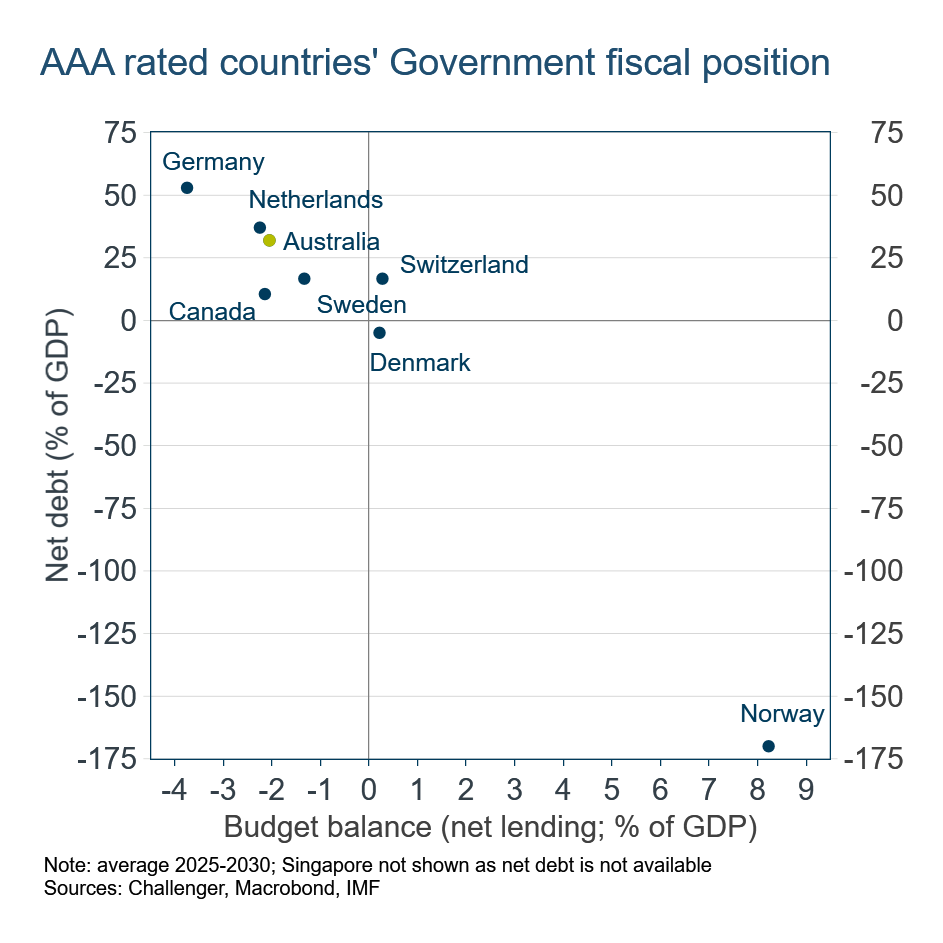
All AAA-rated countries have relatively moderate net debt, at around 50% of GDP or less. However, Australia and several others are running sizeable budget deficits of 1% to 4% of GDP. Australia is not an outlier, but it has the third-highest net debt and is close to having the equal second-largest budget deficit. This is not the best fiscal position, although the comparison is of course within the elite group of AAA-rated countries. Another issue, not addressed here, is the implicit guarantee of state debt and how that affects ratings agencies’ views on Australia’s fiscal strength.
Norway is quite literally off the chart. Its negative net debt of 175% reflects its vast savings from oil revenue, while income from those funds contributes to an enviable 8% budget surplus.
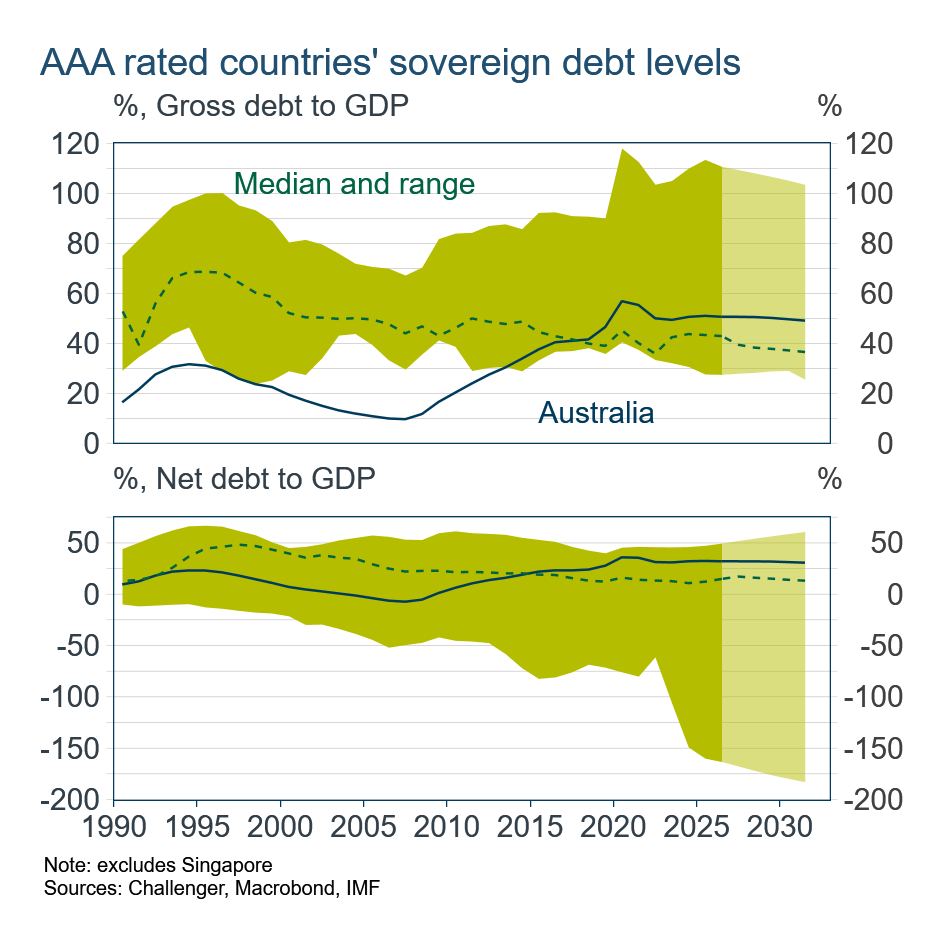
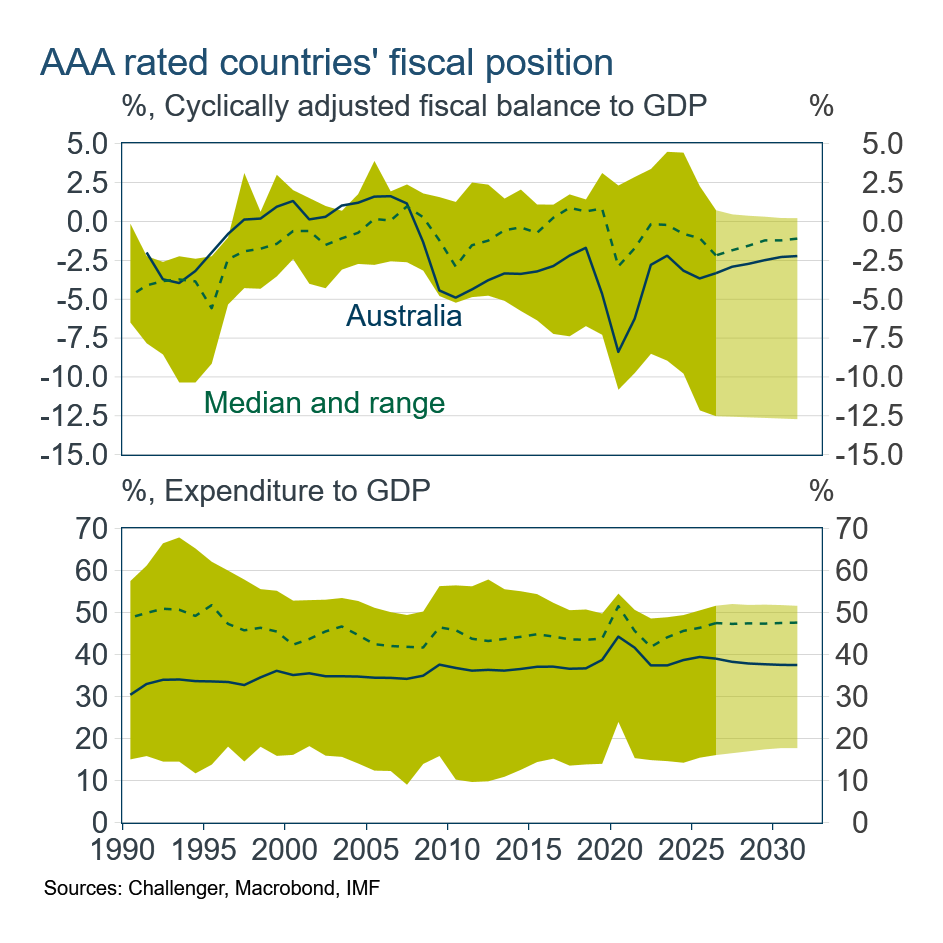
Until the Global Financial Crisis (GFC), Australia had relatively low gross and net debt-to-GDP ratios compared with today’s AAA-rated countries. In the decade after the GFC, however, Australia’s debt ratios drifted higher as persistent fiscal deficits resulted from the substantial stimulus being unwound only gradually. The IMF projects that Australia’s debt ratios will remain above the AAA-country median for the foreseeable future. Australia’s post-GFC experience highlights the risk to fiscal sustainability when large stimulus programs are not unwound quickly.
Australian government expenditure is just under 40% of GDP, below the sample median. Even so, reflecting lower revenue, the fiscal deficit is larger than the sample median. The fiscal balance relative to the median highlights the substantial deterioration during the GFC and the fact that, unlike in peer countries, it has not been reversed almost two decades later.
The fact that Australia is in the elite group of AAA-rated countries shows that its fiscal position is not bad. It is better than that of most countries. And if higher debt financed productive investment, a small increase in borrowing costs would not necessarily be a problem. Even with higher debt costs, sufficiently strong investment returns would lift Australia’s standard of living.
However, the greatest benefit of a AAA rating is not simply a low cost of borrowing. It signals low debt and, therefore, the capacity for substantial fiscal stimulus if Australia is hit by a financial crisis, pandemic or other major shock. That that fiscal capacity is not something we should give up lightly. Maintaining low debt requires fiscal discipline once a crisis has passed. Australia’s post-GFC experience suggests this is a lesson we have not fully appreciated.