

For adviser use only
Quantifying the technical benefits of Challenger CarePlus
Mansi Desai
31 May 2024
Moving into an aged care facility can often be unexpected or unplanned. However, a well-structured aged care advice plan can not only help with managing aged care costs to ensure sustainable cash flow but also provide financial peace of mind for loved ones left behind. Challenger CarePlus was introduced as a solution-based offering that provides clients with regular payments for life and provides 100% of the investment amount to nominated beneficiary(s) or their estate in the event of death1.
CarePlus is comprised of an annuity and an insurance component and can be offered to clients receiving/planning to receive Government-subsidised aged care services. Together, these two products also offer a range of technical benefits which can, in certain cases, deliver clients, reduced aged care costs, reduced tax payable and estate planning certainty. This article quantifies the technical benefits of CarePlus with the help of a case study.
Interaction with social security and aged care rules Centrelink assesses the two components of Challenger CarePlus – CarePlus Annuity and CarePlus Insurance separately and the total assessment is the sum of the assets and income assessments for both the CarePlus Annuity and CarePlus Insurance. This also applies to the means test assessments used to calculate aged care fees. For social security and aged care means testing, CarePlus investments made from 1 July 2019 are assessed as outlined in Table 1:
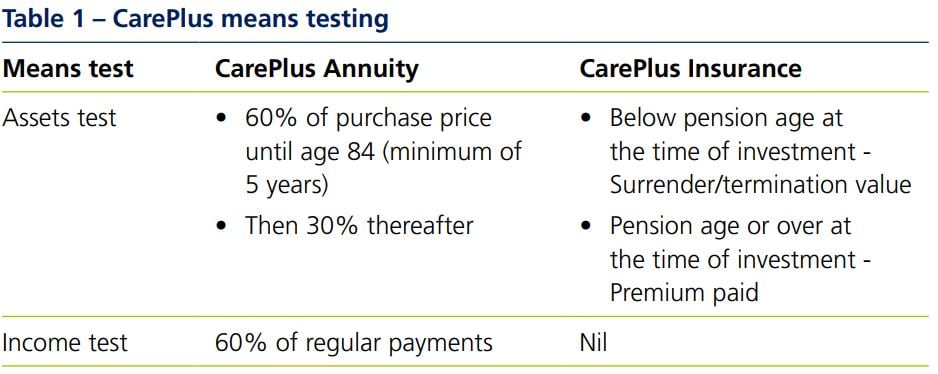
The concessional assessment of CarePlus annuity under the assets test can help increase Age Pension entitlements for asset tested clients. Asset tested clients on part pension may see an increase in their Age Pension rate and the ones who didn’t receive any Age Pension due to being slightly above the cut-off threshold may start to receive the Age Pension and access benefits under the associated Pensioner Concession Card.
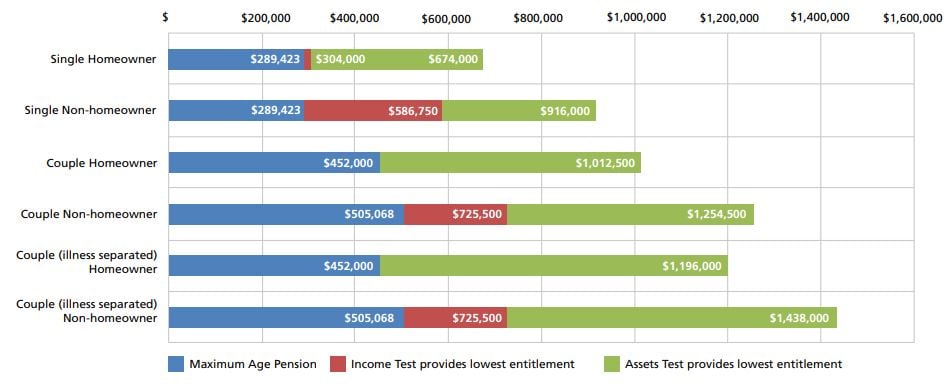
For every $1,000 worth of assets not being assessed, an asset tested client can increase their Age Pension by $78 p.a. For income tested clients, the assessable income from CarePlus (equal to 60% of regular payments) will (with current CarePlus and deeming rates) generally exceed deemed income on financial investments. The chart below explains the interaction between the income and assets tests and provides a snapshot of the dominant means test determining the rate of Age Pension payable. It takes into assumption that all assets held are financial assets and deemed under the Income Test. Rates and thresholds as at 20 March 2024.
Aged care residents can be asked to pay a means tested care fee (MTCF) which is calculated based on their assessable income and assets. This is an ongoing fee and is a contribution towards the cost of their care in the aged care home. The higher their assessable income and assets, the higher their MTCF (subject to annual and lifetime caps).
An investment into CarePlus may help reduce a resident’s assessable income and assets which can reduce their MTCF. The asset-tested amount is calculated as a percentage of assessable assets at increasing thresholds. The asset thresholds as at 20 March 2024 are:
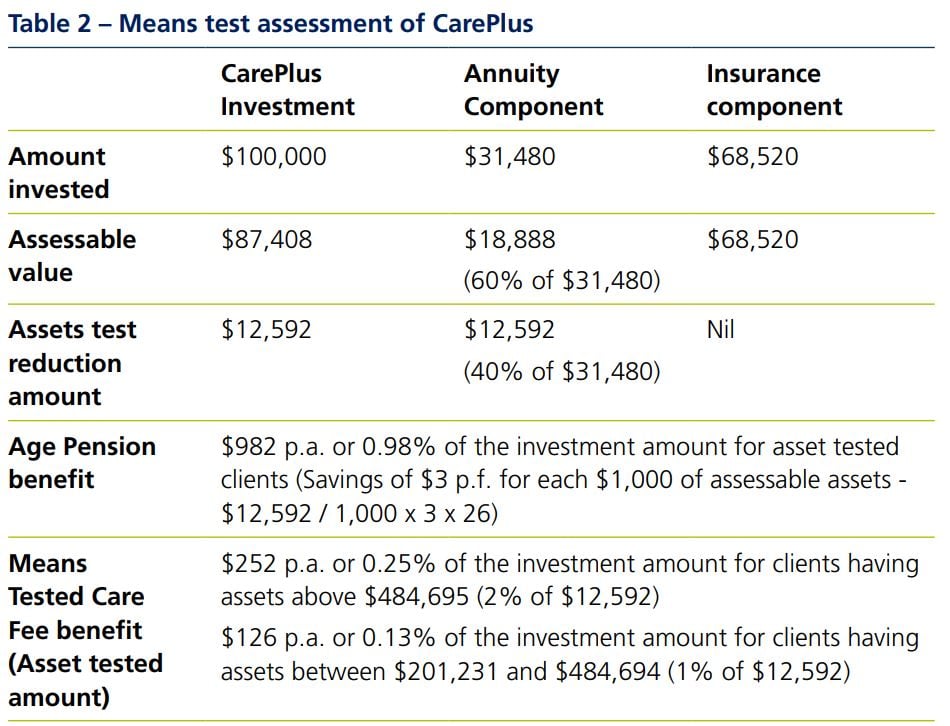
Table 2 outlines the Age Pension benefit for an asset tested client and the MTCF benefit for $100,000 invested in CarePlus as compared to investing $100,000 in a product with no assets test reduction. Note, this benefit changes from year to year and will be different for clients with different age, gender, assets and income.
Assumptions – CarePlus pricing at 22/05/2024 for a female, age 85. CarePlus investment amount of $100,000 (split of $68,520 in CarePlus Insurance and $31,480 in CarePlus Annuity). Rates and thresholds as at 20 March 2024.
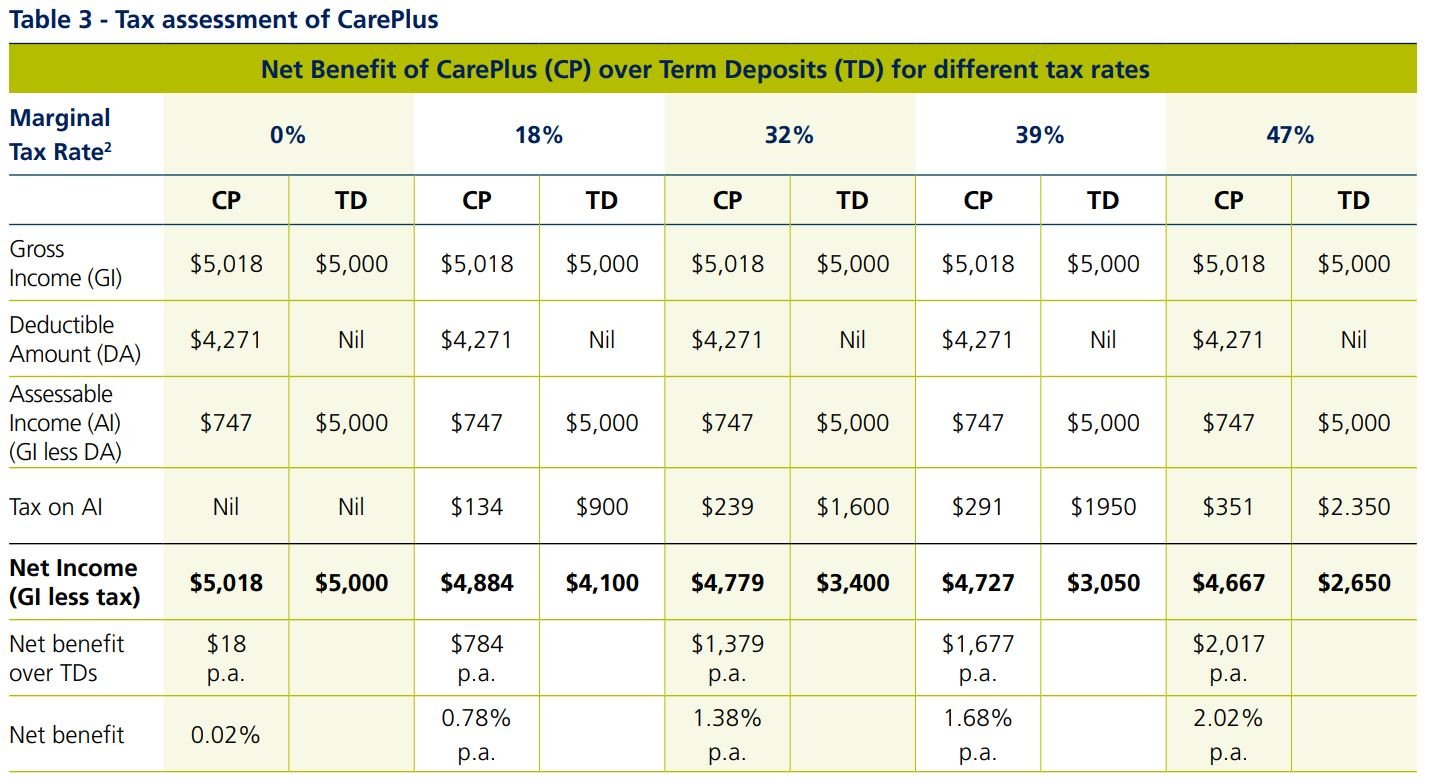
CarePlus can be a tax effective investment option for aged care clients. Unlike other types of investment income, only part of the regular payments from CarePlus is subject to tax. This is because of the availability of a deductible amount that reduces assessable income for tax purposes.
The value of tax benefits can differ based on the client’s marginal tax rates. Table 3 outlines the income tax benefit for $100,000 in CarePlus as compared to investing $100,000 in term deposits. Note, this benefit changes from year to year and will be different for clients with different age, gender, assets and income.
Assumptions - CarePlus pricing at 22/05/2024 for a female, age 85. CarePlus investment amount of $100,000 (split of $68,520 in CarePlus Insurance and $31,480 in CarePlus Annuity) with an annualised payment of $5,018. Term deposits returning 5% p.a.
Clients can nominate a single or multiple beneficiaries or the estate to receive the lump sum death benefit. If no beneficiary is nominated, the death benefit will be paid to the estate. Challenger allows a Power of Attorney (POA) to nominate beneficiaries on CarePlus Insurance where the POA document contains specific authority to this effect. Challenger can also allow a POA3 to nominate themselves as beneficiary with an appropriate POA legal authority.
When paying CarePlus death benefits, Challenger currently does not require probate if there is a valid beneficiary nomination or if the death benefit is payable to the estate and is less than $500,000. This can reduce the time it takes for beneficiaries to receive bequests and help reduce the cost of applying for probate in states where probate filing fees are dependent on the size of the estate. Where there is a valid beneficiary nomination, Challenger will pay the death benefit directly to that beneficiary i.e. the death benefit is a non-estate asset and will not form part of the estate4.
On death, the total death benefit (CarePlus Annuity death benefit if any plus CarePlus Insurance sum insured) paid to the estate and/or nominated beneficiary(ies) is not subject to tax. This can help with providing estate planning certainty to clients and their beneficiaries.
Lynda, age 85 received an approval from the Aged Care Assessment Team and plans to move into a residential aged care facility with an advertised Refundable Accommodation Deposit (RAD) of $700,000. She lives alone in her own home in NSW worth $1.5 million and does not have any other assets and income other than receiving a full Age Pension.
To enable her to afford the aged care fees, she decides to sell her home and pay $700,000 as RAD. Left with $800,000 to invest and a reduction in her Age Pension due to being asset tested, Lynda approaches her adviser to understand her options. Her aim is to ensure a smooth cashflow for managing her aged care costs without rapidly depleting her capital and a sound estate plan for her grandchildren after she passes away.
Her adviser provided a comparison of investing $500,000 in CarePlus versus Term Deposits. After the analysis provided in Table 3 and 4, he recommended investing $500,000 in CarePlus, currently paying a rate of 5.02% p.a. and investing the remaining $300,000 in term deposits providing an income return of 5% p.a.
Assumptions - CarePlus pricing at 22/05/2024 for a female, age 85. CarePlus investment amount of $500,000 (split of $342,600 in CarePlus Insurance and $157,400 in CarePlus Annuity) with an annualised payment of $25,088. Term deposits returning 5% p.a. Rates and thresholds as at 20 March 2024.
With Lynda being asset tested for Age Pension assessment, there is an instant reduction of 40% (40% of $157,400 = $62,960) when assessing the annuity component of CarePlus.
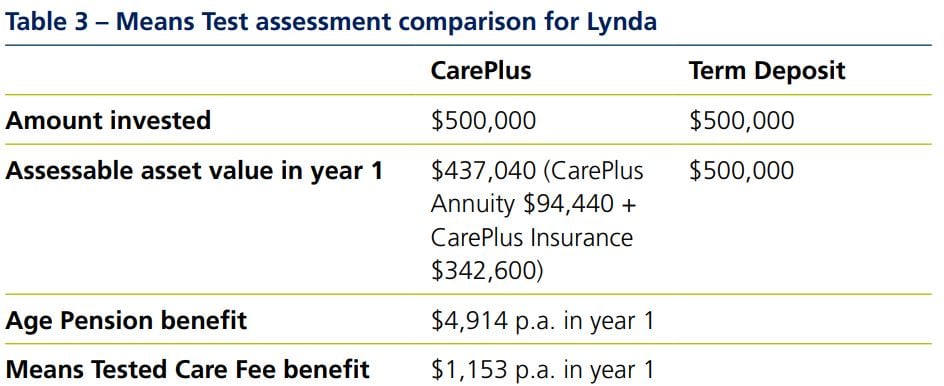
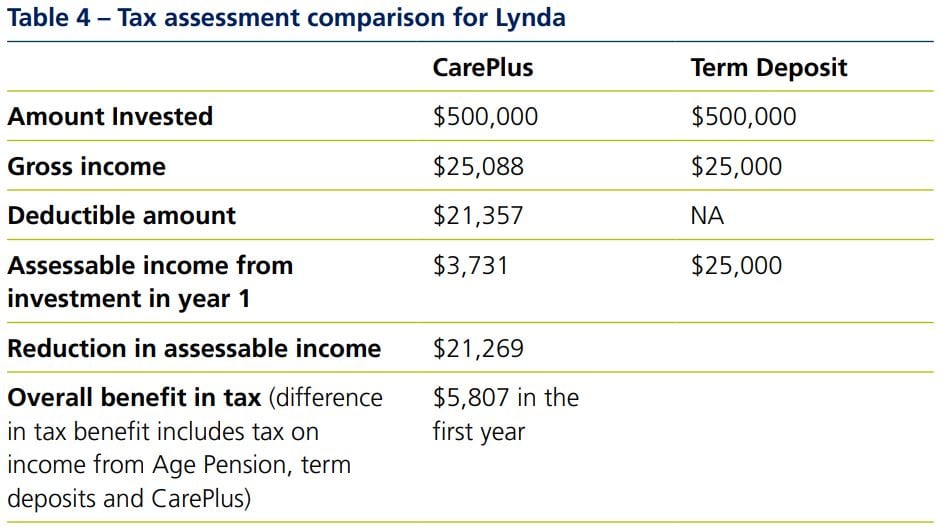
After taking into consideration the overall technical benefits from an investment of $500,000 in CarePlus, Lynda will receive an additional 2.37% of the investment amount in the first year (an additional $11, 874). This benefit comes from:
Additionally, Lynda will also be satisfied knowing that her grandchildren will receive 100% of the amount invested in CarePlus after she passes away.