

Retiring before Age Pension age: helping clients bridge the income gap

Retiring before Age Pension age
Download the full article below.
Early retirement can create one of the more challenging advice conversations: how to help clients generate enough income before Age Pension age, while still preserving capital for the later years of retirement.
For some clients, retiring before age 67 is not a lifestyle choice. It may be driven by redundancy, health issues, caring responsibilities or the physical demands of work. In these situations, advisers often need to solve for two horizons at once: the immediate cashflow gap before Age Pension age and the longer-term need for sustainable retirement income.
Where eligible, pre-Age Pension social security payments such as Disability Support Pension, Carer Payment or JobSeeker Payment may help reduce the pressure on personal savings. But eligibility, means testing and the treatment of different retirement income structures can materially change the advice outcome.
For advisers, the opportunity is to help clients balance near-term income needs with flexibility, social security outcomes and the sustainability of retirement capital. This article explores those issues through a case study of clients considering retirement before Age Pension age.
Unless stated otherwise, the rates and thresholds used in this article apply as at 20 March 2026.
Case study
Vaibhav Surya is 60 and has spent most of his working life in construction and tradebased roles. The physical demands of his work are becoming increasingly difficult, and he is considering whether he can afford to retire before reaching Age Pension age. At this stage, he is unsure whether he would qualify for Disability Support Pension or JobSeeker Payment if he stops working.
His wife, Smriti Surya, is also 60. She does not have the same physical concerns, but she is mentally exhausted from working in a difficult workplace and is considering finishing work at the same time as her husband. At this stage, she does not think she will be eligible for Carer Payment or Carer Allowance and is unsure whether she will be eligible for JobSeeker Payment.
Together, they need to understand how their superannuation, savings and any potential social security payments could support them through retirement, and more specifically during the next seven years while they are under Age Pension age.
The Suryas have the following assets:
- Mortgage-free family home worth $1.5 million, which they are happy to live in for the foreseeable future
- Vaibhav’s superannuation of $450,000 and Smriti’s superannuation of $300,000
- Cash of $50,000
- Personal effects and motor vehicle of $25,000
The Suryas want to enjoy retirement as much as possible and do not have specific plans to leave a bequest to their children. They estimate their essential living expenses at around $52,000 per year, but their preferred retirement lifestyle would require closer to $80,000 per year for as long as their capital allows.
Their desired and essential spending creates four key advice questions:
- Are their spending aspirations sustainable?
- Could they be eligible for any social security payments during the next seven years while they are under Age Pension age?
- What types of income streams should they consider to provide the income they need?
What happens when they reach Age Pension age in seven years’ time?
Are their spending aspirations sustainable?
Using Challenger’s Retirement Illustrator, we can see that, without any social security payments for the first seven years of retirement, and using account-based pensions with fixed return modelling, their retirement capital is projected to be exhausted in 17 years, when they are around age 77. To further highlight the precariousness of their position, sequencing risk also presents a real concern. If poor investment returns occur early in retirement while they are drawing higher levels of income, their savings may not last as long as projected.
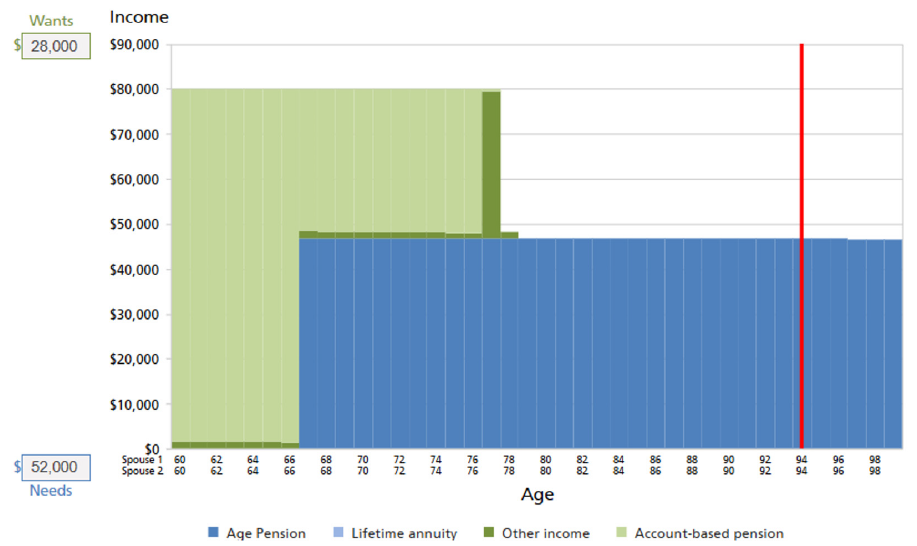
* Reproduced from Challenger Retirement Illustrator on 01.07.2026 # RIC260701000023 Superannuation asset allocation of 50% growth and 50% defensive. Centrelink rates and thresholds are as at 1 July 2026. Assumed returns of 4% p.a. for defensive assets and 7.5% p.a. for growth assets before fees. $50,000 cash and term deposits earning 3.5% p.a. interest. Personal assets of $25,000. $80,000 p.a. desired income. Amounts shown are in today’s dollars and CPI assumed to be 2.5% p.a. See Challenger Retirement Illustrator for all assumptions.
Social security payments before turning 67
The Suryas understand there is a real possibility they may outlive their capital. They therefore want to know whether they may be eligible for any social security payments before qualifying for the Age Pension in seven years’ time. If available, these payments may reduce the drawdown pressure on their retirement savings and help their capital last longer.
The common social security payments in their situation are:
- Disability Support Pension
- Carer Payment and Carer Allowance
- JobSeeker Payment
While Vaibhav has health concerns, he thinks it is unlikely that he will qualify for Disability Support Pension, given its stringent medical assessment and noting an almost 40% rejection rate.
Similarly, Smriti thinks that while Vaibhav needs some care, she is unlikely to be providing ‘constant care’ and is therefore unlikely to qualify for Carer Payment.
Instead, they want to consider JobSeeker Payment. Their financial adviser explains that, from age 60, they may be able to fully meet their mutual obligation requirements by undertaking approved voluntary work of 30 hours per fortnight, which they are comfortable doing.
JobSeeker Payment could provide close to $38,500 p.a. towards their desired $80,000 p.a. spending, subject to eligibility and means testing. This would place significantly less pressure on their own retirement savings.
JobSeeker Payment means testing
JobSeeker Payment has both an assets test and an income test. Failing either test results in ineligibility for JobSeeker Payment.
Under the assets test, partnered homeowners must have assessable assets below $481,500. If their assessable assets exceed the threshold, they are ineligible for JobSeeker Payment. Under the income test, each member of a couple can generally have income of $150 per fortnight before their payment starts to reduce under the personal income test.
Social security concessional status for super in accumulation for those under Age Pension age
Superannuation in accumulation phase held by a client who has not yet reached Age Pension age is generally not assessed under the assets test or income test. Lump sum withdrawals from superannuation are also generally not treated as income.
By contrast, account-based pension balances, including Transition to Retirement Income Streams, are assessed under the assets test. Under the income test, where the account-based pension commenced on or after 1 January 2015, the account balance is subject to deeming.
Given the JobSeeker Payment assets test limit of $481,500 for homeowner couples, care is needed before commencing income streams from accumulation balances. Advisers need to ensure that assessable assets remain within the allowable threshold.
One drawback is that earnings on accumulation-phase balances are taxed within the superannuation fund environment at up to 15%.
Social security concessional status for lifetime annuities meeting the capital access schedule
The social security treatment of a lifetime annuity commenced from 1 July 2019 is generally the same regardless of whether the client is under or over Age Pension age. The same treatment can also apply to pre-Age Pension social security payments, including JobSeeker Payment, provided the annuity satisfies the relevant lifetime income stream rules.
Under the assets test, Challenger’s Lifetime Annuity (Liquid Lifetime) is assessed at 60% of the purchase price until the later of age 85 or five years from commencement, and at 30% thereafter. Under the income test, 60% of the regular payments are assessed.
Income drawdown structures
The Suryas have a number of options for receiving income from their superannuation, including:
- Making lump sum withdrawals from superannuation
- Commencing account-based pensions
- Commencing lifetime annuities
- Using fixed term annuities to provide required income, with the term and residual capital value customised to their desired spending
The Suryas were considering holding three years of desired spending, or $240,000, in cash and investing the rest of their funds in line with their risk profile and asset allocation, similar to a bucket strategy.
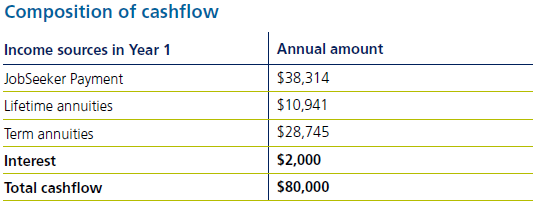
Alternatively, the Suryas’ adviser considered substituting part of the cash bucket with lifetime annuities. The adviser modelled allocating 30% of their combined superannuation balances ($225,000) to Challenger Lifetime Annuities, indexed to CPI and reversionary to each other. This would provide guaranteed regular income starting at $10,941 p.a., indexed to CPI, for the rest of their lives. Importantly, if their other investments were depleted later in retirement, the combination of Age Pension and annuity income could provide guaranteed income of around $58,000 p.a. for life. This would cover their estimated essential spending need of $52,000 p.a., with an additional buffer of around $6,000 p.a.
Impact on JobSeeker Payment upon commencing lifetime and term annuities
Earlier, we noted that homeowner couples need assessable assets below $481,500 to qualify for JobSeeker Payment. If the Suryas commence lifetime annuities with a combined purchase price of $225,000, the assessable asset value would be $135,000 ($225,000 x 60%). To supplement their income, Smriti also commences a 1-year, nil RCV, monthly payments, fixed term annuity with $27,984 which provides the Suryas’ with $28,745 throughout the year. The rationale around commencing a 1-year fixed term annuity rather than a longer term is to ensure that social security assessable income from the annuity is kept to a minimum and is reviewed each year.
Together with $25,000 in personal effects and motor vehicles and $50,000 remaining in the bank, their assessable assets would be well below the allowable threshold.
The income test would slightly reduce their JobSeeker Payment. In Year 1, the lifetime annuities provide combined income of $10,941 p.a. Because JobSeeker Payment applies the income test separately to each member of a couple where both are receiving an allowance, Smriti receives the maximum rate and Vaibhav receives almost the full rate, with a reduction of about $7 per fortnight.
What happens when the Suryas reach Age Pension age?
When the Suryas reach Age Pension age, they will no longer need to rely on JobSeeker Payment and may instead qualify for the Age Pension. At that point, the social security sheltering benefit of accumulation-phase superannuation has effectively reached the end of its useful life, as their remaining superannuation will become assessable whether it remains in accumulation phase or is converted to retirement phase.
They could then consider converting any remaining superannuation to retirement income stream products, such as a combination of account-based pensions, fixed term annuities or an additional allocation to lifetime annuities. The objective would be to continue supporting their desired spending of $80,000 p.a. for as long as possible, while retaining the peace of mind that their estimated essential spending need of $52,000 p.a. is covered for life.
Conclusion
This article has focused on a very specific case study involving clients who are under Age Pension age and may be relying on JobSeeker Payment to help meet their income needs.
However, the broader advice considerations are not limited to JobSeeker Payment. Some clients retiring before Age Pension age may be receiving, or may be eligible for, Disability Support Pension, Carer Payment or another means-tested social security payment. Others may not qualify for any social security payment, whether because they do not meet the relevant non-financial eligibility rules or because their assessable income or assets exceed the applicable thresholds. For this cohort, the advice discussion becomes even more important, as their cashflow requirements may need to be met entirely from superannuation, personal savings and other investments. While each client’s position will depend on their circumstances, advisers may still need to work through similar issues around desired and essential spending, means testing, access to capital and the role of retirement income products in providing income for life.
Please contact your Challenger BDM if you would like to discuss how Challenger income solutions may assist in providing retirement income for your clients.
1 Challenger Lifetime Annuity, Flexible income, monthly payments, CPI indexation based on rates as at 01/07/2026 for a 60 year old male and female investor, reversionary to each other.
The information in this article is current as at 1 July 2026 unless otherwise specified and is provided by Challenger Life Company Limited ABN 44 072 486 938, AFSL 234670 (Challenger, our, we), the issuer of the Challenger annuities (Annuity(ies)), the issuer of CarePlus Annuity and CarePlus Insurance, together referred to as Challenger CarePlus and Challenger Retirement and Investment Services Limited ABN 80 115 534 453, AFSL 295642 (CRISL). The information in this article is general information and is intended solely for licensed financial advisers or authorised representatives of licensed financial advisers, and is provided to them on a confidential basis. It is not intended to constitute financial product advice. This information must not be distributed, delivered, disclosed or otherwise disseminated to any investor, without our express prior approval. Investors should consider the applicable Annuity Target Market Determination (TMD) and Product Disclosure Statement (PDS) available at challenger.com.au and the appropriateness of the applicable product to their circumstances before making an investment decision. This information has been prepared without taking into account any person’s objectives, financial situation or needs. Neither Challenger and/or CRISL, nor any of its officers or employees, are a registered tax agent or a registered tax (financial) adviser under the Tax Agent Services Act 2009 (Cth) and none of them is licensed or authorised to provide tax or social security advice. Before acting, we strongly recommend that prospective investors obtain financial product advice, as well as taxation and applicable social security advice, from qualified professional advisers who are able to take into account the investor’s individual circumstances. Each person should, therefore, consider its appropriateness having regard to these matters and the information in the TMD and PDS for the applicable Annuity before deciding whether to acquire or continue to hold the product. A copy of the TMD and PDS is available at challenger.com.au or by contacting our Adviser Services Team on 13 35 66. Any examples shown in this article are for illustrative purposes only and are not a prediction or guarantee of any particular outcome. Age Pension benefits described in this article will not apply to all individuals. Age Pension outcomes depend on an individual (or couple’s) personal circumstances and may change over time. This article may include statements of opinion, forward looking statements, forecasts or predictions based on current expectations about future events and results. Actual results may be materially different from those shown. This is because outcomes reflect the assumptions made and may be affected by known or unknown risks and uncertainties that are not able to be presently identified. Challenger and CRISL relied on publicly available information and sources believed to be reliable, however, the information has not been independently verified by Challenger and CRISL. While due care and attention has been exercised in the preparation of this information, Challenger and CRISL gives no representation or warranty (express or implied) as to its accuracy, completeness or reliability. The information presented in this article is not intended to be a complete statement or summary of the matters to which reference is made in this article. To the maximum extent permissible under law, neither Challenger, CRISL, nor its related entities, nor any of their directors, employees or agents, accept any liability for any loss or damage in connection with the use of or reliance on all or part of, or any omission inadequacy or inaccuracy in, the information in this article.
Related content
Stay informed
Sign up to our free monthly adviser newsletter, Tech news containing the latest technical articles, economic updates, retirement insights, product news and events.