

Download the full article below.
Home care services can also be privately funded by the recipient without any Government assistance. Home care services which are privately funded can be received at the same time as services provided by the Support at Home program.
In this month’s article, we will look at the home care services and funding provided by the Support at Home program. We will also look at differences with home care services which are privately funded and when they should be considered.
The Support at Home program has a defined service list which outlines the home care services provided by the program. The service list has three participant contribution categories including clinical support, independence and everyday living.
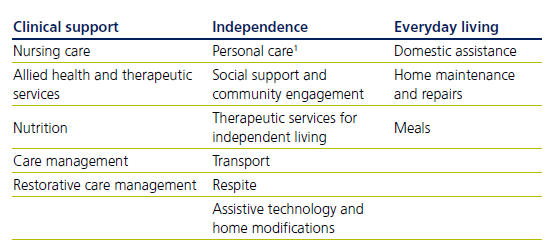
The Department of Health, Disability and Ageing publishes the Support at Home service list Support at Home service list | Australian Government Department of Health, Disability and Ageing.
Privately funded home care generally provides more services than the Support at Home program which is limited by the service list. Privately funded home care services are determined by the provider whereas the Support at Home service list is determined by the Government.
Privately funded home care can be considered when the home care services required are not included in the Support at Home service list.
Support at Home providers set their own prices for home care services which must be published on their website and the My Aged Care website. The provider must also document the prices for home care services they will provide in the service agreement with the recipient.
The Department of Health, Disability and Ageing publishes national median prices for home care services provided by the Support at Home program National summary of Support at Home prices – November to December 2025 | Australian Government Department of Health, Disability and Ageing.
The following table outlines the most common home care services provided by the Support at Home program and the national median price:
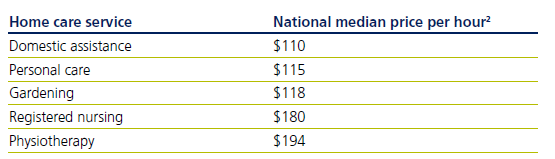
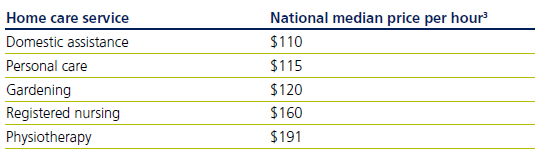
Privately funded providers also set their own prices for home care services which are similar to the prices for Support at Home services however, Support at Home recipients only pay the participant contribution for independence and everyday living services and nothing for clinical support services.
The participant contribution is a percentage of the price for home care services provided to the Support at Home recipient. The participant contribution is determined by the category of the service and the pensioner status and means of the recipient. Recipients who choose not to disclose their means will be subject to the maximum participant contribution for the category of the service.
2 National summary of Support at Home prices - November to December 2025.
3 CareAbout Provider Directory as at 28 July 2026 https://directory.careabout.com.au/
4 Centrelink thresholds as at 1 July 2026
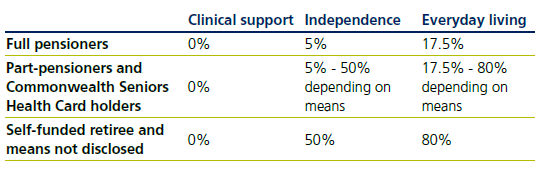
The participant contribution has an indexed lifetime limit of $137,917 after which there will be no further contributions. Services Australia will notify the Support at Home provider and recipient when the lifetime limit has been reached.
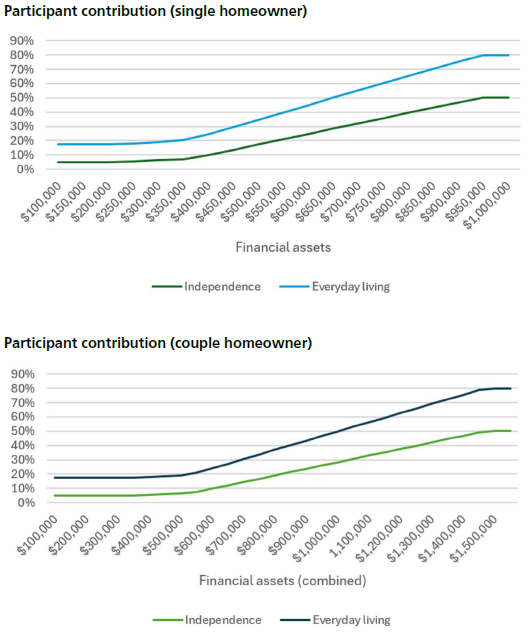
Support at Home recipients who are part-pensioners or Commonwealth Seniors Health Card (CSHC) holders will be means tested for independence and everyday living services. Assessable income and assets for means testing will be the same as that assessed for Centrelink.
The following graphs demonstrate the increase in the participant contribution for independence and everyday living services as financial assets increase for part-pensioners and CSHC holders:4
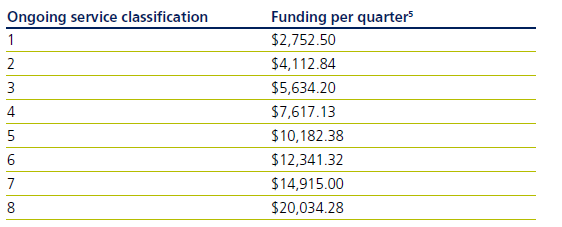
The Support at Home program has eight ongoing service classifications which provide funding for home care services. The service classification depends on the level of home care required which is determined as part of the assessment for the Support at Home program.
There are wait times before funding is available for home care services after approval for the Support at Home program. The wait times depend on the priority category which is determined as part of the assessment for the Support at Home program.

Funding is paid quarterly into a home support account managed by Services Australia which the Support at Home provider claims from after home care services are provided. 10% of the funding for each Support at Home recipient is deducted quarterly for care management services. Any unspent funding is carried over to the next quarter capped at the higher of $1,000 or 10% of the funding.
Privately funded home care services can be accessed immediately whereas the Support at Home program has wait times before funding is available. Privately funded home care services can also be accessed as required whereas Support at Home services are limited to when funding is provided.
Privately funded home care services can be considered while waiting for funding to be available after approval for the Support at Home program. Privately funded home care services can also be considered after funding from the Support at Home program has been exhausted.
Brett is single, 80 years old, homeowner and has been approved for Support at Home ongoing service classification 6. He has $400,000 invested in term deposits and $10,000 of personal assets. He also has $650 per week of personal expenses.
Support at Home ongoing service classification 6 provides funding of $12,341 per quarter7 of which 10% will be deducted for care management services. Brett requires 2 hours of domestic assistance per week, 5 hours of personal care per week and 1 hour of registered nursing per week.
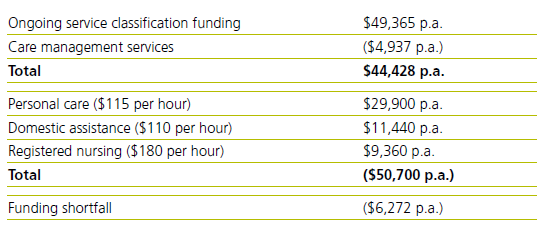
Brett will have a funding shortfall of $6,272 per annum for the home care services he requires from the Support at Home program. He will have a participant contribution of 10.68% for independence services and 25.38% for everyday living services and will not pay for clinical support services7.
Brett should consider privately funding the shortfall on domestic assistance because everyday living services have the highest participant contribution.

What will be Brett’s cash flow if all the personal care and registered nursing is funded by the Support at Home program and part of the domestic assistance is privately funded? Assume personal care services have moved to the clinical support category and has no participant contribution.
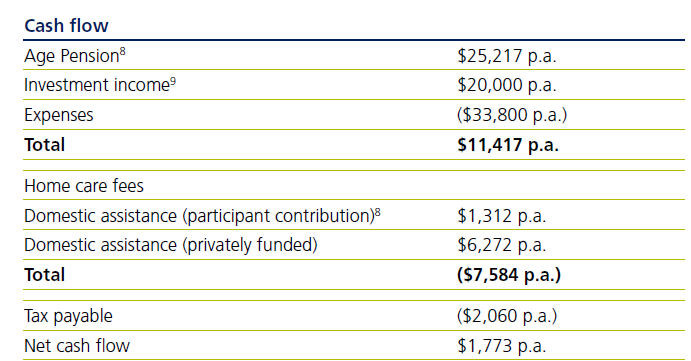
What will be Brett’s cash flow if all the personal care, registered nursing and domestic assistance is privately funded?
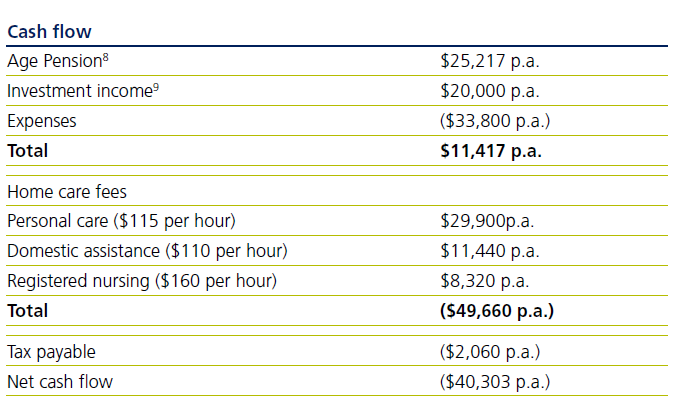
Brett’s cash flow is worse because the participant contribution for home care services is significantly lower than the price for the same privately funded services.
Client scenarios and home care services prices may differ and an analysis should be
undertaken to determine how to spend funding.
References