
The implications of falling housing prices

Subscribe to Macro Musing
To stay up to date on the latest economic insights, subscribe to Macro Musing on LinkedIn.
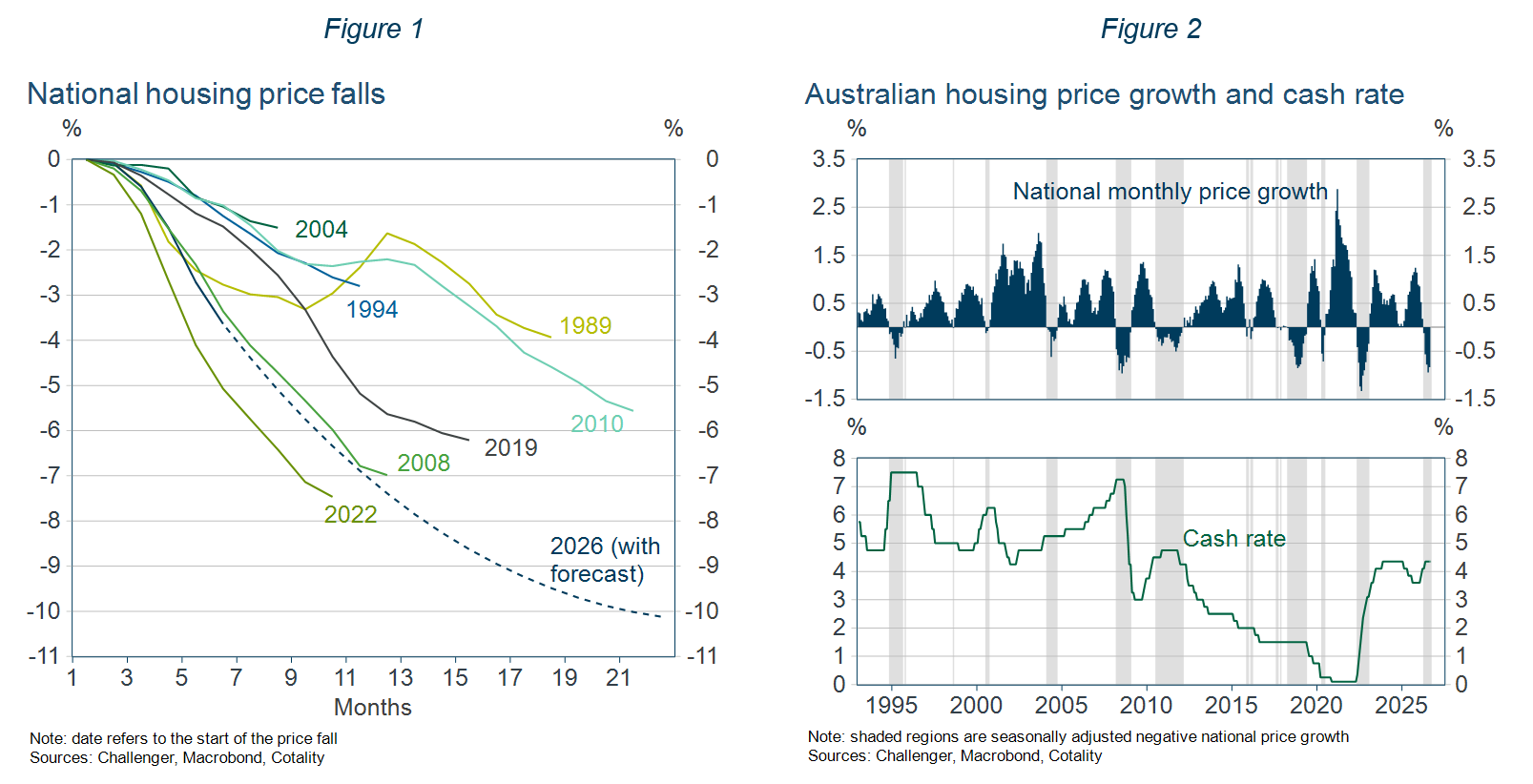
National housing prices have fallen 3.6% from their March peak, with falls in all capital cities except Darwin (Figure 1). Higher interest rates have been the main driver: price growth began to slow when cash rate expectations turned in October last year (Figure 2). The changes to capital gains tax and negative gearing will add to this weakness. Together, these forces are likely to produce a cumulative decline of around 10%, the largest fall in recent decades.
How far are housing prices likely to fall?
Prices are unlikely to fall more than 10% as housing supply remains tight and the increase in interest rates has been modest. Rental vacancy rates are only a little above 1.5% nationally and below 2% in every major city, almost half their longer-run averages. Moreover, the supply shortfall is worsening, with construction falling short of estimates of underlying demand based on population growth and household formation. Only 175 thousand homes have been completed over the past year, well below the 240 thousand a year needed to meet the Government's target of 1.2 million new homes over five years.
Absent the Budget changes, housing prices would likely have fallen by around 5 to 7%, in line with previous cycles. Estimates from the Government and think tanks suggest that the changes to negative gearing and capital gains tax are likely to lower prices by a further 3% or so.
However, an escalation of the conflict in the Middle East or sharp pullback in the AI boom could amplify the price fall. A fall of 25% is often used in financial system stress tests and has historical precedent. Prices in Darwin fell 27% over six years from 2014 as the mining boom unwound while US national housing prices fell 26% over five years during the Global Financial Crisis. Further back, Australian housing prices fell 35% in the Great Depression and at least 35% in the 1890s depression. However, unlike equity market declines, housing price falls of this magnitude tend to unfold relatively slowly, over around six years.
The Australian financial system is reported to be resilient even to a large fall. The RBA Governor (2026) noted that the RBA has estimated that, if housing prices fell by 20%, only around 5% of loans would be in negative equity. Further, the Australian Prudential Regulation Authority (APRA) found that banks did not breach their minimum capital requirements when subjected to price falls of 30% to 40% in its 2020 COVID-19 stress test and 2024 stress test, despite higher mortgage losses and reduced profitability.
Housing prices have a significant impact on consumption in Australia
Discussions of the economic effects of falling housing prices often focuses on the impact of lower household wealth and, therefore, households' ability to fund consumption. However, empirical evidence points to two other important channels. Credit constraints can reduce consumption because lower housing equity diminishes households' ability to refinance into a larger loan, or one with a lower interest rate, and thereby fund consumption. In addition, RBA work notes that the decline in housing turnover that coincides with price weakness reduces complementary household spending on furnishing or modifying a new home.
To isolate the effect of changes in housing prices on consumption, from factors that affect both, state-level econometric regressions control for household financial wealth and income. Common factors, such as interest rates, affect consumption in all states, while differences in housing price trends across states help identify the effect of housing wealth on consumption.
These estimates indicate that a 10% fall in housing prices will reduce consumption spending by 1 to 2%. However, this has limited implications for monetary policy. Most of the price decline reflects the transmission of tighter monetary policy rather than a development that would elicit an RBA response. The additional decline caused by the Budget tax changes is an exogenous drag on the economy, but it is expected to be small and therefore unlikely, by itself, to warrant a material monetary policy response.
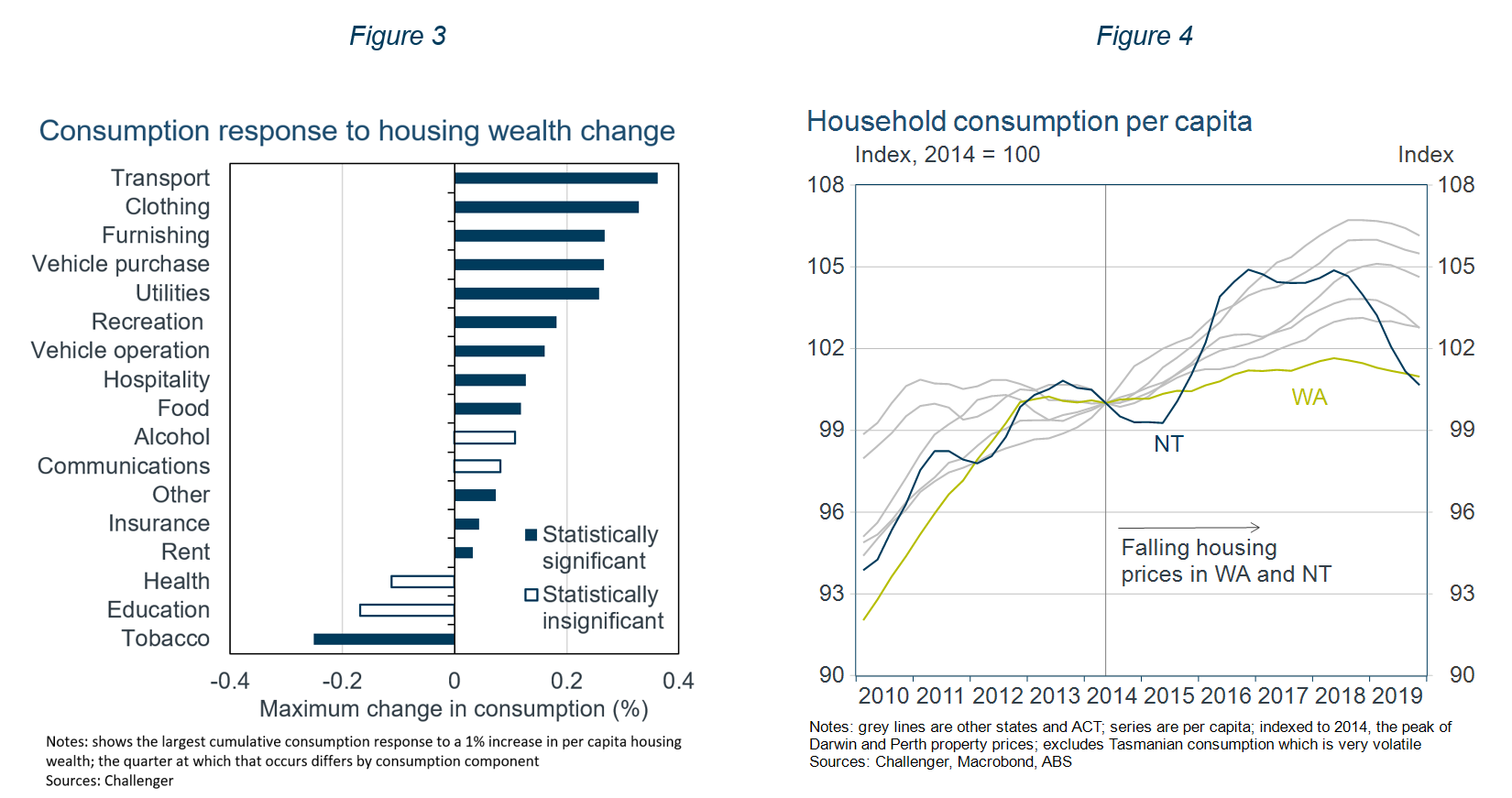
We can also compare the sensitivity of different consumption components. Not surprisingly, discretionary consumption is more sensitive to changes in housing wealth than non-discretionary consumption. Vehicle purchases, furnishings, recreation and hospitality are the most responsive, while health, communications, rent and food show small or statistically insignificant responses (Figure 3). Companies exposed to discretionary spending will experience weaker sales in response to housing price falls.
Do price falls, particularly large falls, have a greater impact on consumption?
Credit constraints and precautionary saving suggest that price falls, particularly large falls, might result in a proportionately larger decline in consumption. However, Australian and US data provide limited evidence that housing price rises and falls have effects of different magnitudes on consumption.
There have been too few large price falls in Australia in recent decades to estimate reliably whether large price changes have a greater impact. An alternative is to examine specific episodes of large housing price falls.
The largest fall in Australia was the 27% decline in Darwin prices that began in 2014. At the same time, prices in Perth fell 15%. Figure 4 shows that per capita consumption growth in both the NT and WA was stronger than in the other states before 2014, as they benefited from the mining boom and rapid housing price growth. After 2014, consumption in WA clearly slowed. Consumption in the NT eventually slowed as well, although it increased sharply in 2015. Housing price growth in WA and the NT was around 40 percentage points slower than in the rest of the country from 2014 to 2019, while per capita consumption grew by 6% less. This response is in line with the full-sample estimates discussed above and therefore does not provide evidence that large housing price falls produce proportionately larger declines in consumption.
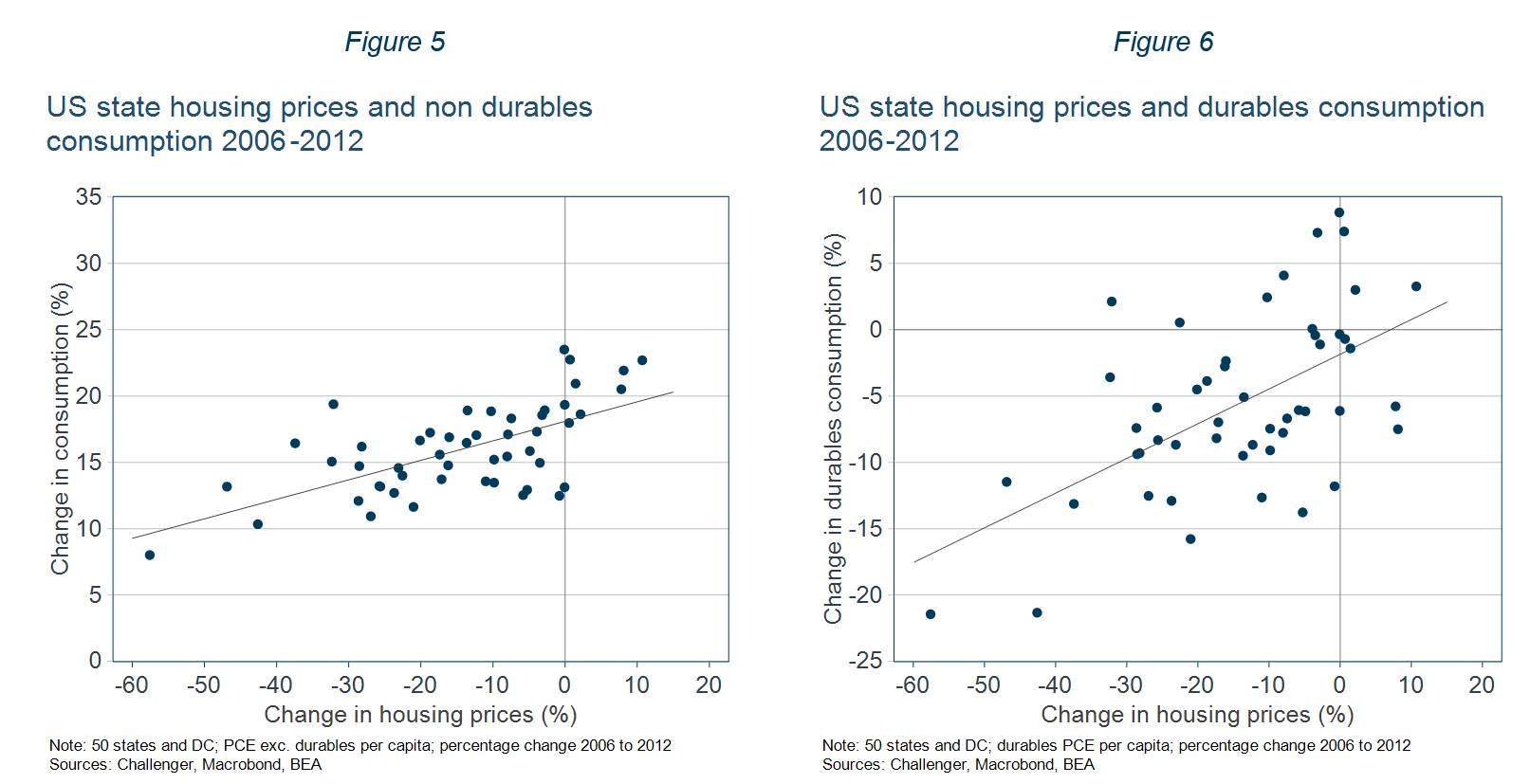
Similarly, the varied housing price movements across US states after the GFC have a linear relationship with per capita consumption, providing no evidence that larger price falls resulted in disproportionately larger declines in consumption (Figure 5 and Figure 6).
Key takeaways and implications for monetary policy
The expected weakness in consumption is an important part of monetary policy transmission and, by itself, would not warrant monetary policy easing. If anything, consumption growth has so far been resilient to the economic slowdown and higher interest rates. In the current economic environment, the decline in housing prices is unlikely to be substantially larger than 10%, given the tight housing market. While lower housing wealth will weigh on consumption, lower housing prices will not be a meaningful consideration in the RBA's policy deliberations unless they fall by more than currently expected and produce a correspondingly larger decline in consumption.