

For adviser use only
Is your client grandfathered for residential care?
Sean Howard, Technical Services Manager
01 June 2026
Download the full article below.
This article explains when clients will be grandfathered for residential care and the various scenarios where grandfathering does or doesn’t apply. References to grandfathered residents throughout the article do not include pre-1 July 2014 residents.
For further information about grandfathering for home care, see April Challenger Tech article “What fees apply to grandfathered home care recipients?”
Individuals who entered residential care before 1 November 2025 will be grandfathered for accommodation payments and ongoing costs. Individuals who entered respite care or residential care through a multi-purpose service before 1 November 2025 will not be grandfathered unless they were approved for a Home Care Package on 12 September 2024 (see below).
Individuals who entered residential care before 1 November 2025 but were on a break from care on 1 November 2025 will be grandfathered for accommodation payments and ongoing costs if the break period was less than 28 days. Approved leave including hospital leave, social leave and emergency leave does not count towards the break period.
Individuals who were approved for a Home Care Package on 12 September 2024 and enter residential care on or after 1 November 2025 will be grandfathered for ongoing costs but not for accommodation payments (partially grandfathered). Individuals who were approved for the Commonwealth Home Support Program and not a Home Care Package on 12 September 2024 will not be partially grandfathered if they enter residential care on or after 1 November 2025.
Residents who are grandfathered for accommodation payments will not be subject to retention amounts or DAP indexation. Residents who are grandfathered for ongoing costs will be subject to the means-tested care fee instead of the hotelling contribution and non-clinical care contribution.
For further information about retention amounts, DAP indexation, the hotelling contribution and non-clinical care contribution, see Challenger Tech Aged Care Guide.
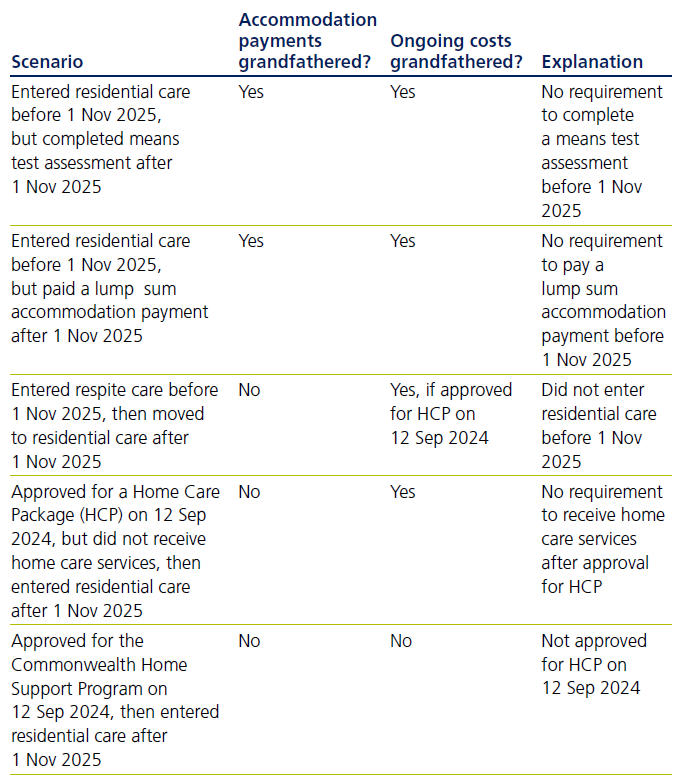
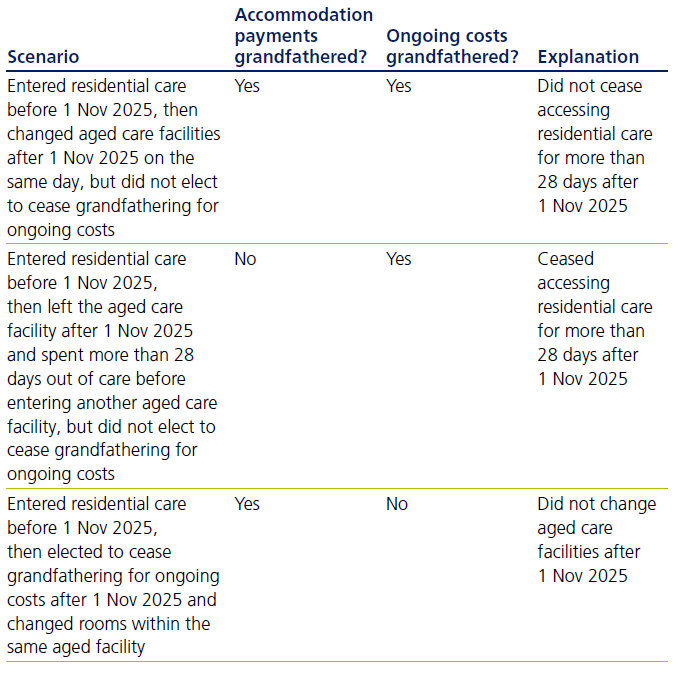
Grandfathered residents who cease accessing residential care for more than 28 days after 1 November 2025 will lose grandfathering for accommodation payments. Grandfathered residents can elect to cease grandfathering for ongoing costs at any time after 1 November 2025, however they cannot elect to cease grandfathering for accommodation payments.
Grandfathered residents who elect to cease grandfathering for ongoing costs and change aged care facilities after 1 November 2025 will lose grandfathering for accommodation payments.
For clients who enter residential care on or after 1 November 2025, it is important to check if they were approved for a Home Care Package on 12 September 2024 and partially grandfathered.
Susan is single, 85 years old, non-homeowner and has been approved for residential care. She was not previously approved for a Home Care Package on 12 September 2024. Her chosen aged care facility has an advertised accommodation price of
$400,000. She has $900,000 invested in term deposits, $50,000 in her bank account and $10,000 of personal assets.
Susan pays $400,000 as a refundable accommodation deposit (RAD) and keeps $500,000 invested in term deposits and $50,000 in her bank account. She will have $50 per week of other expenses while she is in residential care. What will be her cash flow and estate value in the first year?
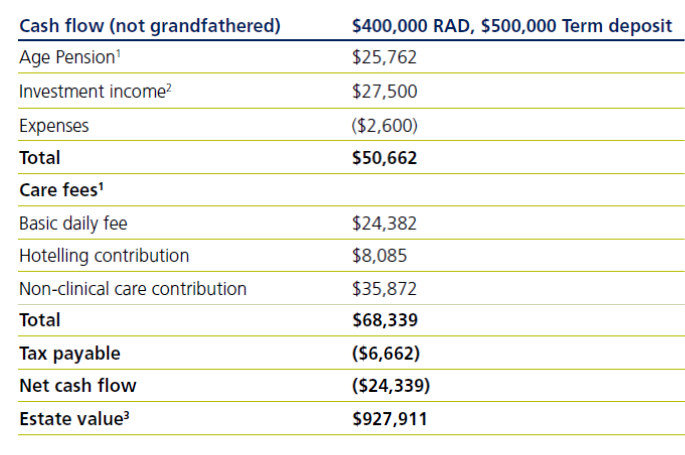
Susan will have a cash flow deficit of $24,339 in the first year and her estate value will be $927,911. What if Susan was previously approved for a Home Care Package on 12 September 2024 and partially grandfathered for residential care?
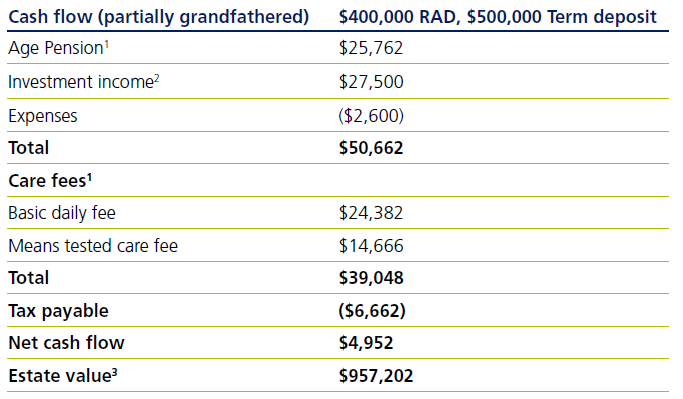
Susan’s cash flow would improve by $29,291 and she would have a surplus of $4,952 in the first year. This would also be reflected in her estate value which would increase to $957,202.
Challenger CarePlus (CarePlus) is a combined lifetime annuity (CarePlus Annuity) and life insurance policy (CarePlus Insurance) which can be purchased by clients who receive or plan to receive Government subsidised aged care services. CarePlus Annuity provides guaranteed regular payments for life and CarePlus Insurance provides a guaranteed death benefit, up to 100% of the amount invested, payable to nominated beneficiaries or the estate in the event of the client’s death4.
CarePlus works effectively with Centrelink and aged care means testing to reduce assessable assets. 60% of the CarePlus Annuity purchase price is assessed until age 85 (with a minimum of 5 years) and then 30% is assessed thereafter. If the client is Age Pension age or over at the time of investment, the greater of the CarePlus Insurance premium and surrender value is assessed.
CarePlus works effectively with tax to reduce assessable income. CarePlus Annuity receives a deductible amount which reduces assessable income from the regular payments. The deductible amount is calculated as the CarePlus Annuity purchase price divided by the client’s life expectancy at the time of investment.
Susan invests $500,000 in CarePlus with $50,000 remaining in her bank account. CarePlus will make regular payments of $26,912 per annum5 and pay a death benefit of $500,000.
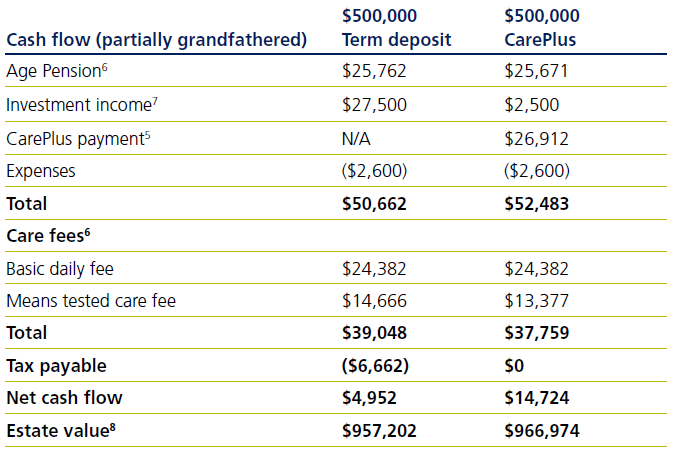
Susan’s cash flow will increase by $9,772 and she will have a surplus of $14,724 in the first year. This will also be reflected in her estate value which will increase to $966,974.
For further information about the effectiveness of CarePlus for clients who are not grandfathered, see November 2025 Challenger Tech article “Effectiveness of CarePlus from 1 November 2025”.